
The Big Picture of Your Plate: What "Healthy and unhealthy dietary patterns and the risk of chronic disease: an umbrella review of meta-analyses of prospective cohort studies" Means for Your Health
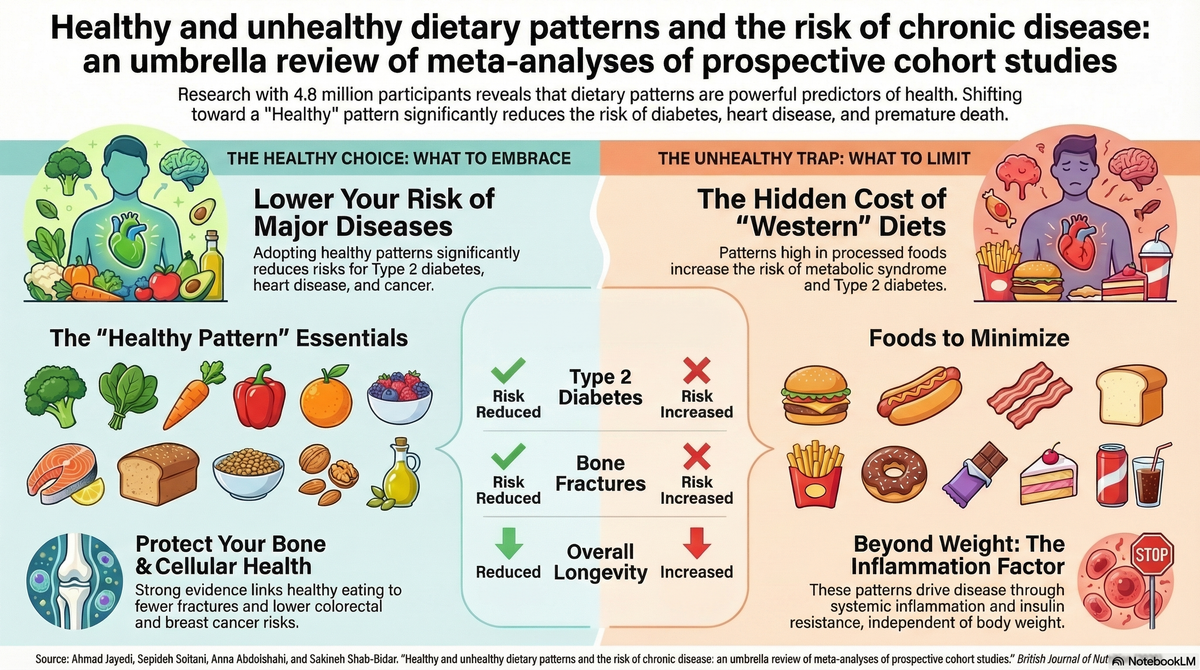
It is incredibly easy to get overwhelmed by the modern nutrition landscape. One day you read that coffee is a miracle cure, and the next day it is the enemy. We often find ourselves hyper-fixating on single "superfoods" or demonizing specific ingredients while completely missing the forest for the trees. But what if the secret to avoiding chronic disease isn't found in a single magical ingredient, but in the overall rhythm of how you eat every single day?
A massive review of dietary research proves that zooming out to look at your overall "dietary pattern" is far more powerful than stressing over individual foods. Here is what the science actually says about how the combined synergy of your meals protects your body—or puts it at risk.
Synergy Over Superfoods
When we eat, we don't consume nutrients in isolation; we eat meals containing complex combinations of fats, fibers, vitamins, and minerals. The core insight of this research is that dietary components have interactive and synergistic effects on our bodies. This means that how different foods work together is far more important than any single food on its own. Evaluating your diet as an entire "pattern" accounts for the cumulative effects of both the risk-increasing and risk-decreasing foods you consume over time. It is the totality of your food choices, not the occasional "cheat meal" or a single green smoothie, that dictates your long-term health.
Practical Guidance:
- What to do: Focus on the big picture of your weekly meals rather than micromanaging every single calorie or nutrient.
- What not to do: Don't obsess over finding one "magic bullet" superfood to cure your health woes while ignoring a fundamentally poor baseline diet.
- Habit to change: Stop labeling individual meals as strictly "good" or "bad." Instead, evaluate your dietary pattern over the course of a week to ensure the overall balance tips heavily toward whole, nutrient-dense foods.
The Anatomy of a Disease-Fighting Diet
So, what does a protective pattern actually look like? Across the globe, healthy dietary patterns are consistently built on a foundation of vegetables, fruits, fish, whole grains, low-fat dairy products, legumes, olive oil, and nuts. Adopting this type of eating pattern serves as a powerful shield against major illnesses. Consistently eating this way is proven to significantly lower the risk of developing Type 2 diabetes, colorectal cancer, and breast cancer. Surprisingly, a healthy dietary pattern also significantly protects against bone fractures, showing that whole foods support skeletal strength just as much as metabolic health.
Practical Guidance:
- What to do: Make plant-based foods (like vegetables, legumes, and whole grains) and healthy fats (like fish and olive oil) the default foundation of your meals.
- What not to do: Don't assume that protecting your health requires extreme, restrictive diets; simply prioritizing traditional, whole foods offers massive protective benefits against cancer and diabetes.
- Decision to change: Swap out refined grains for whole grains, and intentionally add one extra serving of vegetables or legumes to your plate every day to build a stronger cumulative defense system.
The Danger of the "Western" Plate
On the flip side, the research clearly identifies the specific combinations of food that actively drive chronic disease. Unhealthy dietary patterns—often referred to as a "Western" diet—are dominated by red and processed meats, refined grains, French fries, high-fat dairy, sweets, and sugar-sweetened beverages. The cumulative effect of eating these ultra-processed and heavily refined foods is devastating to the body's systems. Following this unhealthy pattern directly increases the risk of developing Type 2 diabetes and metabolic syndrome. Furthermore, just as healthy diets protect your bones, this high-sugar, highly processed pattern actively increases your risk of suffering from bone fractures.
Practical Guidance:
- What to do: Treat processed meats, sugary drinks, and heavily refined snacks as rare, occasional treats rather than daily dietary staples.
- What not to do: Don't ignore the hidden dangers of the "Western" diet; even if you aren't overweight, relying on processed foods and refined grains puts your metabolic and skeletal health at severe risk.
- Habit to change: Identify the most frequent highly processed food in your current routine—like a daily sugary soda or a habitual processed meat sandwich—and replace it with a whole-food alternative to break the unhealthy pattern.
Summary for Life
The research boils down to a single, concrete life rule: Your health is not defined by the occasional perfect meal or the occasional indulgence, but by the consistent, lifelong pattern of choosing whole, minimally processed foods over factory-made convenience.
Reflective Question: If you took a snapshot of everything you ate over the last week, would the overall pattern look like a powerful medicine protecting your future, or a slow-moving hazard to your metabolic health?
References
Jayedi, A., Soltani, S., Abdolshahi, A., & Shab‑Bidar, S. (2020).
Healthy and unhealthy dietary patterns and the risk of chronic disease: an umbrella review of meta‑analyses of prospective cohort studies.
British Journal of Nutrition, 124(11), 1133–1144.
https://doi.org/10.1017/S0007114520002330