Your Wallet and Your Well-Being: Understanding "The High Price of Debt: Household financial debt and its impact on mental and physical health"
We all know the familiar, sinking feeling of opening a credit card bill that is higher than expected. In today's world, carrying some form of debt—whether it is a student loan, a car payment, or a revolving credit card balance—has become a completely normalized part of daily life. We easily accept that debt takes a massive toll on our bank accounts and our future financial freedom. But what if the cost of carrying that balance is much steeper than just the interest rate?
A compelling scientific study has revealed that toxic debt isn't just draining our wallets; it is literally making us sick. The research proves that high levels of financial debt act as a potent poison to both our psychological well-being and our physical bodies. Here is what the science says about the hidden health costs of debt, and how you can protect your mind and body from the financial strain.
The "Relative Debt" Trap: It Is Not Just What You Owe
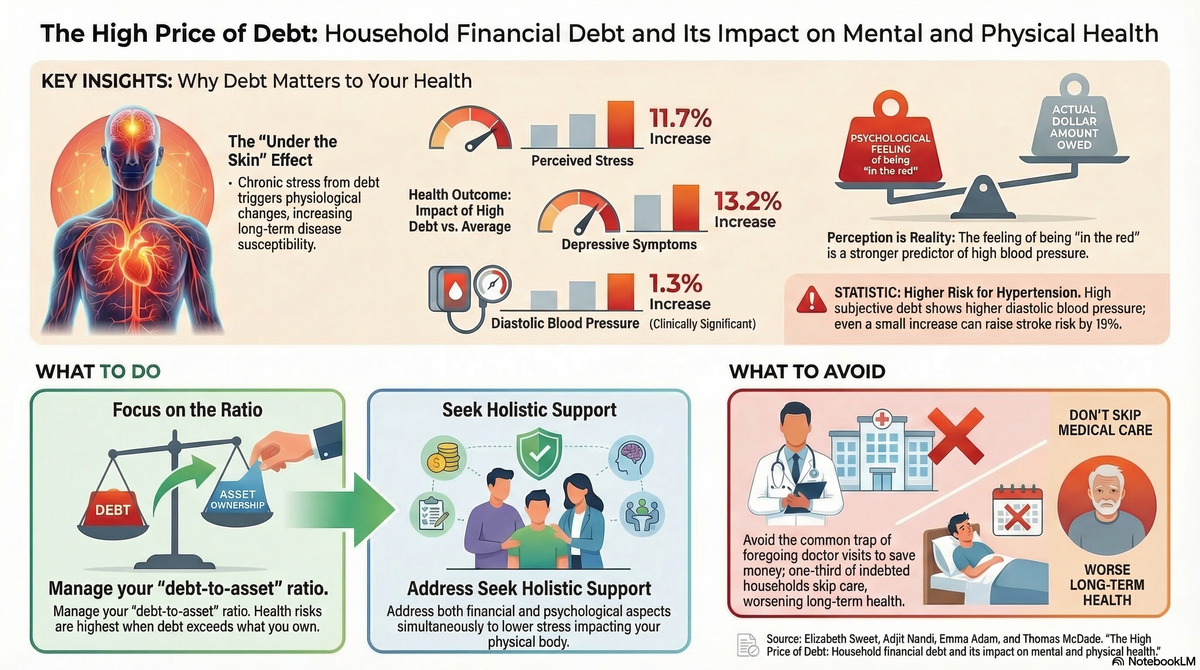
When we panic about our finances, we usually focus on the absolute dollar amount we owe. However, the researchers discovered that simply having a high amount of absolute debt isn't necessarily the problem. For example, having a large mortgage or significant student loans often accompanies a higher income and can actually be an investment in your future. The real danger to your health emerges from your "relative debt"—which is the ratio of your debts compared to your available assets.When your debts vastly outweigh your savings and assets, you are operating without a safety net. This specific financial state—where you owe far more than you own—is what reliably triggers higher perceived stress, more depressive symptoms, and worse overall health.
Practical Guidance:
- What to do: Focus on building your emergency savings (your assets) with the exact same urgency that you use to pay down your balances. A small safety net drastically reduces the psychological threat of debt.
- What not to do: Don't panic simply because you have a large "absolute" loan (like a mortgage), provided you have the income and assets to comfortably manage it without financial strain.
- Habit to change: Shift your financial tracking from exclusively obsessing over "what I owe" to monitoring your overall "net worth" (your assets minus your debts) to maintain a realistic, less stressful perspective on your financial health.
The Heavy Physical Toll of "Feeling" Indebted
The psychological burden of debt does not just stay in your head; it actively damages your cardiovascular system. The researchers looked at individuals with high subjective relative debt—people who felt that even if they liquidated everything they owned, including their home, they would still be in debt. The study found that this deep, psychological feeling of being hopelessly indebted was associated with significantly higher diastolic blood pressure.This means that the chronic worry caused by financial strain forces your heart to work much harder. Even a small increase in diastolic blood pressure clinically increases your risk of developing hypertension and suffering a stroke. The perception of being trapped by debt is a very real, physical medical issue.
Practical Guidance:
- What to do: Acknowledge your financial stress as a legitimate physical health risk. Actively practice stress-reduction techniques—like deep breathing, daily walking, or meditation—to protect your cardiovascular system while you work on your financial plan.
- What not to do: Don't let the shame or stigma of debt isolate you in silent panic. Suppressing the psychological burden of debt only amplifies the physiological stress on your heart.
- Decision to change: Stop separating your physical health from your financial health. Treat paying down toxic, high-interest credit card debt not just as a financial goal, but as a vital, life-saving cardiovascular intervention.
The Chronic Stress Cycle and Medical Trade-Offs
How exactly does a bank statement cause physical illness? Debt "gets under the skin" by acting as a chronic, inescapable psychosocial stressor. Chronic stress leads to long-term physiological changes that increase your susceptibility to metabolic and cardiovascular diseases.Furthermore, the stress of debt actively alters your real-world health behaviors. When people are overwhelmed by debt, they frequently skip necessary medical checkups, fail to fill prescriptions, or ignore painful symptoms in a desperate attempt to reduce family expenses. Debt forces you into a tragic cycle where you become too stressed to function well, and too financially strapped to take care of your basic medical needs.
Practical Guidance:
- What to do: Create a concrete, written payoff strategy (like the snowball or avalanche method) to regain a sense of control over your finances, which immediately begins to lower the chronic stress of the unknown.
- What not to do: Never sacrifice essential, preventative medical care or stop taking necessary medications just to make a minimum payment on a credit card.
- Habit to change: If financial anxiety is keeping you up at night, stop trying to manage it entirely on your own. Reach out to a certified, non-profit credit counselor to help you build a structured repayment plan.
Summary for Life
The deep truth of this research boils down to a profound and concrete life rule: Your financial health and your physical health are deeply intertwined; to protect your heart and your mind, you must actively eliminate toxic debt that exceeds your resources, treating financial stability as a vital medical necessity.
Reflective Question: If your next credit card statement came with a warning label about your blood pressure and mental health, what spending habit would you immediately change today?
References
Sweet, E., Nandi, A., Adam, E. K., & McDade, T. W.
The high price of debt: Household financial debt and its impact on mental and physical health.
Social Science & Medicine, 2014 91, 94–100.