Your Smartphone is Stealing Your Brainpower (Even When It’s Off): Insights from “The mere presence of a smartphone reduces basal attentional performance”
1. Introduction: The Invisible Anchor
Most of us have a standard ritual when we sit down to work or study: we clear our desk, grab a glass of water, and place our smartphone right next to us. We might turn it face-down or switch it to silent, keeping it there "just in case" of an emergency. We assume that as long as we aren’t looking at the screen, our focus is safe.
But have you ever considered if that silent device is actually acting as a mental anchor, dragging down your cognitive speed? Research by Skowronek et al. (2023) suggests that a device you aren't even touching—and which is completely powered off—can still make you slower and less sharp. Crucially, this study was conducted via video conferences during the COVID-19 lockdown, meaning the data wasn’t gathered in a sterile lab, but in the participants' "natural environments"—their own home desks. The results reveal a startling "mere presence" effect that challenges our assumptions about willpower and work.
2. The "Extraneous Load": Why Your Phone is a Cognitive Tax
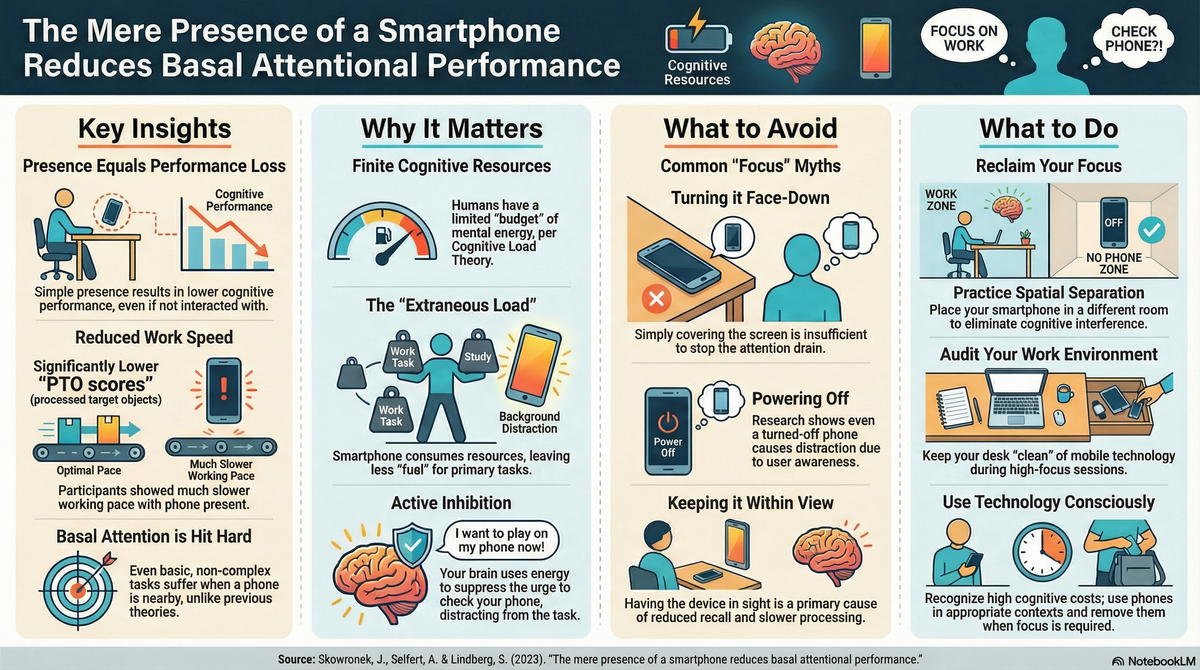
To understand why a silent phone is distracting, we must look at Cognitive Load Theory (CLT). Our brains have a strictly limited "budget" of working memory and cognitive resources. When we take on a task, we utilize these resources to process information.
The Insight According to the research, a smartphone acts as an extraneous load—a background distraction that consumes energy regardless of the task at hand. This happens because the smartphone triggers our involuntary attention systems. Just as your brain is hardwired to snap to attention when you hear your own name, it maintains a level of "vigilance" for your phone. Your executive functions must then work overtime to suppress the impulse to check the device, leaving less energy for your actual work.
Real-World Meaning Your brain is effectively "fighting" the phone's presence to keep you on task. Because the phone represents a portal to unlimited social contact and information, ignoring it isn't a passive state; it’s an active, resource-draining struggle.
Actionable Guidance
- What to do: Acknowledge that your attention is a finite resource. You have a fixed "budget" for focus each day.
- What to avoid: Stop assuming that "willpower" is enough. Trying to ignore a phone in your line of sight is a task in itself that depletes your mental energy.
- Habit Change: Create "Low-Tech Zones"
- Designate your primary work desk as a smartphone-free zone.
- Perform high-focus tasks in environments where digital devices are physically absent.
3. Speed vs. Accuracy: The "Slow Motion" Effect
The most significant breakthrough in the Skowronek et al. study concerns the level of tasks affected. Previous research suggested that phones only distracted us during complex, "high-level" thinking. However, this study found that even basal attentional performance—our basic, low-level ability to process simple stimuli—is throttled by a phone’s presence.
The Insight Using the d2-R test, researchers measured Attention Performance (AP) and Work Speed (PTO). They found that participants with a phone on their desk were significantly slower and less attentive. Crucially, while their speed (PTO) dropped, their accuracy (E% score) did not.
Real-World Meaning The phone puts your brain into "slow motion." You aren't necessarily making more mistakes; you are simply taking much longer to finish. You aren't losing the quality of your work, but you are losing the time of your life. Even for routine, "mindless" tasks, the phone acts as a hidden tax on your productivity.
Actionable Guidance
- What to do: Recognize that proximity to your phone is a primary cause of "work creep"—where tasks that should take 30 minutes stretch into an hour.
- Habit Change: Use a timer to compare how quickly you finish routine tasks with the phone on the desk versus in another room.
Finishing faster is the ultimate goal. The data shows that smartphone presence doesn't make you "mess up," but it does make you slower. To reclaim your free time, the device must go.
4. The "Off" Switch Myth: Why Face-Down Isn't Enough
A common defense is, "But my phone is off." The study specifically addressed this, testing participants whose phones were switched off and placed face-down.
The Insight Even with zero possibility of a notification, the distraction remained. The researchers concluded that "minimal awareness" of the phone’s presence is the trigger. As long as the brain knows the device is within reach, it allocates resources to it.
Real-World Meaning A smartphone is not just an object; it is a symbol of our social world. Even a dead battery doesn't kill the mental weight the device carries. Your brain remains vigilant, waiting for the "possibility" of the device, which consumes the very capacities you need for deep work.
Actionable Guidance
- What to do: Move the phone completely out of your visual field and reach.
- What not to do: Don't settle for "Do Not Disturb" mode or flipping the phone over. If it's on the desk, it's costing you brainpower.
5. The "Out of Sight" Solution: The Power of Spatial Separation
The study found only one condition that effectively restored full attentional capacity: Spatial Separation.
The Insight Full cognitive performance was only recovered when the smartphone was placed in a different room. This physical distance removes the extraneous load, allowing the brain to transition from a "diffused state" to a "focused state."
Real-World Meaning (The Creativity Trade-off) There is a nuance for the modern worker: research by Liu et al. suggests that a "diffused state" of attention (the kind caused by a phone's presence) might actually benefit creativity and brainstorming. Therefore, as a productivity specialist, I recommend a balanced approach: keep the phone nearby for "blue-sky" thinking, but banish it for execution.
Actionable Guidance
- Habit Change: The 3-Step Deep Work Setup
- Power down: Ensure no auditory distractions can pierce your focus.
- Relocate: Physically move the phone to a different room or a closed drawer in another part of the house.
- Schedule a Reunion: Set a specific "reunion time" to check notifications only after your deep work block is complete.
6. Conclusion: A New Rule for Your Digital Life
The research provides a definitive "Life Rule" for the digital age: The Room Rule. If a task requires you to be sharp, fast, or focused, the phone belongs in a different room.
By cutting the chain to this "Invisible Anchor," you stop donating your limited mental budget to a silent piece of glass. Ask yourself: How much time are you losing every day simply because your phone is watching you work? By reclaiming that basal brainpower, you don't just work better—you finish faster, leaving more time for the life that happens outside the screen.
7. References
- Skowronek, J., Seifert, A., & Lindberg, S. (2023). "The mere presence of a smartphone reduces basal attentional performance." Scientific Reports. https://www.nature.com/articles/s41598-023-36256-4