Why You’re Feeling Foggy: Understanding How “Mild Dehydration Impairs Cognitive Performance and Mood of Men”
It starts with a subtle shift—what journalists and researchers alike might call "metabolic friction." You are midway through a typical Tuesday, and suddenly, the email you are drafting feels like an uphill climb. Your focus drifts, a "cognitive drag" settles over your thoughts, and you find yourself uncharacteristically snappy with a colleague. While most of us reach for a second or third espresso to power through this afternoon slump, the culprit often isn't a lack of caffeine, but a modest loss of fluids.
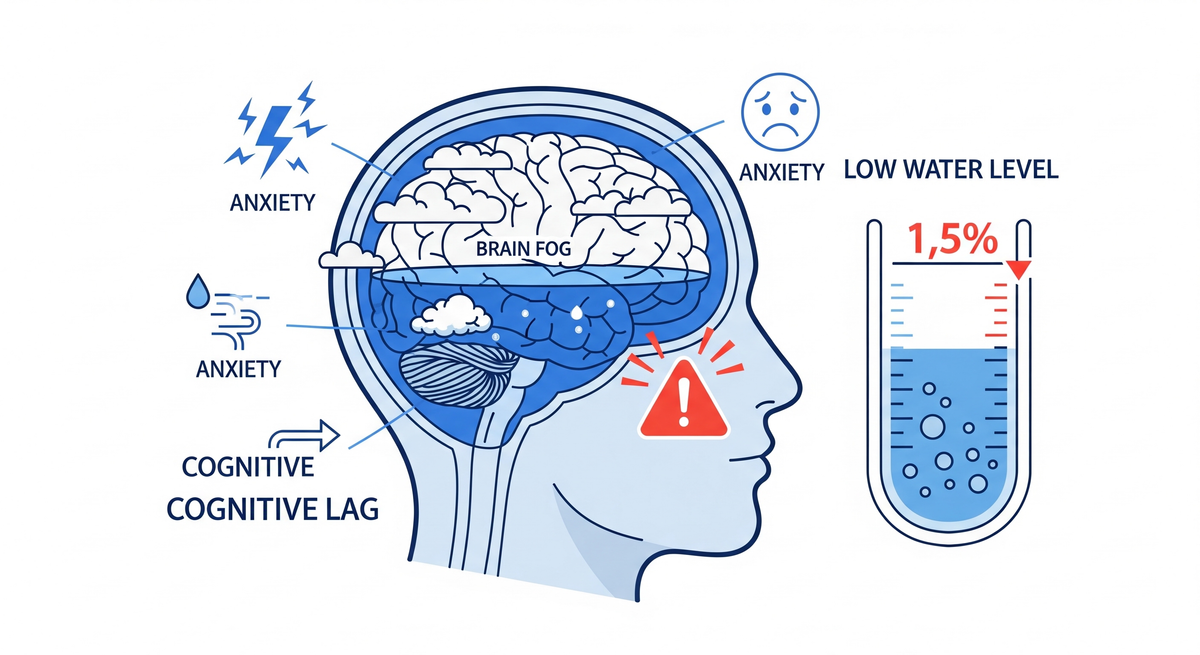
According to research published in the British Journal of Nutrition, "mild" dehydration—defined as a body mass loss of just 1% to 2%—can measurably impair the male brain. In the study led by Ganio et al. (2011), men who reached a mean fluid loss of 1.59% experienced limited but detectable hits to their mental sharpness. Crucially, these drops in performance occurred without hyperthermia (overheating); the men’s body temperatures remained stable, proving that you don’t need a desert trek or a fever to lose your edge. This level of dehydration happens during routine daily activities and moderate exercise.
Why You’re Missing the Details: The Rise of "False Alarms"
One of the study’s most precise findings involves "Visual Vigilance." This is the air-traffic-controller part of your brain—the ability to monitor a landscape (or a spreadsheet) and catch rare but vital details. The research found that as men reached that 1.5% threshold, errors increased significantly (P=0.048), specifically in the form of "false alarms."
Essentially, a thirsty brain begins to "hallucinate" details, thinking it sees a target that isn't actually there because it lacks the resources to verify information accurately.
Practical Guidance
- The Lesson: If your work requires high-stakes precision—such as coding, proofreading, or long-distance driving—water is your primary safety net.
- What to do: Implement a "Water First" rule for errors. If you find yourself re-reading a complex paragraph for the fifth time or making unforced typos, don’t just "push through." Drink a full glass of water. It’s the most efficient way to reset your vigilance.
The Mental Lag: Your Brain’s "Scratchpad" is Running Dry
Dehydration also compromises your "Working Memory," which serves as the brain’s mental scratchpad for quick decision-making and pattern recognition. The study found that mildly dehydrated men experienced a significant slow-down in response latency (P=0.021). This is the time it takes for your brain to react to and process a memory-based task.
In a fast-paced meeting, this lag is the difference between a sharp, articulate contribution and that "buffering" sensation where you can’t quite find the right word. While we often use caffeine to fix this, the source suggests a deeper chemical reality: Water acts as a "lubricant" for the brain’s complex messaging systems. Caffeine is merely a "volume knob"—it can turn up the noise of a tired brain, but it cannot replace the fluid necessary for smooth signal transmission.
Practical Guidance
- What to avoid: Don't rely on stimulants to "speed up" a lagging brain. Masking hydration-induced fatigue with caffeine creates a false sense of alertness while the underlying physiological slow-down remains.
- Habit Change: Keep a water bottle at your workstation. Aim for consistent sips to ensure your mental scratchpad never runs dry.
The Mood Connection: Tension, Anxiety, and Fatigue
The impact of dehydration isn't just cognitive; it’s deeply emotional. Using the "Profile of Mood States" (POMS) questionnaire, researchers discovered that mild dehydration significantly increased feelings of tension, anxiety, and fatigue/inertia (P < 0.05).
Surprisingly, these shifts in mood occurred even when the men were at rest. This suggests that your "bad mood" or afternoon anxiety might actually be a physiological signal of thirst. When your brain detects a drop in hydration, it may trigger stress responses in higher-order cortical regions, manifesting as unexplained irritability or a sudden loss of motivation.
Practical Guidance
- What to do: Treat "unexplained" irritability as a physical symptom rather than a purely emotional one.
- Habit Change: Drink a glass of water before entering high-stress environments, like performance reviews or difficult negotiations. It helps lower the physiological tension that exacerbates anxiety.
The Fitness Buffer: Why Some Feel the Fog Faster
The research also points to a fascinating link between physical fitness and cognitive resilience. Fitness acts as a "buffer" against the effects of water loss. In the study, individuals who were less aerobically fit felt the adverse effects of dehydration more acutely.
This is because less-fit people operate at a higher percentage of their maximal capacity during the same task, resulting in greater physiological stress (higher heart rates and slightly higher temperatures) at the same workload. If you are out of shape, your "hydration tax" is higher; you will feel the brain fog sooner and more intensely than a more fit peer.
Conclusion: The 1.5% Rule
The takeaway from Ganio et al. is a concrete rule for maintaining your professional edge: If you feel the sensation of thirst, you have already lost the lead.
A mere 1.5% drop in body water is enough to slow your reaction times, increase your "false alarm" rate, and sour your mood. These effects are subtle, but in a world of high-performance demands, they are the difference between excellence and "good enough." Before you attribute your next productivity slump to burnout, ask yourself: Is your current "stress" actually just a 1.5% drop in hydration?
References
Ganio, M. S., Armstrong, L. E., Casa, D. J., McDermott, B. P., Lee, E. C., Yamamoto, L. M., Marzano, S., Lopez, R. M., Jimenez, L., Le Bellego, L., Chevillotte, E., & Lieberman, H. R. (2011). Mild dehydration impairs cognitive performance and mood of men. British Journal of Nutrition, 106(10), 1535–1543.
https://www.cambridge.org/core/journals/british-journal-of-nutrition/article/mild-dehydration-impairs-cognitive-performance-and-mood-of-men/3388AB36B8DF73E844C9AD19271A75BF