Why Your Morning Routine is Your Secret Weapon: Insights from "Time-of-Day Differences in Treatment-Related Habit Strength and Adherence"
We have all been there: standing in the bathroom at 10:00 PM, toothbrush in hand, suddenly struck by the realization that we completely forgot to take our evening vitamin or medication. It is a recurring frustration, especially because the morning dose seems to happen almost on autopilot. Why do we consistently succeed in our routines at 8:00 AM, yet so often falter by 8:00 PM?
This discrepancy isn’t just a personal failing; it is a fascinating glimpse into the architecture of the human mind. In a study published in Annals of Behavioral Medicine, researchers Phillips, Burns, and Leventhal propose a compelling framework for why the clock dictates our success. By analyzing how we manage daily health tasks, they offer a roadmap for moving our most important behaviors into the "safety zone" of the early hours.
The Morning Advantage: Why Early Birds Stay on Track
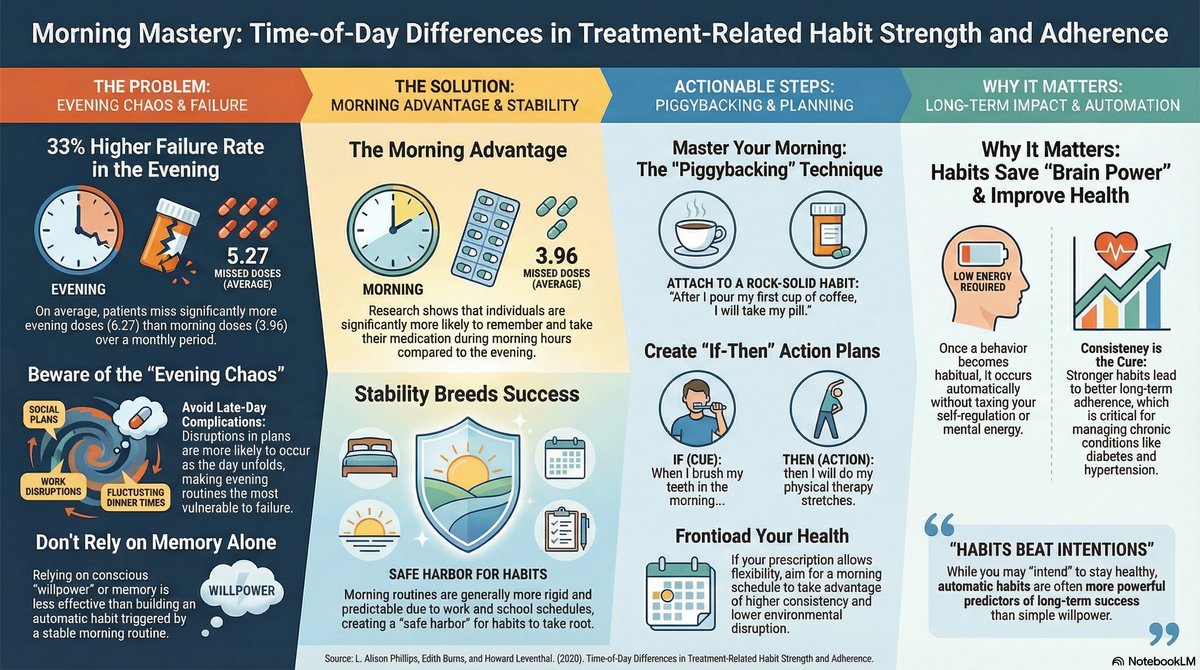
The research highlights a significant trend: adherence to daily health tasks is notably higher in the morning than in the evening. While the researchers initially suspected this was because morning habits are more "consistent" in their timing, the data revealed a more nuanced story. It isn't just about the clock—it’s about Context Stability.
Our mornings are generally the most predictable chapters of our day. This stability provides the perfect soil for habits to take root. Mornings are inherently "habit-friendly" because:
- Fixed Anchors: Most people rise at a similar time each day due to work or school, creating a reliable "starting gun" for the day’s first behaviors.
- Predictable Rituals: Activities like brewing coffee, showering, or dressing usually occur in a rigid sequence that rarely varies.
- Environmental Consistency: You are typically in the same physical space (your home) with the same visual cues every single morning.
Beyond the environment, we also benefit from a fresh supply of Cognitive Resources. Early in the day, our "brain power" for self-regulation is at its peak. Before the emails, decisions, and stresses of the world begin to drain our mental energy, we have the focus required to follow through on our intentions.
The Evening Slump: When Routines Fall Apart
If the morning is a calm harbor, the evening is where our best intentions meet the reality of a shifting world. The study confirmed that missed tasks are far more frequent as the day wanes. This "Evening Slump" is driven by a high degree of variability; while your 7:00 AM looks the same every day, your 7:00 PM is at the mercy of life’s unpredictability.
The evening routine often disintegrates due to:
- Shifting Contexts: Social invitations, late meetings, or varying dinner times disrupt the learned cues our brains rely on to trigger an action.
- The "Gas Tank" of Willpower: Researchers point to Ego Depletion—the idea that our self-regulation is a limited resource. By sunset, the "gas tank" of our willpower is often empty, leaving us with little mental fuel to "consciously remember" a task if our usual routine is even slightly disturbed.
- The Fragility of the Habit: Interestingly, the researchers found that when we do remember our evening tasks, we are actually quite consistent with the timing. The problem isn't that evening habits are "sloppy"—it's that they are easily broken entirely when the evening chaos interferes.
The Art of "Piggybacking": How to Build Unbreakable Habits
To bridge the gap between intention and action, the study points to a powerful behavioral tool called Piggybacking. This involves taking a new behavior and "stacking" it directly onto an existing, rock-solid routine.
One of the most profound insights from the research is that Time itself is a weak cue. Simply saying "I will take my pill at 8:00 PM" is often ineffective because 8:00 PM doesn't actually look like anything; it is just a number on a clock. In contrast, an Action is a vivid, physical trigger.
Piggybacking works because it uses an established anchor—like the act of making coffee or brushing your teeth—to automatically pull the new behavior along with it. By linking a vital task to an existing sequence, you bypass the need for "conscious remembering" and let your environment do the heavy lifting.
Your Daily Habit Blueprint
Use the following framework to audit your current routines and shift your most critical goals into the morning "Safe Zone."
Category | Morning Strategy | Evening Safeguard |
Critical Tasks | Move vital health tasks (meds, exercise, planning) to follow a morning anchor like coffee or a shower. | Do not leave high-stakes tasks for the evening; treat the evening as the "overflow" zone only. |
Environmental Cues | Rely on the high Context Stability of your home environment to trigger your actions. | Expect your environment to change (restaurants, travel, social events) and set a digital backup. |
The Habit Shift | The Decision Rule: If a task is essential for your long-term wellness, do not wait for the evening chaos. | Recognize Ego Depletion; if you must do a task in the evening, do it the moment you walk in the door. |
Summary: The One-Minute Life Rule
The core takeaway from the behavioral science is clear: Consistency is not a matter of willpower; it is a matter of geography and timing. Because our mornings provide stable environments and fresh mental energy, they are the most reliable windows for success.
The Golden Rule of Habits: If it matters for your health, anchor it to the sunrise, not the sunset.
If you find yourself constantly failing at an evening goal, ask yourself: Is this a lack of discipline, or am I simply fighting against the evening's unpredictability? Audit your evening failures and consider moving them to the "Safety of the Morning." By the time the world gets messy, your most important work will already be done.
References
[1]
Phillips, L. A., Burns, E., & Leventhal, H. (2020). Time-of-Day Differences in Treatment-Related Habit Strength and Adherence. Annals of Behavioral Medicine.
Ann. Behav. Med. (2020) XX:1–6
DOI: 10.1093/abm/kaaa042