Why Your Bad Mood Might Just Be Thirst: Insights from "Mild Dehydration Affects Mood in Healthy Young Women"
We have all experienced it: the mid-afternoon wall where focus evaporates, or those moments of unexplained irritability that seem to strike out of nowhere. Most of us are quick to blame a poor night’s sleep, a demanding boss, or the weight of "daily stress." However, a landmark study published in The Journal of Nutrition (2012) suggests the culprit is often much simpler and significantly more objective.
The research, titled "Mild Dehydration Affects Mood in Healthy Young Women," led by Lawrence E. Armstrong and colleagues at the University of Connecticut, reveals that our emotional state is inextricably tied to our fluid balance. The data suggests a fascinating biological safeguard: losing as little as 1.36% of your body water—a level reached easily during "normal daily activities"—can profoundly alter how you feel and function.
To ensure scientific rigor, the researchers studied 25 healthy women, specifically controlling for the menstrual cycle by testing during the placebo phase of oral contraceptive use. They found that even when factors like heart rate and body temperature (hyperthermia) were controlled, the mere deficit of water triggered a significant shift in psychological well-being.
The Brain's Early Warning System: Dehydration as a "Mood Killer"
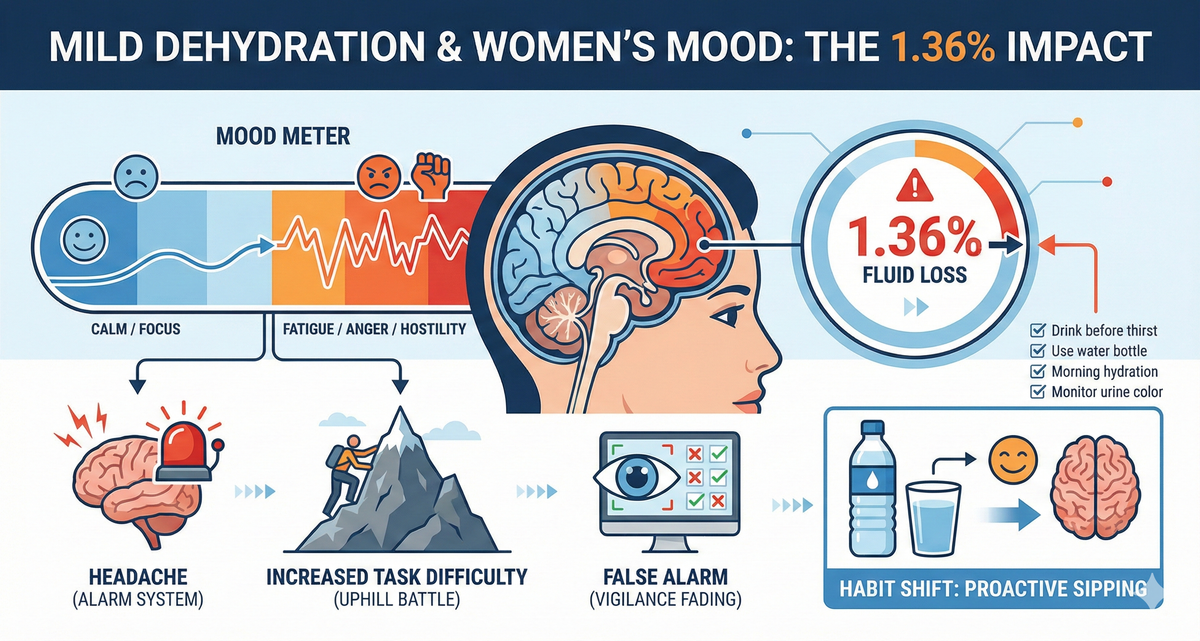
The research utilized the Profile of Mood States (POMS) to measure emotional subscales. The results were stark: even at a "mild" level of 1.36% fluid loss, dehydration acted as a persistent mood killer. Participants experienced measurable increases in fatigue-inertia and anger-hostility, alongside a sharp decline in vigor-activity.
This isn't just a random emotional shift; the study’s discussion points to a deep-seated physiological mechanism. Hypothalamic neurons in the brain detect fluid loss and signal higher-order cortical regions. This triggers negative mood states as a "biological alarm system," designed to alert the individual to seek water before more severe physical consequences—like impaired survival instincts—take hold.
Habit Shift: Proactive Fluid Management
- What to do: Drink water before you feel thirsty.
- What not to do: Don’t wait for a "dry mouth." Thirst is a late-stage signal; by the time you feel it, your mood and energy have already been compromised.
- Habit to change: Carry a reusable water bottle during errands or at your desk. Consistent, incremental sipping is more effective than "chugging" water once you're already irritable.
The "Uphill Battle": When Simple Tasks Feel Like Mountains
Dehydration changes your perception of effort. Using Visual Analogue Scales (VAS), researchers found that mildly dehydrated women reported a significant increase in perceived task difficulty and a decreased ability to concentrate.
The data suggests that when fluid volume is low, the brain must exert more neural "effort" to achieve the same results. This creates a psychological uphill battle: a project that should be manageable suddenly feels overwhelming. Because the researchers found these effects even when heart rate and body temperature were stable, we know it isn't just "exercise fatigue"—it is specifically the water deficit making the brain work harder than it needs to.
Workday Strategy: The Hydration Reset
- What to do: If a to-do list suddenly feels impossible, take a 5-minute hydration break.
- What not to do: Don't try to "power through" mental fatigue with caffeine. The study required participants to refrain from caffeine for 12 hours prior to testing to ensure accuracy; in the real world, over-relying on diuretics can exacerbate fluid loss.
- Habit to change: Use the "Water First" rule. Before every meeting or new complex task, drink four ounces of water to prime your brain for the effort.
The Alarm System: Why Dehydration Headaches Are Restless
The study confirmed that headaches are a primary physiological symptom of 1.36% fluid loss. These symptoms occurred not only during exercise but also while the participants were at rest. A headache is effectively the body's loud "alarm system" for a drop in blood volume and brain hydration.
Preventative Checklist: Monitoring Hydration
- What to do: Monitor the color of your urine. In the study, participants began in a "euhydrated" (perfectly balanced) state; aim for a pale yellow or straw color to maintain that baseline.
- What not to do: Don't ignore a mild "tension" headache. It is often a signal for fluids rather than a sign of stress.
- Habit to change: Drink a full glass of water immediately upon waking to counteract the fluid loss that occurs naturally overnight.
The IQ Myth: Your Logic is Fine, But Your Vigilance is Fading
One of the most nuanced findings of the study involves the "False Alarm" phenomenon. The researchers found that "hard" cognitive skills—like memory, pattern recognition, and logical reasoning (tested via Grammatical Reasoning)—remained functional even when dehydrated.
However, Scanning Visual Vigilance suffered. While dehydration doesn’t lower your IQ, it lowers your "gatekeeping." Dehydrated individuals were significantly more prone to "False Alarms" (P=0.02) during vigilance tasks. You still know the material, but your brain "misses the mark" because the sustained attention required to be precise is the first thing to be drained. In short: Dehydration doesn’t make you less smart, but it makes being smart feel exhausting.
Conclusion: The 1% Rule for a Better Life
The research by Armstrong et al. (2012) can be distilled into a single life rule: Maintain your fluid balance to protect your peace of mind.
Losing just over 1% of your body water is enough to turn a manageable workday into a cycle of fatigue, anger, and perceived difficulty. This occurs at rest as much as it does during exercise. The next time you feel unexplained anger or find yourself staring blankly at a "difficult" email, ask yourself: When was the last time I had a full glass of water?
References
Armstrong, L. E., Ganio, M. S., Casa, D. J., Lee, E. C., McDermott, B. P., Klau, J. F., Jimenez, L., Le Bellego, L., Chevillotte, E., & Lieberman, H. R. (2012). Mild Dehydration Affects Mood in Healthy Young Women. The Journal of Nutrition, 142(2), 382–388.
https://pubmed.ncbi.nlm.nih.gov/22190027/