Why You Can’t Stick to That New Habit: Insights from "Self-Determination Theory Applied to Health Contexts: A Meta-Analysis"
We’ve all been there: January 1st arrives, and we are determined to hit the gym, eat more greens, or finally quit that one bad habit. But by mid-February, the sneakers are gathering dust and the salad spinner is hidden in the back of the cupboard. Why is it so hard to make healthy changes stick? We often blame a lack of "willpower," but science suggests the problem isn't your strength—it’s your strategy.
A massive research review involving 184 different data sets explored how our deepest psychological needs drive our physical health. The findings show that when we approach health as a "must-do" chore driven by guilt, we are almost destined to fail. However, when we tap into our natural human needs, healthy living becomes much more sustainable. Here is how to stop fighting yourself and start thriving.
The "Big Three" Nutrients for Your Mind
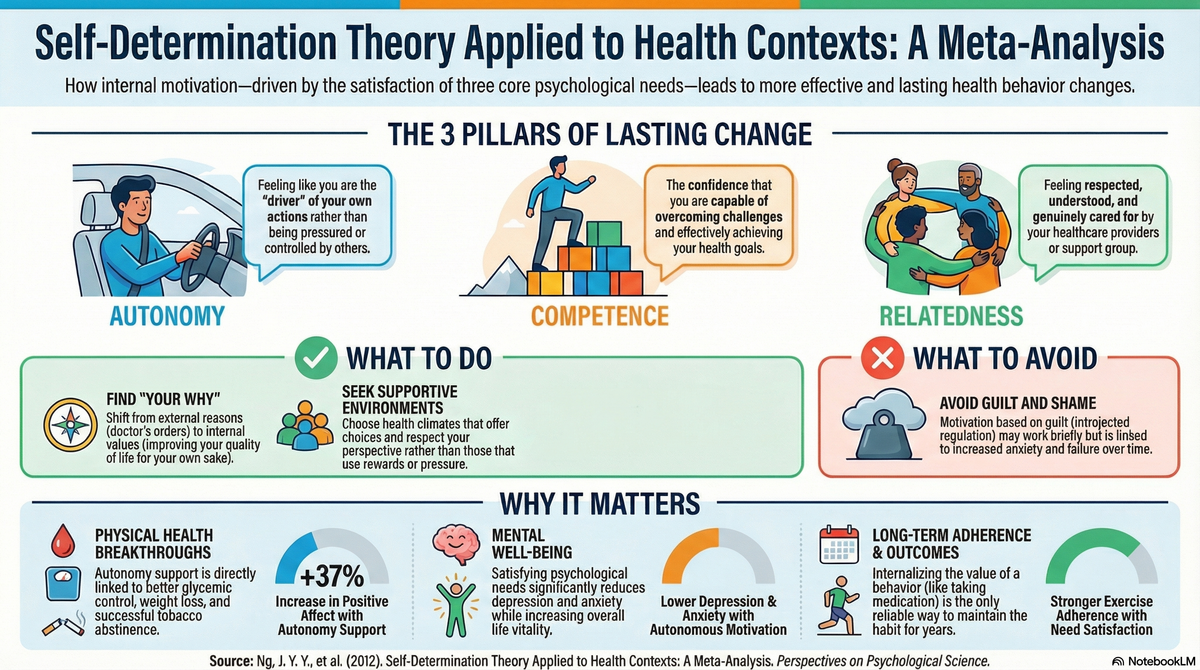
Just as your body needs vitamins to function, your mind requires three "psychological nutriments" to stay motivated: Autonomy (feeling like you are the author of your own choices), Competence (feeling effective and capable), and Relatedness (feeling understood and cared for by others).
When these three needs are met, you have a higher quality of "psychological energy" to fuel long-term change. Research shows that satisfying these needs directly predicts better mental health—like less anxiety and depression—and better physical outcomes, such as weight loss and better blood sugar control.
Practical Guidance:
- What to do: Choose activities that make you feel capable and free. If you hate running, don't run. Find a movement that feels like "you."
- What not to do: Don't force yourself into a rigid "one-size-fits-all" program that makes you feel powerless or stupid.
- Habit to change: Shift your focus. Instead of just tracking calories, track how often you felt "in the zone" or proud of a new skill you mastered that day.
Stop Using Guilt as Fuel
Not all motivation is created equal. The study distinguishes between controlled regulation (doing things because of external pressure, rewards, or internal guilt) and autonomous self-regulation (doing things because they align with your values or because you genuinely enjoy them).Using guilt or shame to motivate yourself might work for a week, but it is linked to higher levels of stress and dissatisfaction. On the flip side, when you "internalize" a habit—meaning you personally value the benefits of, say, not smoking—you are far more likely to maintain that behavior over the long haul.
Practical Guidance:
- What to do: Identify the "why" behind your goal. Ask, "How does this habit help me become the person I want to be?".
- What not to do: Stop telling yourself "I should" or "I have to." These are the hallmarks of pressure-based motivation that eventually burns out.
- Decision to change: Reframe your goals. Instead of "I need to lose weight so I don't look bad" (guilt), try "I want to have more energy to play with my kids" (value).
Your Environment Matters More Than You Think
The "climate" you live and work in can either support or sabotage your health. The research found that an autonomy-supportive climate—one where people listen to your perspective and provide choices—leads to much better health outcomes than a "controlling" environment that uses rewards or pressure.This applies to your relationships with doctors, trainers, and even family members. When you feel understood and trusted, you are more likely to fill your prescriptions and stick to your exercise plan.
Practical Guidance:
- What to do: Surround yourself with people—doctors, friends, or coaches—who ask for your input and respect your choices.
- What not to do: Avoid "experts" who bark orders at you or try to motivate you by promising "prizes" for good behavior, as this actually undermines your internal drive.
- Habit to change: Be your own "autonomy supporter." When you face a barrier to change, don't criticize yourself. Instead, look for a different way to solve the problem that respects your current reality.
Focus on Growth, Not Fame
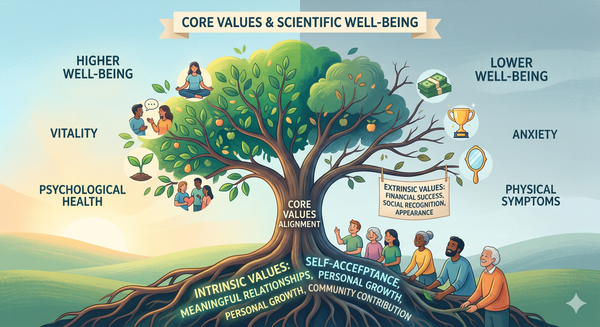
What are you actually aiming for? The study looked at life aspirations and found that people chasing "intrinsic" goals (like personal growth, meaningful relationships, and physical fitness) had better health than those focused on "extrinsic" goals (like wealth, fame, or image). Chasing an "image" often leads to unhealthy shortcuts, whereas chasing "growth" leads to vitality.
Practical Guidance:
- What to do: Set goals based on how you feel and how you grow, such as "I want to be strong enough to hike that trail".
- What not to do: Don't make "looking like a fitness influencer" your primary goal. This extrinsic focus is often linked to poorer mental health.
- Decision to change: Re-evaluate your social media feed. Unfollow accounts that make you obsess over "image" and follow those that inspire "growth" and "community".
Summary for Life
The research points to a profound and concrete life rule: To change your life, you must stop being your own toughest boss and start being your own best supporter—choosing habits that make you feel capable, free, and connected to what you truly value.
Reflective Question: If no one was watching and you couldn't feel guilty about it, what is one healthy choice you would actually want to make for yourself today?
References
Ng, J. Y. Y., Ntoumanis, N., Thøgersen‑Ntoumani, C., Deci, E. L., Ryan, R. M., Duda, J. L., & Williams, G. C. Self‑Determination Theory Applied to Health Contexts: A Meta‑Analysis. Perspectives on Psychological Science, 2012 7(4), 325–340.