Why You Can't Choose What to Eat for Dinner: Unpacking "Decision Fatigue: A Conceptual Analysis"
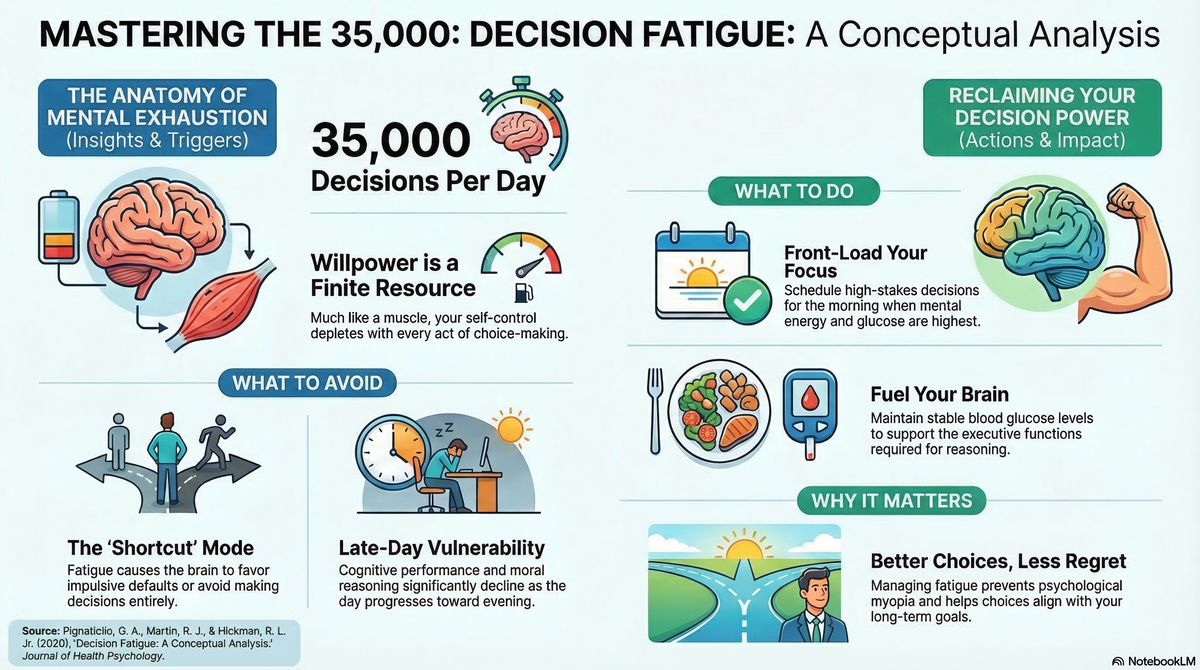
Have you ever stood in front of the refrigerator at 8:00 PM, totally exhausted, and eaten a handful of shredded cheese because deciding what to cook felt like climbing a mountain? You are not alone. It is estimated that the average adult makes around 35,000 decisions every single day. From what shirt to wear, to managing complex projects at work, our brains are constantly evaluating options and making trade-offs.
However, this endless mental marathon comes with a hidden cost. A comprehensive scientific review reveals that our ability to make good choices literally runs out over time, leading to a phenomenon known as "decision fatigue". Here is what the science says about why our brains crash, and how you can protect your daily mental energy.
The Invisible Mental Drain
We often think we can just power through our to-do lists through sheer willpower. But the core insight of this research is that human beings have a strictly limited capacity to regulate their behavior and make choices. Every time you process information to formulate a decision, or try to control your attention and emotions, you drain an internal cognitive battery. This drained state is called "ego depletion". The actual process of making choices—especially complex or difficult ones—significantly depletes this energy, much like physical exertion fatigues a muscle.
Practical Guidance:
- What to do: Automate as many trivial daily choices as possible—like eating the same breakfast or laying out your clothes the night before—to conserve your mental battery for important tasks.
- What not to do: Don't schedule back-to-back meetings that require intense deliberation and problem-solving without giving your brain a break.
- Habit to change: Stop treating your mental energy as infinite. Begin protecting your cognitive resources just as carefully as you protect your physical energy or your bank account.
The Clock and the Body
If you have ever made a terrible purchase late at night, biology is to blame. Our ability to make logical choices is heavily dependent on the time of day. As the day progresses and we make more choices, our decision-making quality steadily and predictably decreases. This mental fatigue is powerfully compounded by our physical state. Physiological factors like sleep deprivation, general fatigue, and low blood glucose levels directly trigger decision fatigue and impair our judgment. You cannot separate the health of your body from the quality of your decisions.
Practical Guidance:
- What to do: Schedule your most complex, high-stakes decisions for the morning, when your cognitive battery is fully charged.
- What not to do: Don't try to resolve a major life conflict or make a significant financial decision on an empty stomach or after a poor night's sleep.
- Habit to change: Shift your mindset to recognize that eating a healthy meal and getting enough sleep are not just physical health goals; they are critical tools for maintaining your professional and personal judgment.
The Impulsive and the Passive
How do you know when you are suffering from decision fatigue? When our brains are exhausted, they desperately look for shortcuts to save energy. This manifests in drastically altered behaviors: we become impulsive, we procrastinate, or we passively accept the "default" option just to avoid the effort of making a choice. Fatigued individuals also experience emotions more intensely, making minor frustrations feel incredibly irritating. Cognitively, an exhausted brain relies on biased mental shortcuts rather than logic, and surprisingly, our physical endurance even drops.
Practical Guidance:
- What to do: Treat sudden urges to procrastinate or act impulsively late in the day as a biological warning sign that your mental battery is empty, rather than a personal character flaw.
- What not to do: Don't go shopping or browse online stores at the end of a highly demanding workday, as your tired brain will naturally lean toward impulsive purchases to avoid the friction of critical thinking.
- Habit to change: Learn to identify your personal "fatigue symptoms." If you notice yourself getting unusually irritable or avoiding simple choices, immediately step away and rest instead of forcing a decision.
The Burden of Regret
The aftermath of making choices while fatigued is incredibly costly. Fatigued individuals often suffer from "psychological myopia," meaning they focus only on immediate information and completely ignore important background context. Because they fail to properly plan or evaluate all their options, exhausted people frequently experience high "decisional conflict" (uncertainty) and "decision regret"—the painful realization that they should have taken a different path. Pushing through fatigue doesn't make you productive; it just guarantees you will make a choice you regret.
Practical Guidance:
- What to do: Implement a mandatory "cooling off" period for major decisions. If you feel pressured to choose something at the end of the day, sleep on it to prevent psychological myopia.
- What not to do: Don't finalize plans or sign contracts when you are feeling uncertain and overwhelmed, as this state almost always leads to decision regret.
- Decision to change: Give yourself the permission to say "I am too tired to make a good decision about this right now, let's revisit it tomorrow morning."
Summary for Life
The deep truth of human cognition boils down to a single, concrete life rule: Because your ability to make good choices is a limited daily resource, you must ruthlessly automate the trivial decisions in your life so you can save your mental energy for the choices that truly matter.
Reflective Question: If you only had the mental energy to make five high-quality decisions today, did you spend them on things that matter, or did you waste them on what to wear and what to eat?
References
Pignatiello, G. A., Martin, R. J., & Hickman, R. L. Jr. Decision fatigue: A conceptual analysis. Journal of Health Psychology, 2020 25(1), 123–135.