
Why Living by Your Core Values Scientifically Increases Your Well-Being (And How to Start)

In 1996, psychologists Tim Kasser and Richard Ryan published a study that produced a finding counterintuitive enough to attract decades of follow-up research: people who placed the highest priority on financial success, physical attractiveness, and social recognition showed lower vitality, more physical symptoms, and less self-actualization than people who prioritized self-acceptance, meaningful relationships, community contribution, and personal growth [1]. The more strongly people held extrinsic values — the ones oriented toward external rewards and others' evaluations — the worse their psychological health. The more strongly they held intrinsic values — the ones oriented toward inherently satisfying activities and genuine growth — the better. The finding has since been replicated in a meta-analysis of 105 correlational studies. It is one of the most robust findings in the psychology of motivation and well-being [2].
 Viktoria Samokhval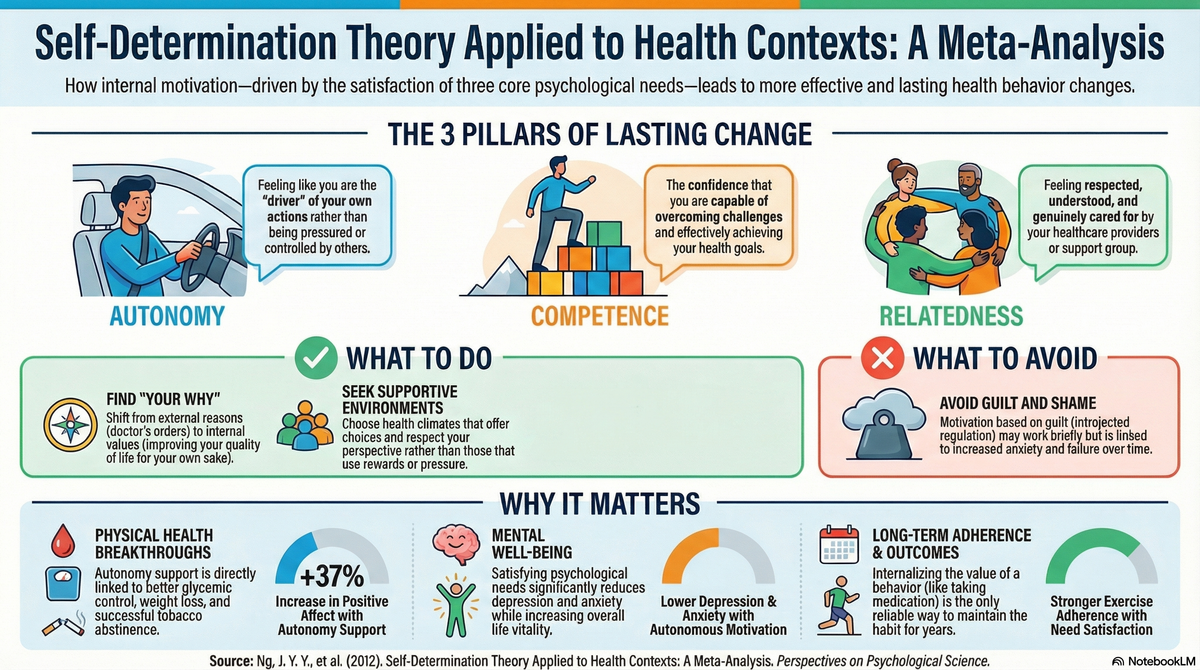
[2]
What this research reveals is not a prescription about which specific values to hold. It reveals a structural truth about how values function in the human psychological system. Some categories of values are aligned with the satisfaction of basic psychological needs. Others are not. And when you organize your life around values that reliably frustrate your core needs — however culturally legitimate those values may be — the psychological cost accumulates over time in measurable ways. Understanding this is the starting point for treating your values not as vague ideals but as a serious psychological tool for building a better life.
The Kasser Research: Intrinsic vs. Extrinsic Values
Kasser and Ryan's framework divides aspirations into two fundamental categories. Intrinsic aspirations include self-acceptance (developing as a person, understanding oneself), affiliation (having deep, enduring relationships), community feeling (contributing to improving the world), and physical health. Extrinsic aspirations include financial success (accumulating wealth), appealing appearance (being attractive, fashionable), and social recognition (being famous, admired). The categories are not arbitrary. They reflect a theoretically grounded distinction between goals whose pursuit is inherently satisfying and goals whose pursuit is oriented toward obtaining external validation or reward.
The psychological outcomes associated with these two categories are consistently different. People who place high relative importance on extrinsic aspirations show lower vitality, less self-actualization, higher rates of anxiety and depression, and more physical health complaints [3]. People who place high relative importance on intrinsic aspirations show the opposite profile: higher vitality, greater well-being, and lower rates of psychological distress. The meta-analysis synthesizing 105 studies confirmed that intrinsic values relate positively to well-being indicators across diverse populations, while extrinsic values are unrelated or negatively related to wellness. The finding holds across different cultures, age groups, and socioeconomic conditions.
 Viktoria Samokhval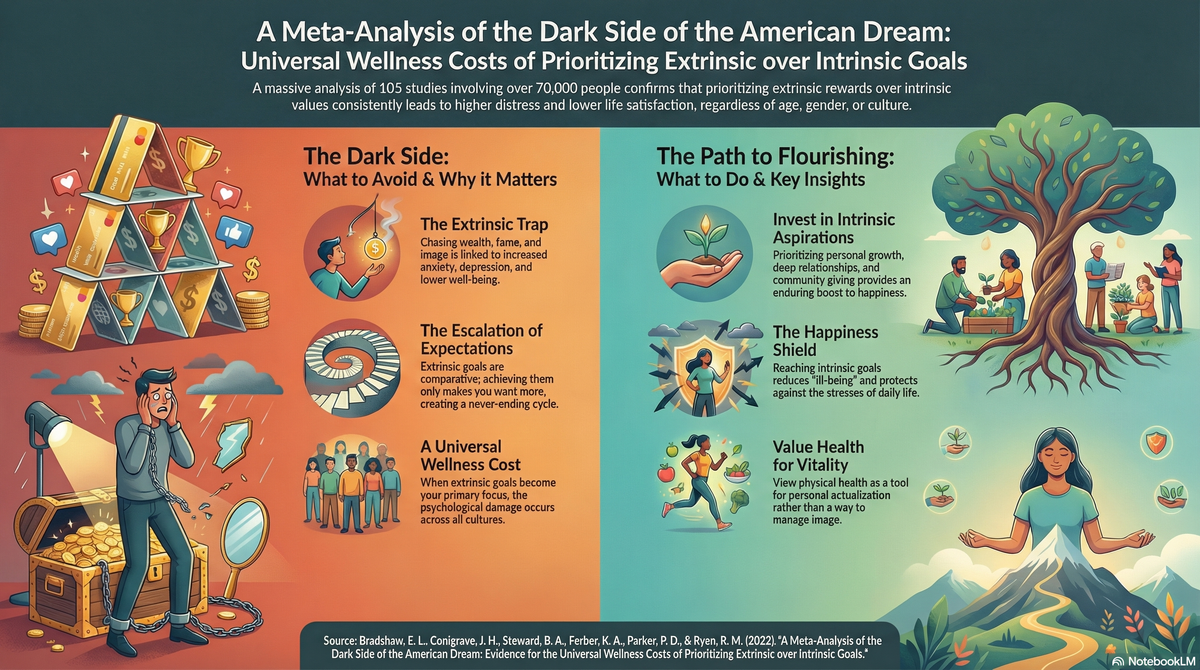
[3]
Self-Determination Theory: Why Values Alignment Satisfies Core Needs
The psychological mechanism through which values affect well-being is clarified by self-determination theory, developed by Edward Deci and Richard Ryan over more than four decades of research. The theory identifies three basic psychological needs whose satisfaction is essential for well-being: autonomy (the experience of acting from genuine choice rather than external pressure), competence (the experience of effective engagement with one's environment), and relatedness (the experience of meaningful connection with others). When these needs are satisfied, well-being flourishes. When they are chronically frustrated, psychological health deteriorates.
Values alignment directly serves the autonomy need. When your actions reflect your genuine values — when you are doing what you do because it expresses what you actually care about, not because it is expected, rewarded, or required — you experience a sense of volitional engagement that is qualitatively different from compliance. Deci and Ryan's cross-cultural research, which examined populations in Belgium, China, the United States, and Peru, found that autonomy need satisfaction predicted well-being across all four cultural contexts. People who act from genuine values experience more energy, more persistence, more satisfaction, and better outcomes than people who act from external pressure — regardless of what they are doing. The content of the activity matters less than whether it is genuinely chosen.
What Values Clarification Actually Is
Values clarification is a psychological concept with a specific meaning that is distinct from both goal-setting and moral philosophy. In the framework of Acceptance and Commitment Therapy — one of the most empirically supported therapeutic approaches of the past thirty years — values are defined as chosen directions of travel: the qualities of being and acting that you want to move toward, regardless of circumstances. They are not destinations you arrive at. They are compass bearings you navigate by. A goal is to run a marathon. A value is to take care of your physical health. The goal can be achieved and checked off. The value applies to every subsequent decision as long as you hold it.
This distinction matters because goals, once achieved, provide only temporary psychological benefit. The satisfaction of accomplishment fades quickly — a well-documented phenomenon in well-being research sometimes called the hedonic treadmill. Values, by contrast, provide ongoing psychological orientation. Every decision made in accordance with a genuine value is simultaneously an expression of who you are and a contribution to a life that coheres around what matters. The cumulative effect of thousands of values-aligned decisions is a life that feels purposeful. The cumulative effect of thousands of values-violated decisions is a life that feels hollow, regardless of what has been accomplished by external measures.
The Cost of Values-Behavior Mismatch
Cognitive dissonance — the psychological discomfort of holding values that contradict your behavior — is one of the most reliably documented phenomena in social psychology. When you act in ways that conflict with your stated values, the mismatch generates psychological cost. This cost is not abstract. It shows up as reduced sense of integrity, increased anxiety, lower life satisfaction, and a diffuse sense that something is wrong that is difficult to name precisely because the cause is not a single dramatic event but an accumulating pattern of small contradictions.
Research on decision fatigue adds another dimension. When you do not have a reliable framework for evaluating options, each decision requires effortful deliberation from scratch. Values clarification resolves this problem by providing a stable decision criterion. If you know clearly what you value most, decisions that align with those values are made with less effort and followed with less regret. Values clarity does not eliminate difficult decisions. It makes them faster and leaves less residue of doubt. The cost of chronic values-behavior mismatch is not measured in single moments but in the accumulated weight of a life lived slightly off-course from itself.
How to Identify Your Core Values
The most research-supported approach to values clarification begins with identifying peak experiences: moments in your life when you felt most alive, most fully yourself, most engaged and energized. These experiences often point directly toward values because they are characterized by activities that naturally express what you care about most. Reviewing three to five of these experiences and asking what they had in common — what qualities of action, being, or relationship were present — typically produces a draft list of candidate values [4].
 Viktoria Samokhval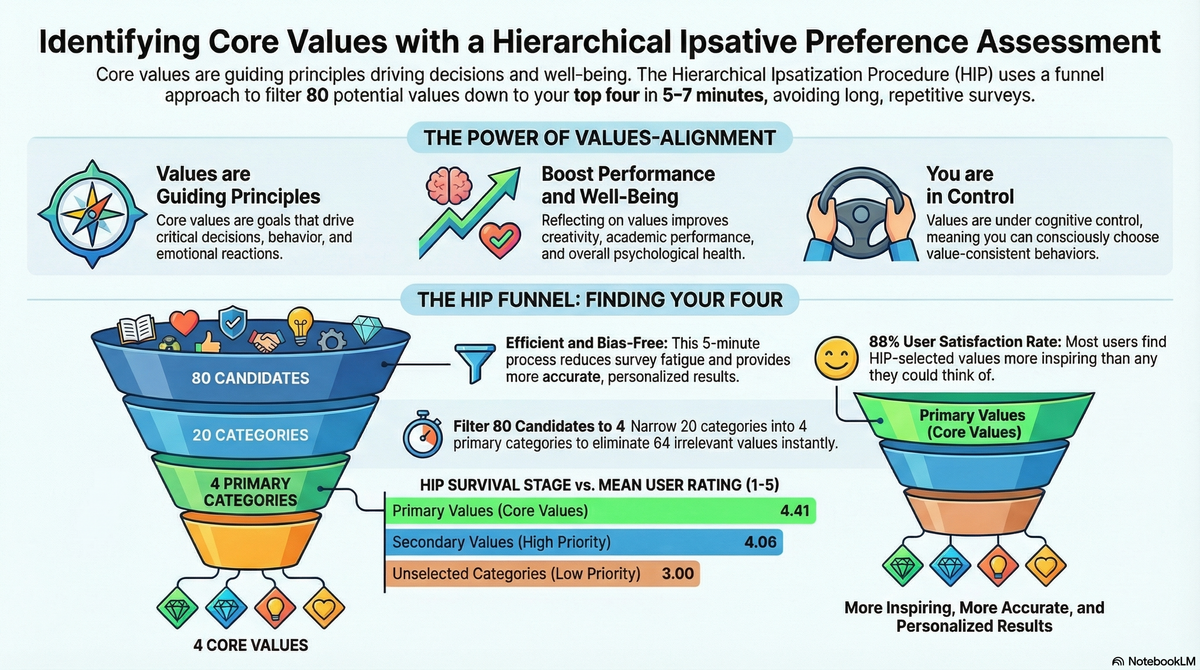
[4]
A common pitfall is confusing aspired values with lived values. Aspired values are what you believe you should care about. Lived values are what your actual behavior reveals you do care about. The gap between them is often larger than people expect, and confronting it honestly is both uncomfortable and productive. A second pitfall is holding too many values simultaneously. Research on values clarification consistently finds that narrowing to three core values produces more behavioral guidance than maintaining a long list. Three values can be held in working memory and applied in real time. The exercise of narrowing — of determining which three values you would be least willing to sacrifice — is itself a powerful clarification process that reveals what actually matters at the level of genuine priority rather than stated preference.
Values-Aligned Daily Living
The transition from values clarification to values-aligned living requires a practical bridge. A five-minute daily values check — reviewing your core values at the beginning of the day and identifying one specific action or decision that will express each of them — has been shown in ACT-based intervention research to significantly increase values-congruent behavior over time. The practice is deliberately minimal because its purpose is not to restructure your day but to bring your values into conscious awareness before the automatic demands of daily life override them.
The compound effect of consistent values alignment is documented in research on meaning and well-being. People who consistently act in accordance with their core values report higher sense of meaning, greater life satisfaction, stronger sense of personal integrity, and lower rates of regret over time. These benefits accumulate: the initial improvements are modest, but they build on each other as values-aligned behavior becomes habitual and as the coherence between what you care about and how you actually live becomes self-reinforcing. Values are not abstract ideals. They are the operating system of a psychologically healthy life — the framework through which all other well-being practices find their deepest traction. The research makes the case for treating them not as the screensaver but as the foundation.
References
-
Kasser, T., & Ryan, R. M. Further examining the American dream: Differential correlates of intrinsic and extrinsic goals.
Journal of Personality and Social Psychology,1996 71(3), 549–561 -
Ng, J. Y. Y., Ntoumanis, N., Thøgersen‑Ntoumani, C., Deci, E. L., Ryan, R. M., Duda, J. L., & Williams, G. C. Self‑Determination Theory Applied to Health Contexts: A Meta‑Analysis.
Perspectives on Psychological Science, 2012 7(4), 325–340 -
Bradshaw, E. L., Conigrave, J. H., Steward, B. A., Ferber, K. A., Parker, P. D., & Ryan, R. M. A meta‑analysis of the dark side of the American dream: Evidence for the universal wellness costs of prioritizing extrinsic over intrinsic goals.
Journal of Personality and Social Psychology,2023 124(4), 873–899 -
Stanislaw, H., & McCreary, J. Identifying core values with a hierarchical, ipsative, preference assessment.
Journal of Personality Assessment, 2023 105(3), 329–341