Why Friendship is a Matter of Life and Death: Insights from "Loneliness and Social Isolation as Risk Factors for Mortality: A Meta-Analytic Review"
We obsess over our diets, track our daily steps, and carefully monitor our sleep. We are constantly warned by public health campaigns about the dangers of smoking, physical inactivity, and poor eating habits. But what if one of the greatest threats to our lifespan isn't what we eat or how much we move, but who we spend our time with?
A monumental research review explored this very question, proving that a lack of human connection is not just an emotional hardship; it is a literal health hazard. By analyzing data from millions of people, researchers discovered that social isolation is just as critical to our physical survival as diet and exercise. Here is what the science says about the life-saving power of human connection and how you can build a healthier, more connected life.
The Lethal Weight of Being Alone
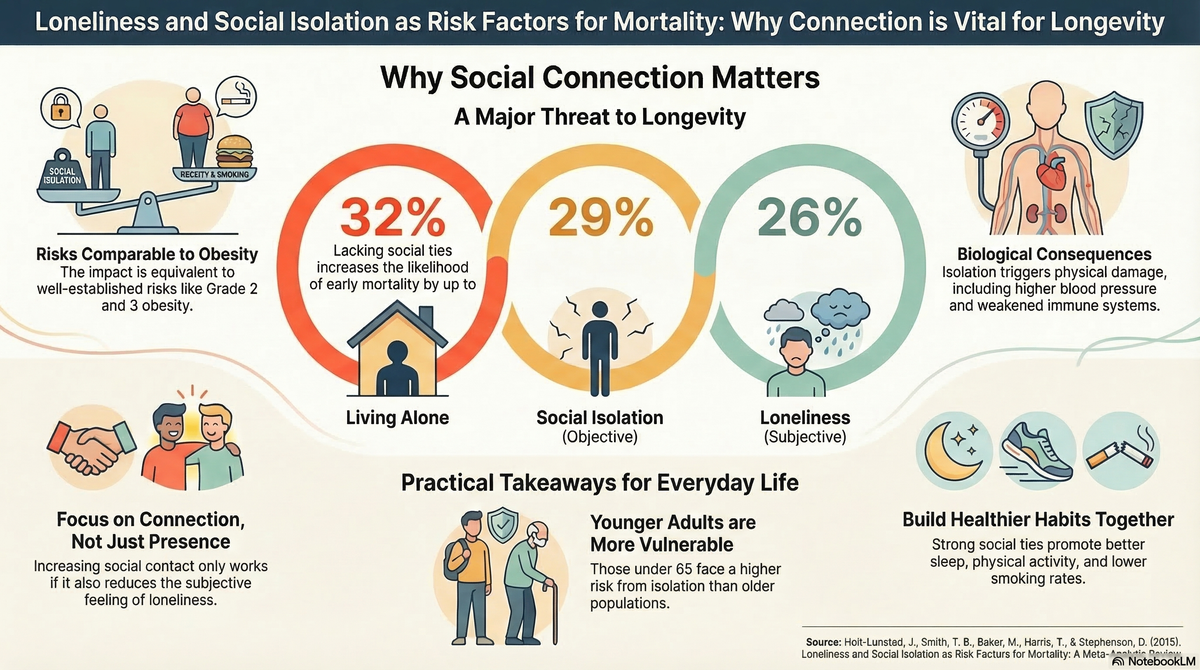
We often confuse being physically alone with feeling lonely, but the research shows both states are incredibly dangerous. The study found that objective social isolation (having few social ties or living alone) and subjective loneliness (the emotional feeling of being disconnected) both independently increase the likelihood of premature death by roughly 26% to 32%. The researchers discovered no significant difference between the two; lacking physical social contact and feeling emotionally lonely are both equally deadly. You do not have to be physically isolated to suffer the health consequences of loneliness, and having people around does not automatically protect you if you do not feel authentically connected to them.
Practical Guidance:
- What to do: Focus on building both the quantity and the quality of your relationships, ensuring you have regular contact with people you genuinely feel close to.
- What not to do: Don't assume someone is fine just because they are surrounded by coworkers or acquaintances; they might still be subjectively lonely.
- Habit to change: Treat your social life as a critical pillar of your physical health routine, prioritizing coffee dates and phone calls just like you prioritize going to the gym.
Listen to Your Loneliness Alarm
Why does feeling disconnected hurt us physically? From an evolutionary perspective, loneliness is an adaptive biological signal, just like hunger or thirst. It is designed by nature to motivate us to alter our behavior and reconnect with others because human survival has historically depended on group cooperation. When we are isolated, our bodies react negatively, often leading to poorer health behaviors, higher blood pressure, and decreased immune functioning. When you feel lonely, your body is literally warning you that you are in danger.
Practical Guidance:
- What to do: Respond to feelings of loneliness with immediate social action, just as you would respond to hunger by eating a meal.
- What not to do: Don't ignore or suppress the feeling of loneliness, or try to numb it with solitary distractions like endless scrolling on social media.
- Decision to change: Shift your mindset from viewing loneliness as a shameful personal failure to viewing it as a helpful, biological prompt to reach out to a friend.
The Myth of the "Lonely Senior"
We typically picture loneliness as a problem strictly for the elderly, assuming that aging, widowhood, and retirement are the primary drivers of isolation. However, the data reveals a shocking reality: social deficits are actually more predictive of premature death in adults younger than 65. Middle-aged adults are at a greater risk of mortality when they live alone or feel lonely compared to older adults in the exact same circumstances. While older populations do experience loneliness, younger and middle-aged adults are uniquely vulnerable to its lethal physical effects.
Practical Guidance:
- What to do: Check in on your middle-aged friends, colleagues, and family members, even if they seem completely fine and busy with their careers or independent lives.
- What not to do: Don't wait until retirement to start worrying about building a social safety net or joining community groups.
- Habit to change: Make a conscious decision to prioritize maintaining friendships during your busy middle-age years, rather than letting them naturally fade due to the pressures of work or family obligations.
A Threat Greater Than Obesity
It is easy to brush off a quiet, isolated weekend as no big deal, but the cumulative physical risk of social isolation is staggering. The research indicates that the heightened risk of mortality from a lack of social relationships is comparable to well-established public health risks like substance abuse and physical inactivity. Even more surprisingly, the current evidence shows that the mortality risk of loneliness is actually equivalent to, or greater than, the risk associated with severe obesity. While we spend billions of dollars fighting the obesity epidemic, we are largely ignoring a social epidemic that is just as deadly.
Practical Guidance:
- What to do: Advocate for social connection as a primary, non-negotiable health goal in your household, alongside eating your vegetables and getting enough sleep.
- What not to do: Don't sacrifice your relationships to achieve physical fitness goals—like skipping every social dinner just to stick to a rigid, isolating diet.
- Decision to change: Balance your health metrics. Start tracking the time you spend connecting with loved ones with the exact same dedication you use to track your daily steps or calories.
Summary for Life
The research points to a profound and concrete life rule: Human connection is not a luxury or a mere emotional comfort; it is a fundamental biological requirement for survival, and we must fiercely protect our relationships as if our lives depend on them—because they do.
Reflective Question: If you treated your daily social interactions as a literal prescription for your physical health, who is the first person you would reach out to today?
References
Julianne Holt-Lunstad, Timothy B. Smith, Mark Baker, Tyler Harris, and David Stephenson. "Loneliness and Social Isolation as Risk Factors for Mortality: A Meta-Analytic Review." Perspect Psychol Sci 2015 Mar;10(2):227-37. doi: 10.1177/1745691614568352.