
Why Constructive Criticism Backfires: Lessons from "The Effects of Feedback Interventions on Performance: A Historical Review, a Meta-Analysis, and a Preliminary Feedback Intervention Theory"
We have all been there: you sit down for a performance review, or you try to give your partner some "helpful advice" on how they load the dishwasher. You expect your words to act as a helpful course correction. Instead, the person becomes defensive, flustered, and their performance actually gets worse. Why does a tool that is supposed to help us grow so often lead to disaster?
For decades, society has operated on the assumption that feedback is always a good thing. However, a landmark evaluation of feedback research reveals that our fundamental understanding of constructive criticism is deeply flawed. Let's break down the hidden mechanics of feedback and how you can transform the way you communicate.
The Feedback Paradox: More Harm Than Good?
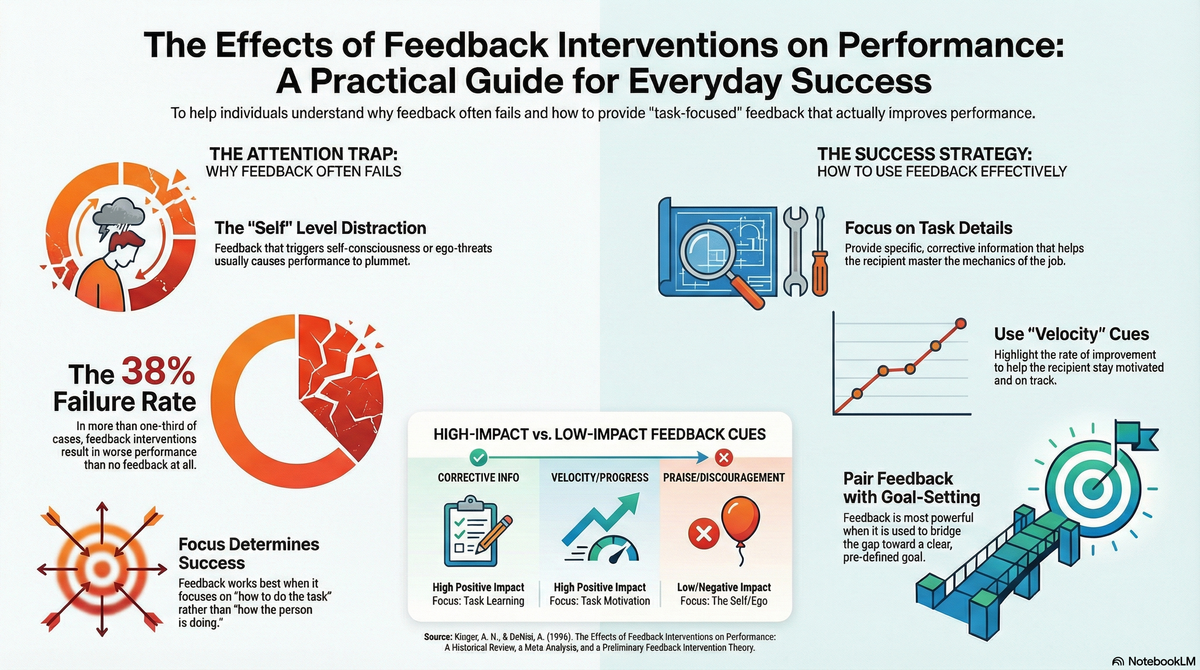
The most shocking revelation from the research is that feedback does not universally improve performance. In fact, in over one-third of the cases studied, providing feedback actually caused performance to decrease. This destroys the common myth that any feedback is better than no feedback at all. When we give feedback without understanding how it works, we are essentially flipping a coin with someone's productivity and motivation.
Practical Guidance:
• What to do: Treat feedback like a powerful prescription medication—use it intentionally and carefully.
• What not to do: Don't give feedback just because you feel a compulsory need to say something or "manage" a situation.
• Habit to change: Before offering an opinion on someone's work or behavior, pause and ask yourself if the feedback is truly necessary, or if it is more likely to disrupt their workflow.
Focus on the Task, Not the Ego
Why does feedback backfire? The answer lies in where the feedback directs a person's attention. Feedback is highly effective when it focuses a person's attention directly on the task and how to improve it. However, when feedback shifts a person's attention to their "self"—triggering thoughts about their self-esteem, identity, or fears of looking incompetent—performance plummets. Interestingly, even praise can weaken performance if it distracts the person from the task and makes them hyper-focus on their ego.
Practical Guidance:
• What to do: Keep your feedback strictly behavioral and task-oriented. Say, "This spreadsheet is missing the final column," instead of "You are being careless."
• What not to do: Don't use personal attacks or even overly personal praise (e.g., "You are a genius!") when trying to correct a specific action, as both pull attention away from the work itself.
• Habit to change: Stop using the word "You" when correcting mistakes. Shift your language to focus on "the project," "the process," or "the result."
The Danger of Critiquing Complex Tasks
It turns out that human beings are incredibly sensitive when learning something new. The research highlights that feedback is much more effective on simple, familiar tasks than on complex or highly novel ones. When someone is learning a difficult new skill, their brain is already working at maximum capacity. Interrupting them with feedback can overwhelm their cognitive resources, causing them to lose focus and perform worse. People often need the space to learn through trial and error before they are ready to process external critiques.
Practical Guidance:
• What to do: Give people the grace and space to stumble through the early stages of a complex new task without immediate intervention.
• What not to do: Don't hover and micromanage someone who is trying to figure out a difficult, unfamiliar software or process.
• Decision to change: Wait until a person has a basic grasp of a new skill before you introduce corrective feedback. Let them discover the basic rules on their own first.
The Power of the Target
Feedback is essentially useless if the person receiving it doesn't know what they are aiming for. The research shows that feedback works best when it is paired with clear goal setting. When a person has a highly specific standard to meet, feedback acts as a helpful map showing them the gap between where they are and where they need to be. Without a clear goal, feedback feels arbitrary and confusing.
Practical Guidance:
• What to do: Always establish a clear, measurable goal before any work begins.
• What not to do: Don't offer vague criticisms like "Do better" or "Try harder," because they provide no standard for the person to measure their progress against.
• Habit to change: Whenever you are about to give feedback, start by reminding the person of the shared goal. "Since our goal is to cut presentation time down to 10 minutes, let's look at which slides we can cut."
Summary for Life
The deep truth of human performance boils down to a single, concrete life rule: To help someone improve, focus your words entirely on the work they are doing and the goal they are trying to reach, while fiercely protecting their ego from the conversation.
Reflective Question: The next time you are tempted to offer "constructive criticism," will your words help the person focus on solving the problem, or will your words force them to defend their self-worth?
References
Kluger, Avraham N., and Angelo DeNisi. "The Effects of Feedback Interventions on Performance: A Historical Review, a Meta-Analysis, and a Preliminary Feedback Intervention Theory." Psychological Bulletin, vol. 119, no. 2, 1996, pp. 254-284.