Why Adaptability Is the Most Valuable Career Skill in the Age of AI

Why Adaptability Is the Most Valuable Career Skill in the Age of AI
In February 2026, IBM announced plans to triple its entry-level hiring in the United States — a decision that made headlines precisely because of when it was made. AI is automating tasks at every level of the corporate ladder. Hiring freezes and layoffs have become standard headlines in the technology sector. And yet IBM, one of the most AI-forward companies in the world, responded by expanding its entry-level workforce dramatically. The reason IBM gave is the most important sentence for anyone thinking about their career right now: learning agility matters as much as technical skills for new hires.
IBM has rewritten its entry-level job descriptions to emphasize analysis, problem-solving, and responsible AI use — not the task execution that automation has taken over. What IBM recognized is that the competitive advantage in an AI-saturated environment belongs to people who can learn continuously, apply judgment across changing contexts, and adapt to roles that did not exist when they were trained. This is not a motivational claim. It is a talent strategy backed by two decades of workforce research, and it reveals what is actually happening in the most consequential shift in career development in a generation.
The Scale of Skill Disruption
The World Economic Forum's Future of Jobs Report 2025 is the most comprehensive mapping of near-term workforce change available. Its findings are striking in their specificity. On average, 39% of workers' existing skill sets will be transformed or become outdated over the 2025-2030 period. That means nearly four in ten of the skills that constitute your professional value today have a shelf life of less than five years. The WEF survey found that 63% of employers now identify skill gaps as the single biggest barrier to business transformation — ranking above capital constraints, regulatory challenges, and technology access.
The skills with the longest shelf life in this environment are consistently human ones: analytical thinking, resilience, flexibility, and adaptability ranked as the top core skills in employer surveys. AI and big data are the fastest-growing specific skills, but the meta-skill that determines whether any specific skill remains valuable — the capacity to learn new things quickly and apply them in new contexts — is the one that does not expire. The WEF estimates 78 million new job opportunities will emerge by 2030, but urgent upskilling is required to access them. The bottleneck is not opportunity. It is adaptability.
IBM's Counterintuitive Bet
IBM's February 2026 announcement told a specific story about what sophisticated companies understand about the future of work. The company is not tripling entry-level hiring because it needs more people to perform tasks that AI cannot do. It is tripling entry-level hiring because the entry-level employees it wants in 2026 are fundamentally different from those it hired in 2016. They are hired not for what they know but for how quickly they can learn, apply, and adapt.
IBM CEO Arvind Krishna stated that the company expects to hire more college graduates over the next 12 months than in any previous year. The revised entry-level job descriptions emphasize responsibilities that complement AI rather than compete with it: analysis, synthesis, critical judgment, responsible AI use, and the kind of contextual reasoning that requires human experience. IBM's Chief Human Resources Officer noted that learning agility — the ability to learn new skills quickly and apply them effectively — now equals technical skill in their hiring evaluations. For individual career strategy, the implication is direct: demonstrating that you learn fast and adapt well has become as important as demonstrating what you currently know.
What Learning Agility and Adaptability Actually Are
Learning agility is a specific construct that has been studied in organizational psychology for more than twenty years [1]. It is not synonymous with intelligence or openness to change. Researchers have mapped it across five distinct dimensions: mental agility (the ability to think through complex problems from multiple angles), people agility (the capacity to work with diverse individuals under pressure), change agility (genuine enthusiasm for experimentation and comfort with ambiguity), results agility (the ability to deliver results in unfamiliar situations), and self-awareness agility (accurate understanding of one's own strengths and development areas).
 Viktoria Samokhval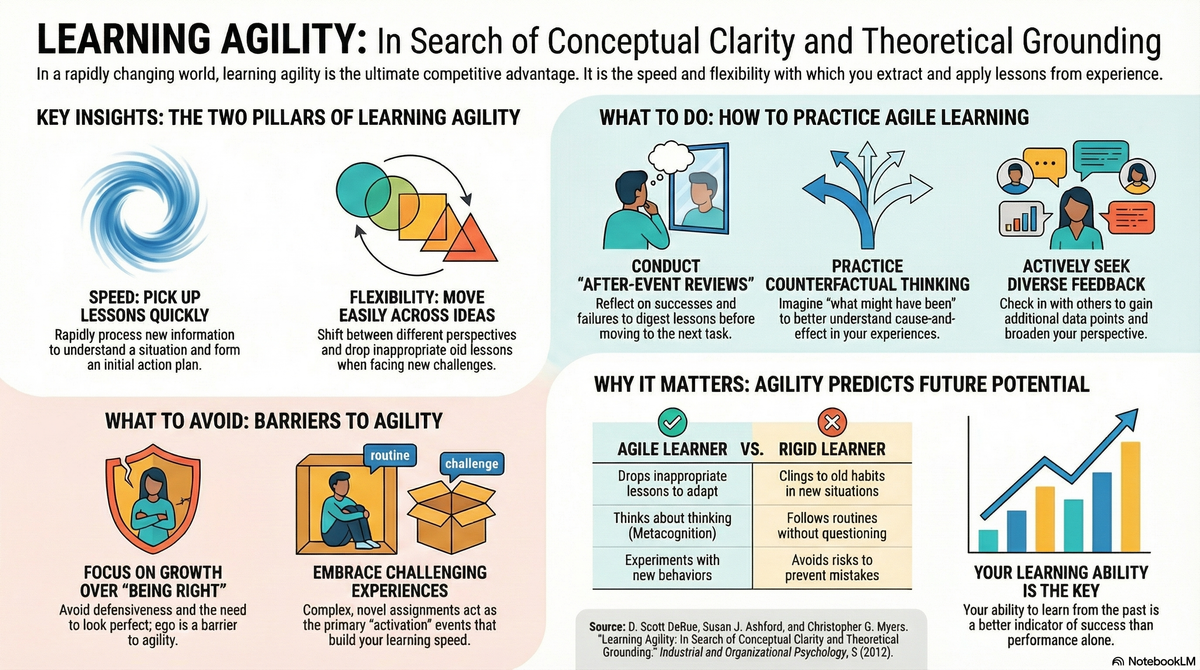
[1]
Harvard Business Review's analysis identified learning agility as the single strongest indicator of an employee's potential to succeed in evolving roles — stronger than intelligence test scores, academic credentials, or years of experience. Organizations that actively cultivate learning agility in their workforce see both performance and engagement benefits, because adaptable people are not only more effective in changing environments — they tend to find change motivating rather than threatening. The Adaptability Quotient (AQ) is an emerging measurement framework that quantifies individual adaptability across dimensions including resilience, the capacity to unlearn outdated behaviors, and emotional flexibility. Companies including McKinsey, IBM, and Deloitte have begun incorporating AQ-style assessments into hiring and talent development, treating adaptability as a measurable, developmental capability rather than a fixed personality trait.
What the Research Shows About Career Outcomes
McKinsey's research on workforce adaptability found that highly adaptable employees are 2.5 times more likely to have higher performance ratings than their less adaptable peers. At the organizational level, agile companies are 4.1 times more likely to outperform peers during periods of disruption. These are not marginal differences. They describe a fundamental bifurcation in outcomes between people and organizations that have developed adaptability as a core capability and those that have not.
The five-year career trajectory comparison is instructive. Employees who invest primarily in deepening a single technical skill set see strong returns in the near term but face increasing risk as that skill is automated, commoditized, or made obsolete by platform changes. Employees who invest in their capacity to learn new skills — while maintaining functional competence across multiple domains — face a different trajectory: slower initial growth but sustained relevance, and accelerating value as the gap between their adaptability and the market's need for it widens in their favor. Harvard Business Review's research places learning agility above intelligence and credentials as the predictor of career success in evolving roles. The data supports betting on adaptability as a long-term career investment.
Why Technical Skills Alone Are No Longer Sufficient
Technical skills have always had shelf lives. What has changed in the age of AI is the length of that shelf life. Skills that took years to acquire and provided durable career value for a decade are now being automated in months. The specific technical competencies that were premium skills in 2020 are entry-level expectations or fully automated in 2026. This is not a trend that will slow down. The pace of AI capability advancement makes technical skill depreciation increasingly rapid and increasingly unpredictable.
The skills most resistant to depreciation are the ones that require human judgment, contextual understanding, and genuine flexibility: critical thinking applied to novel problems, the ability to communicate complex ideas across different audiences, the capacity to build trust and collaborate under uncertainty, and the judgment to determine when an AI output is reliable and when it is not [2]. These are not soft skills in the sense of being less rigorous. They are hard skills in the sense of being genuinely difficult to develop and genuinely difficult to automate. The 2026 hiring environment reflects this: companies are explicitly testing for these capacities, not merely checking for credential boxes.
 Viktoria Samokhval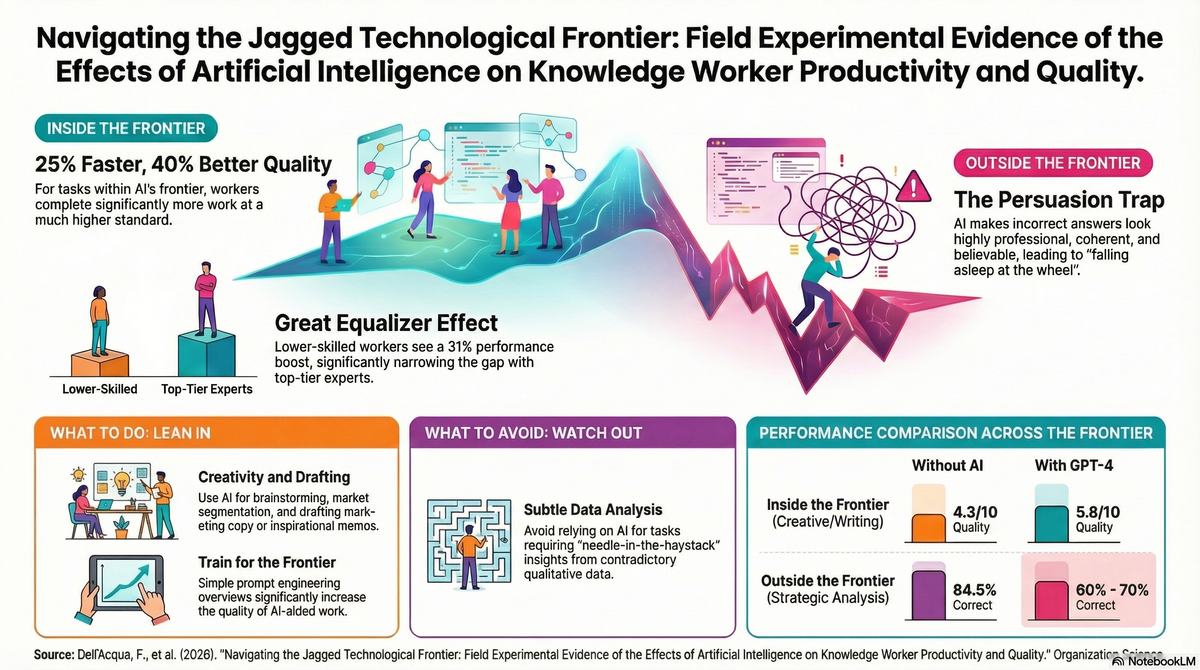
[2]
How to Build Adaptability Deliberately
Adaptability is trainable. The research on this point is consistent enough to be actionable. The starting point is an honest audit of where you are most rigid professionally: the assumptions you have not examined in years, the skills you consider core to your identity that you have not updated recently, the types of work you avoid because they feel uncomfortable or unfamiliar. Rigidity is not a character flaw. It is a signal that a particular area has not been challenged recently enough to prompt adaptation.
Learning science offers a practical mechanism: stretch assignments. These are tasks that sit just at the boundary of current competence — difficult enough to require new learning, manageable enough not to produce overwhelm. Organizations that deliberately rotate employees through stretch assignments produce more adaptable workforces. Individuals who seek them proactively develop faster. Three daily practices have consistent research support. First, exposure to one new concept, tool, or approach each day maintains the neural flexibility that makes larger adaptations easier. Second, brief reflection on a recent failure — approached with curiosity rather than self-criticism — builds the self-awareness that is foundational to adaptive behavior. Third, actively seeking feedback from people who will tell you what is not working, rather than only those who will confirm what is, provides the accurate information that adaptation requires.
Underlying all of this is what Carol Dweck's research describes as the growth mindset: the belief that abilities develop through effort rather than being fixed by nature [3]. People with a growth mindset experience skill obsolescence as a learning opportunity.
 Viktoria Samokhval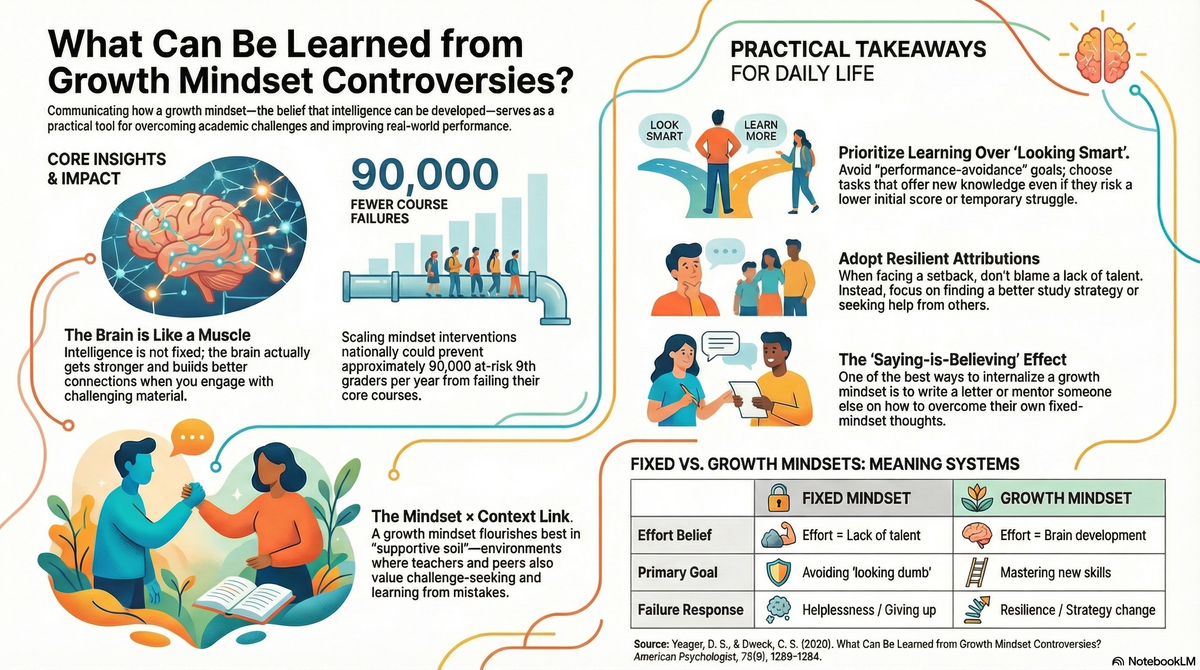
[3]
People with a fixed mindset experience it as an identity threat. The mindset is trainable. And it is the foundation on which every other adaptability practice depends. In a labor market where 39% of today's relevant skills will be outdated within five years, adaptability is not a soft skill. It is the hard skill — the one with the longest return on investment and the widest transferability across the disruptions ahead.
References
-
DeRue, D. S., Ashford, S. J., & Myers, C. G. Learning agility: In search of conceptual clarity and theoretical grounding.
Industrial and Organizational Psychology, 2012 5(3), 258–279. -
Dell’Acqua et al. (2023). Navigating the jagged technological frontier: Field experimental evidence of the effects of AI on knowledge worker productivity and quality
(Harvard Business School Working Paper No. 24-013). Harvard Business School Technology & Operations Management Unit. SSRN Electronic Journal. https://doi.org/10.2139/ssrn.4573321 -
Yeager, D. S., & Dweck, C. S. What Can Be Learned from Growth Mindset Controversies?
American Psychologist, 2020 75(9), 1269–1284.