Unlocking Teen Happiness: What "A PERMA model approach to well-being: a psychometric properties study" Teaches Us About Thriving
If you have ever spent time with a teenager, you know that their moods can be a mystery. One day they are on top of the world, and the next, they are withdrawn or overwhelmed. As parents, educators, and mentors, we all want the young people in our lives to be genuinely happy and fulfilled, but it can be incredibly difficult to know what actually makes a difference. Is it getting good grades? Having the newest smartphone? Or something deeper?
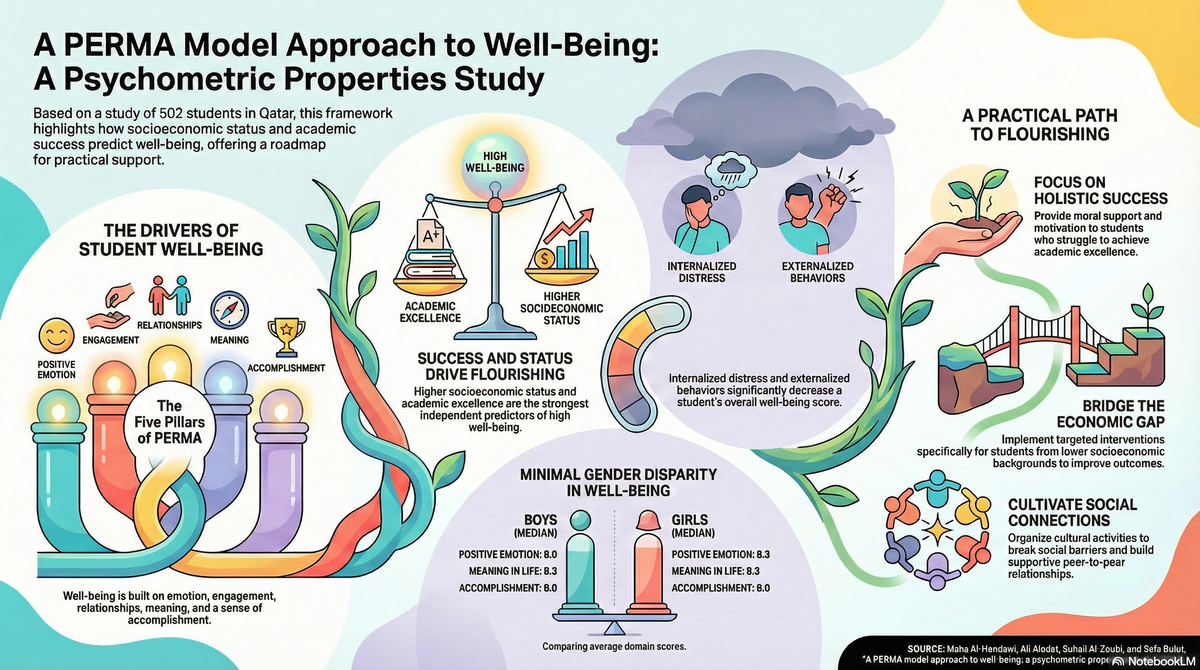
A fascinating study recently explored these questions using the "PERMA" model—a psychological framework that breaks happiness down into Positive emotion, Engagement, Relationships, Meaning, and Accomplishment. By examining what drives well-being in high school students, researchers uncovered the hidden forces that either build up or tear down a young person's mental health. Here is how you can use this science to help the teens in your life thrive.
The Grades-Happiness Connection
We often push students to get good grades so they can get into a good college or secure a well-paying job. But the research reveals an immediate, emotional benefit to doing well in school: academic success is strongly and positively linked to a student's daily well-being. Students who perform at an "excellent" level report significantly higher overall happiness. This isn't just about the letter on a report card; it is about the profound sense of accomplishment and mastery that comes from setting a goal, working hard, and seeing tangible progress.
Practical Guidance:
• What to do: Celebrate the effort and the small steps of progress, not just the final grade, to help teens build a lasting sense of mastery and confidence.
• What not to do: Don't make your love or approval contingent on perfect test scores, which can trigger anxiety and defeat the joy of learning.
• Habit to change: Shift your daily conversations. Instead of immediately asking, "What grade did you get on the test?", try asking, "What is something you learned today that you feel proud of?"
The Hidden Weight of Financial Stress
We like to believe that money doesn't buy happiness, but the reality of a teenager's environment matters. The study found that a family's socioeconomic status (SES) plays an independent and significant role in a student's well-being. Teens from higher-income households generally reported higher levels of well-being. Why? Because financial security provides easier access to resources (like tutoring or extracurriculars) and buffers them from the chronic, exhausting stress of economic instability.
Practical Guidance:
• What to do: If resources are tight, actively connect teens with free community programs, school clubs, or mentorships that provide enriching experiences without the financial burden.
• What not to do: Avoid placing the heavy burden of adult financial worries on a teenager's shoulders; they need a stable emotional environment to focus on their growth.
• Decision to change: Look for ways to build "relationship wealth" and "meaning wealth" in your home through free, shared family activities, ensuring that a lack of money doesn't equate to a lack of joy.
The Danger of Silent (and Loud) Struggles
When teenagers are struggling, they usually show it in one of two ways: internalizing behaviors (withdrawing, anxiety, depression) or externalizing behaviors (acting out, aggression, defiance). The research confirms that both of these behavioral patterns severely damage a teen's overall well-being. Interestingly, these behaviors often disrupt their ability to form positive peer relationships and stay engaged in school, creating a downward spiral that is hard to escape.
Practical Guidance:
• What to do: Pay close attention to sudden behavioral shifts. If a normally outgoing teen suddenly isolates themselves, or a calm teen becomes highly aggressive, treat it as a distress signal requiring gentle, supportive intervention.
• What not to do: Don't dismiss extreme withdrawal or disruptive behavior as "just a typical teenage phase." These are valid indicators of psychological distress.
• Habit to change: Build a habit of regular, low-pressure emotional check-ins—like chatting during a car ride or while cooking dinner—where teens feel safe sharing their worries before they turn into major behavioral issues.
Happiness Has No Gender or Age Limit
One of the most surprising insights from the study was what didn't matter. The researchers found no significant effect of gender or age on the students' overall well-being scores. While we often assume that teenage girls face vastly different emotional landscapes than teenage boys, or that older seniors are inherently more stressed than younger freshmen, the core ingredients of happiness remain universal. Every teenager, regardless of their demographic, fundamentally needs positive emotions, deep relationships, and a sense of meaning to thrive.
Practical Guidance:
• What to do: Treat every teenager as an individual who requires connection and purpose, ensuring that both boys and girls are given equal emotional support.
• What not to do: Avoid falling back on gender stereotypes, such as assuming that boys don't need to talk about their feelings or that girls are naturally "more emotional."
• Habit to change: Approach each teen's struggles based on their unique personality and environment, rather than making assumptions based on their age or gender.
Summary for Life
The research boils down to a concrete life rule: To help a teenager build a happy, resilient life, we must look beyond their age and gender, and instead focus on giving them the tools to succeed academically, manage their emotional behaviors, and feel secure in their environment.
Reflective Question: Are you helping the teenagers in your life build a deep sense of meaning and accomplishment, or are you just hoping they survive the stress of high school on their own?
References
Maha Al-Hendawi, Ali Alodat, Suhail Al-Zoubi, and Sefa Bulut. "A PERMA model approach to well-being: a psychometric properties study.", July 2024, BMC Psychology 12(1) DOI:10.1186/s40359-024-01909-0