The Truth About Talent and Effort: What "What Can Be Learned from Growth Mindset Controversies?" Teaches Us About Overcoming Setbacks
Have you ever hit a wall while trying to learn a new skill—maybe struggling to grasp a complex software program at work, or failing to pick up a new language—and caught yourself thinking, "I’m just not wired for this"? We have all experienced moments where our natural abilities seem to fall short. In these moments, it is incredibly tempting to believe that our intelligence and talents are fixed traits we are simply born with.
For years, the concept of a "growth mindset"—the belief that our intellectual abilities can be developed—has been hailed as the ultimate secret to success. But recently, some critics have questioned whether this mindset actually works. A comprehensive review by the foundational researchers of mindset theory tackled these controversies head-on, clarifying exactly how, when, and why a growth mindset impacts our lives. Here is what the science actually says about the psychology of success, and how you can practically apply it to break through your own limitations.
The Setback is the Signal
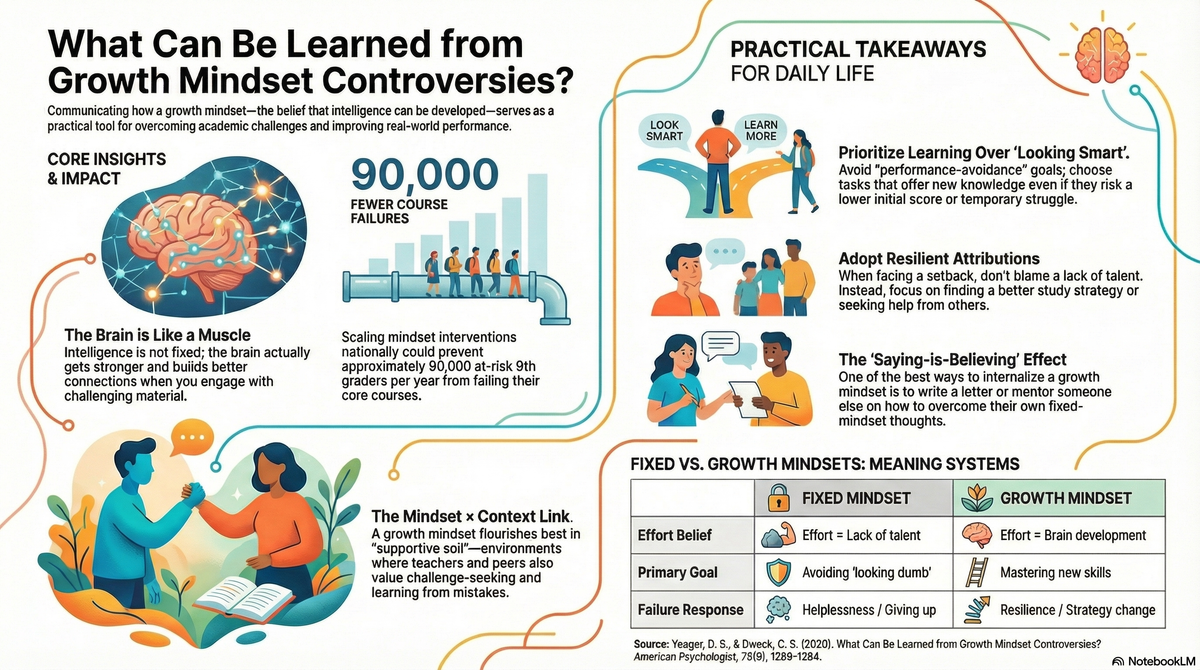
We often misunderstand what a growth mindset actually is, confusing it with generic positive thinking or the idea that "anyone can do anything if they just try hard enough." The research clarifies that mindset theory is specifically about how we respond to challenges and setbacks.When you have a fixed mindset, a failure feels like a permanent indictment of your natural ability. Consequently, you might shy away from difficult tasks just to avoid looking incompetent. However, when you hold a growth mindset, your focus shifts from proving your ability to developing it. A setback is no longer proof that you are "dumb"; it is simply a signal that you need to apply more effort or find a new strategy.
Practical Guidance:
- What to do: Treat failures as data. When you struggle, ask yourself what specific part of your strategy isn't working, rather than judging your overall intelligence.
- What not to do: Don't hide from challenging projects just to protect your reputation as a "smart" or "capable" person.
- Habit to change: Shift your internal monologue during difficult tasks. Replace "I am not good at this" with "I haven't figured out the right strategy for this yet."
Redefining Effort: The "Meaning System"
Why do some naturally talented people quit the moment things get hard? The research reveals that our mindsets create an entire "meaning system" that dictates how we interpret effort.If you have a fixed mindset, you likely harbor "negative effort beliefs". This means you secretly believe that if you have to work hard at something, you must lack natural talent. You view effort as a weakness. Conversely, a growth mindset fosters the belief that effort is the very mechanism that builds intelligence. You understand that the brain is like a muscle that physically strengthens when you do challenging work.
Practical Guidance:
- What to do: Openly discuss the hard work, mistakes, and revisions that go into your successes, normalizing the struggle for yourself and those around you.
- What not to do: Don't secretly admire or strive for "effortless perfection." Pretending you didn't have to work hard to succeed reinforces a toxic, fixed mindset meaning system.
- Decision to change: Change how you praise others (and yourself). Stop complimenting raw talent ("You're so smart!") and start praising the process ("I'm proud of the strategy and effort you used to solve that").
You Cannot Grow in a Vacuum
One of the most profound insights from the recent data is that a growth mindset is not a magic spell you can cast in isolation. The research introduces the "Mindset × Context" perspective.This means that even if you deeply believe in your ability to grow, you will struggle to succeed if your environment actively punishes mistakes or highly prizes innate genius. For a growth mindset to truly translate into better performance, you need a supportive context—like teachers, peers, or managers who encourage risk-taking and afford you the opportunity to act on your desire to learn.
Practical Guidance:
- What to do: Seek out mentors, friend groups, and workplace cultures that explicitly value continuous learning and view mistakes as stepping stones rather than fatal flaws.
- What not to do: Don't beat yourself up for failing to thrive in a highly punitive, hyper-competitive environment that demands immediate perfection; your environment might be suffocating your mindset.
- Habit to change: If you are a leader or parent, stop just telling people to have a growth mindset. Start actively redesigning your environment to ensure that seeking help and admitting struggles are rewarded behaviors.
The Power of Small Trajectory Shifts
In a world obsessed with overnight transformations, critics have pointed out that the statistical impact of growth mindset interventions seems relatively small. But the researchers highlight a crucial reality: in the real world, no single psychological intervention creates a massive, miraculous change all at once.Instead, a growth mindset acts as a crucial pivot point at a vulnerable moment. The data shows that shifting your mindset during a difficult transition can prevent a downward spiral, stopping you from giving up entirely when things get tough. A slight change in your trajectory today—choosing to study for one more hour instead of quitting—compounds over a lifetime, leading to dramatically different long-term outcomes.
Practical Guidance:
- What to do: Set realistic expectations for your personal growth. Celebrate the small victories of persistence, even if the final goal is still far away.
- What not to do: Don't abandon a new, positive habit or learning strategy just because it doesn't yield immediate, dramatic success.
- Decision to change: Measure your success not by how quickly you master a new skill, but by how resiliently you recover from your first major mistake while learning it.
Summary for Life
The deep truth of human potential boils down to a single, concrete life rule: To unlock your capabilities, you must stop treating your effort as proof of your inadequacy and start treating it as the very tool that builds your intelligence, surrounding yourself with people who celebrate the struggle.
Reflective Question: If you truly believed that your next major failure was just a required workout for your brain, what intimidating challenge would you volunteer for tomorrow morning?
References
Yeager, D. S., & Dweck, C. S. What Can Be Learned from Growth Mindset Controversies? American Psychologist, 2020 75(9), 1269–1284.