The True Fountain of Youth: Why "Cumulative social advantage is associated with slower epigenetic aging and lower systemic inflammation" Changes How We Age
We spend billions of dollars every year on anti-aging skin creams, exotic supplements, and intense fitness routines, all desperately trying to pause the clock. We view aging and health as battles fought in the gym or at the pharmacy. But what if one of the most powerful anti-aging treatments on the planet is completely free, and sitting right outside your front door?
A groundbreaking scientific study reveals that your social life doesn't just make you happy; it literally dictates how fast your body degrades. Researchers have discovered that building a rich, deeply connected life acts as a biological shield, slowing down cellular aging and cooling dangerous inflammation inside your body. Here is what the science actually says about the life-saving power of connection, and how you can use it to biologically turn back time.
The Power of the "Social Portfolio"
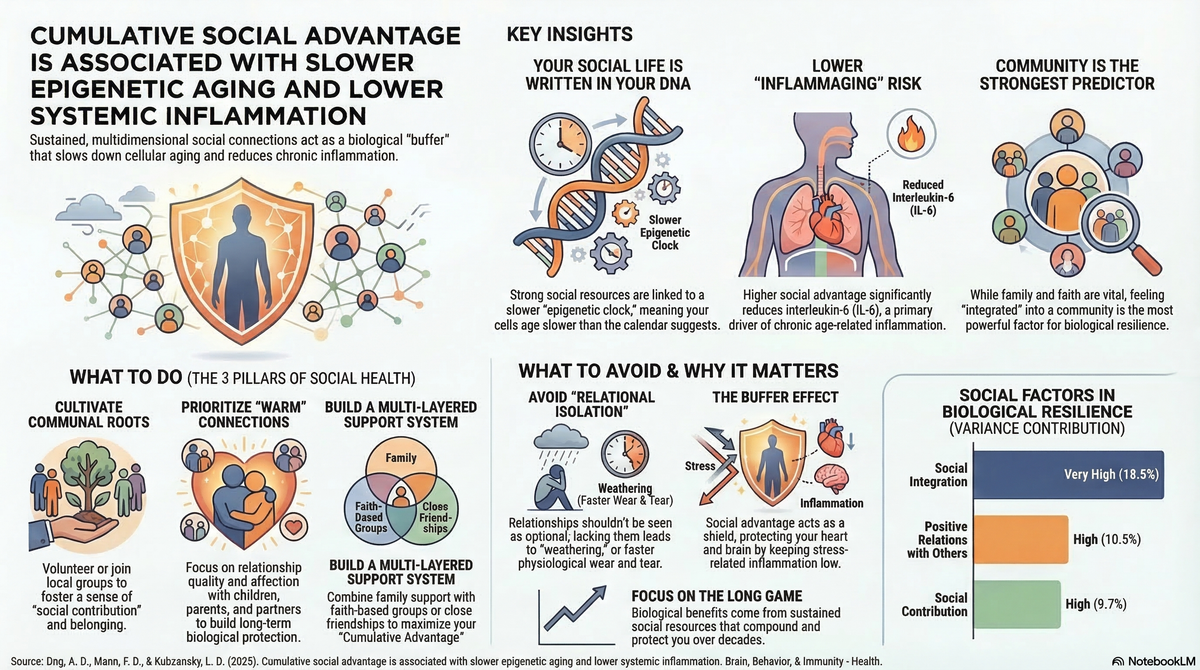
We often think of social support as just having a good spouse or a best friend. However, the researchers focused on a concept called "Cumulative Social Advantage" (CSA). This means having sustained, lifelong access to a wide variety of social resources. It is not just about intimate emotional support; it is a rich web that includes a loving family history, community engagement, and participation in faith-based or spiritual groups. The more diverse and layered your social connections are, the more they compound over time to protect your health, much like a diversified financial portfolio protects your wealth.
Practical Guidance:
- What to do: Diversify your social portfolio by actively participating in multiple spheres of life—such as family gatherings, neighborhood associations, and volunteer groups.
- What not to do: Don't rely on just one single person (like a romantic partner) to fulfill all of your social and emotional needs.
- Habit to change: Look at your weekly schedule and intentionally carve out time for a social circle you usually neglect, like calling an extended family member or attending a local community event.
Slowing Down Your Cellular Clock
The most astonishing finding of this research is that a strong social web physically slows down the aging process at a molecular level. Using highly advanced "epigenetic clocks"—which measure the wear and tear on your DNA to determine your true biological age—researchers found that people with high cumulative social advantage age significantly slower than their isolated peers. High-quality relationships literally pump the brakes on your body's physiological decline. If you have a rich social life, your cells are likely younger than the age listed on your driver's license.
Practical Guidance:
- What to do: Treat maintaining your friendships and community ties as a critical, non-negotiable part of your medical and physical healthcare routine.
- What not to do: Don't sacrifice your social life in the pursuit of "health"—like constantly skipping social dinners just to stick to a rigid sleep schedule or diet.
- Decision to change: View social outings not as a guilty indulgence, but as an active anti-aging treatment. Prioritize coffee dates and phone calls just as you prioritize taking your vitamins.
Friendship as an Anti-Inflammatory
If you follow health news, you have likely heard of "inflammaging"—the chronic, low-grade inflammation that naturally increases as we get older and drives major illnesses like heart disease and neurodegenerative decline. The study found that cumulative social advantage is robustly associated with lower levels of systemic inflammation, specifically a dangerous inflammatory marker called Interleukin-6 (IL-6). In simple terms, having a great social support system acts like a long-term anti-inflammatory drug for your entire body, cooling down the immune responses that cause chronic disease.
Practical Guidance:
- What to do: Lean into your social network when you are going through prolonged periods of stress, using human connection to naturally soothe your body's stress response.
- What not to do: Don't isolate yourself when you feel physically or mentally run down, as this isolation can actively drive up the very inflammation making you feel worse.
- Habit to change: Swap out one hour of solitary, stress-inducing activities (like scrolling through negative news) for an hour of active, positive engagement with a friend or community member.
The Surprising Value of the "Outer Circle"
When analyzing what makes up a protective social life, the researchers found something surprising: communal and relational indicators were the most powerful. Feeling integrated into your community, believing you have something valuable to contribute to society, and having generally positive relations with others accounted for the vast majority of the biological benefits. This means that the "outer circle" of your life—feeling like you belong to a neighborhood or a cause—is incredibly vital. You don't just need people to cry to; you need people to belong to.
Practical Guidance:
- What to do: Find a way to actively contribute your skills or time to your local community, ensuring you feel a sense of social value and integration.
- What not to do: Don't dismiss the health value of your "weak ties"—the brief, friendly interactions you have with neighbors, coworkers, or the local barista.
- Decision to change: Stop rushing through your public life with your headphones on. Start initiating small talk and engaging with the community around you to build your sense of social belonging.
Summary for Life
The research points to a profound and concrete life rule: To protect your body from the ravages of aging and disease, you must stop viewing your social life as a casual luxury, and start fiercely investing in a diverse web of family, friends, and community as your primary defense system.
Reflective Question: If your cellular age was determined entirely by the depth of your community involvement and the quality of your social connections, how old would your body be right now?
References
Anthony D. Ong, Frank D. Mann, Laura D. Kubzansky. "Cumulative social advantage is associated with slower epigenetic aging and lower systemic inflammation." Brain Behav Immun Health 2025 Sep 3:48:101096. doi: 10.1016/j.bbih.2025.101096.