The Time-Cost of Connection: Unpacking "How many hours does it take to make a friend?"
We have all experienced the frustration of trying to make friends as an adult. You meet someone great at a party or the office, share a few pleasant chats, but the deep connection you are looking for never seems to materialize. We often assume that true friendship relies on a magical "spark" that either happens instantly or does not happen at all.
But what if building a relationship is actually a highly predictable process? A fascinating look into the science of human bonding reveals that friendship is not just about having a great personality; it is about logging a specific amount of time and engaging in the right types of interactions. Here is what the science says about the literal math behind making friends, and how you can apply it to build your own social circle.
The Hourly Milestones of Friendship
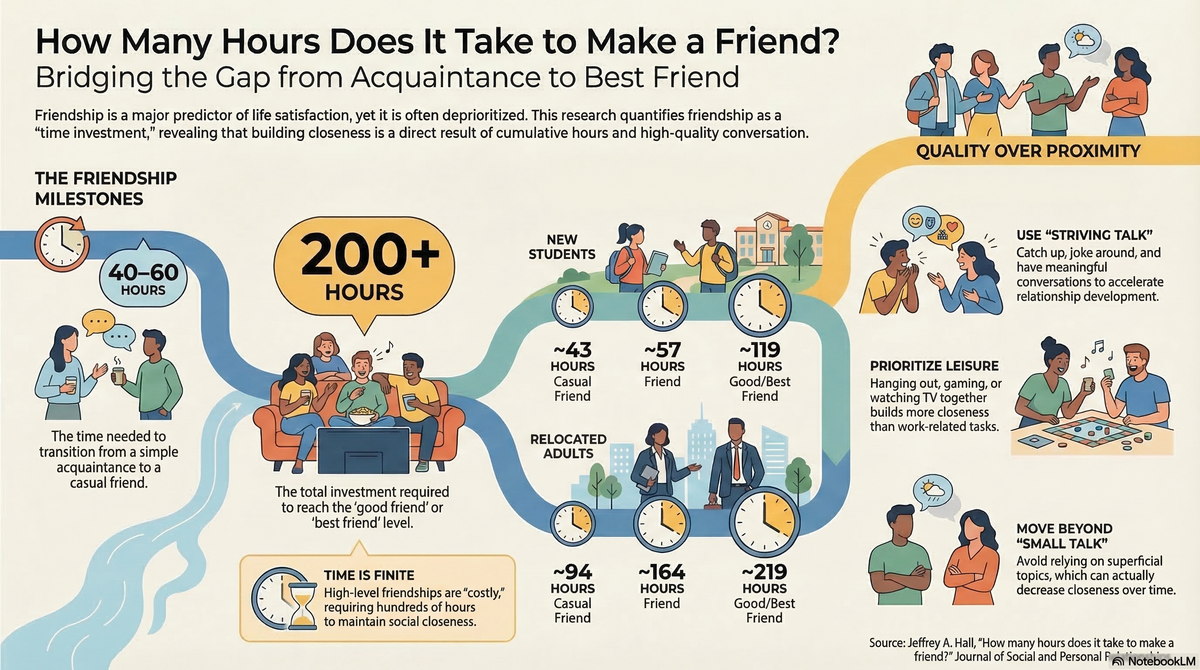
When we try to make friends, we often give up too quickly if we do not feel an immediate, deep bond. However, the research reveals that friendships level up through very specific hourly milestones. To transition an acquaintance into a casual friend, it takes roughly 40 to 60 hours of time spent together. To upgrade that casual relationship into a standard friendship, you must invest about 80 to 100 hours. And if you are looking to forge a deep, "good" or "best" friendship, you are looking at a serious commitment of 200 hours or more. Friendship is a literal investment of your daily life, requiring you to budget your limited free time strategically.
Practical Guidance:
- What to do: Be patient and intentionally log the hours. Recognize that you cannot shortcut the process of becoming close to someone.
- What not to do: Do not write off a potential new friend just because you do not feel like "best friends" after two short coffee dates.
- Habit to change: Stop relying on spontaneous meet-ups. Build recurring events into your schedule—like a weekly trivia night or a Sunday morning run—to effortlessly accumulate the hours required to build a bond.
The Office Doesn't Count
If friendship just takes time, you might assume you are automatically best friends with your coworkers, given you spend 40 hours a week together. Unfortunately, the science says otherwise. Time spent in "closed systems" like a workplace or a classroom does not reliably lead to interpersonal closeness. When interactions are obligatory, they do not satisfy our biological need to belong. To truly make a friend, you have to spend time engaged in mutual leisure activities, like hanging out, relaxing, or watching a movie. The relationship changes when both people voluntarily choose to spend their precious free time together.
Practical Guidance:
- What to do: Shift the context of your relationship. If you want to befriend a coworker, you must invite them to do something entirely unrelated to your jobs, outside of the office environment.
- What not to do: Do not assume that sitting in the same room or working on the same project automatically counts toward your "friendship hours."
- Decision to change: Make a deliberate choice to transition your acquaintances out of the environment where you met them. Invite them to your home or a local coffee shop just for the sake of hanging out.
Ditch the Small Talk
While putting in the hours is essential, what you actually say during those hours dictates whether the relationship will survive. We often rely on polite small talk to navigate new relationships, but the data shows a shocking reality: engaging in excessive small talk actually predicts a decrease in friendship closeness over time. To build a lasting bond, you must engage in "striving" communication. This means catching up on each other's daily lives, engaging in meaningful conversations, and joking around to release tension. Integrating someone into your daily life through playful and meaningful talk essentially fast-tracks the friendship process.
Practical Guidance:
- What to do: Pivot away from safe topics and start actively asking people about what is happening in their daily lives right now.
- What not to do: Do not rely on discussing the weather, sports scores, or mundane current events, as this keeps people at a superficial distance.
- Habit to change: Stop trying to be perfectly polite all the time. Allow yourself to joke around, be playful, and share real updates about your day to bridge the gap between acquaintance and friend.
Summary for Life
The deep truth of human relationships boils down to a single, concrete life rule: To build a thriving social circle, you must stop waiting for a magical spark and start intentionally investing your free time into shared leisure and deep, playful conversations.
Reflective Question: If you look at the newest acquaintance in your life, are you actively creating opportunities to log the required 50 hours of fun, meaningful time together, or are you just waiting for them to do the work?
References
Hall, J. A. How many hours does it take to make a friend? Journal of Social and Personal Relationships, 2019 36(4), 1278–1296