The Secret to Unstoppable Teams: Unpacking "Psychological Safety and Learning Behavior in Work Teams"
Have you ever sat in a meeting, realized a major flaw in a project, but stayed completely silent because you didn't want to look foolish? We have all been there. The fear of sounding incompetent, or being blamed for a mistake, can paralyze even the smartest people. But what happens when an entire team operates under that fear? Breakthrough research on team dynamics reveals the hidden force that separates thriving, innovative groups from those that stagnate and fail to adapt. It turns out that the most powerful tool for team success isn't necessarily having the smartest individuals—it is creating an environment where people aren't afraid to be human.
The Magic of Psychological Safety
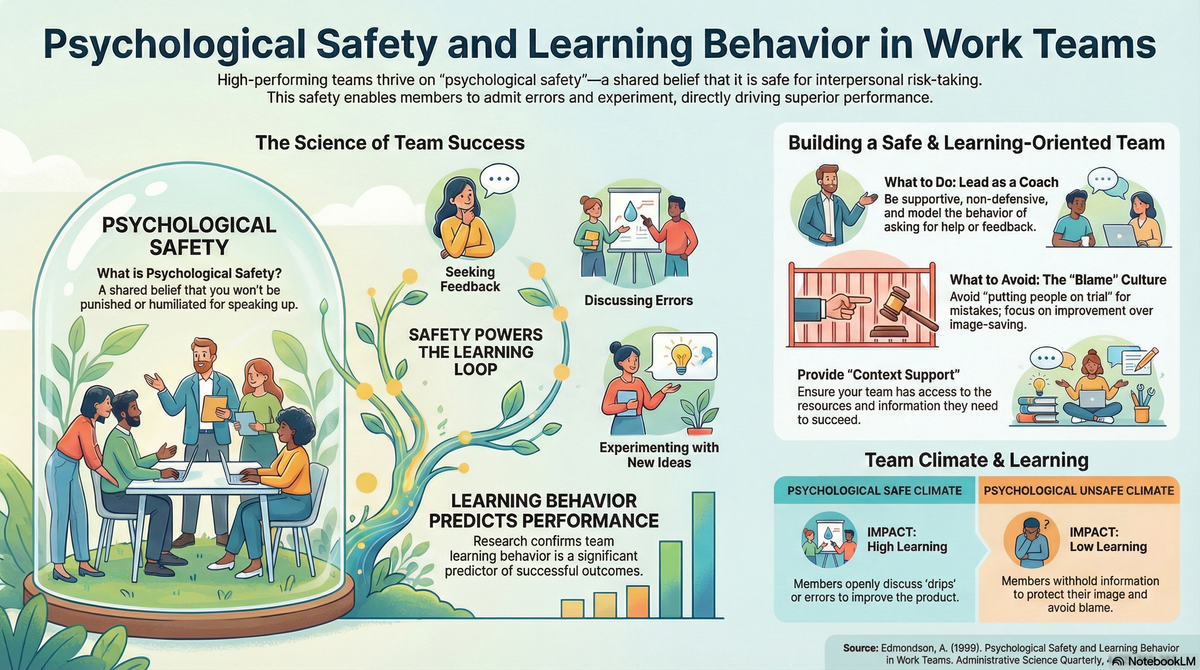
At the core of a highly effective group is a concept called "team psychological safety". This isn't just about people liking each other or being polite. It is a shared, deeply held belief that the team is a safe place to take interpersonal risks. When psychological safety is present, team members feel confident that they will not be embarrassed, rejected, or punished for speaking up, asking for help, or admitting a mistake. In environments that lack this safety, the fear of damaging one's image or career prospects causes people to suppress crucial information and conform to the status quo.
Practical Guidance:
• What to do: Assume positive intent when a coworker points out a flaw or gives you feedback; treat it as an attempt to make the work better, not as a personal attack.
• What not to do: Never punish, mock, or dismiss someone when they admit they don't know something or ask for help.
• Habit to change: When bad news is delivered, intentionally shift your reaction from "Whose fault is this?" to "How can we fix this together?".
Learning Behavior is How Teams Thrive
A team cannot adapt to changes or improve its results if it just keeps doing the same things on autopilot. To truly excel, teams must engage in "learning behavior"—a continuous cycle of asking questions, seeking feedback, experimenting, and openly discussing errors. However, these behaviors are inherently risky because they expose our vulnerabilities and imperfections. The research shows a powerful chain reaction: psychological safety gives people the courage to engage in these risky learning behaviors, and it is these learning behaviors that directly drive high performance. Confidence in the team's overall ability is great, but it is the feeling of interpersonal safety that actually gets people to open up and learn.
Practical Guidance:
• What to do: Actively seek out feedback from outside your immediate bubble, such as from customers, clients, or other departments.
• What not to do: Don't hide errors or unexpected outcomes to protect your reputation.
• Habit to change: Stop treating mistakes as failures. Start viewing them as vital data points and openly share them with your team to prevent others from making the same errors.
Leaders Set the Stage
You might think that a team just needs the right resources, clear goals, and good equipment to succeed. While having a supportive context is helpful, these structural factors primarily work because they help build psychological safety. A leader’s behavior is the most visible signal of a team's culture. When a team leader is supportive, acts as a coach, and responds non-defensively to challenges, it sends a clear message that the environment is safe. Conversely, an authoritarian or punitive leader quickly trains the team to keep their mouths shut and their heads down. Interestingly, teams with high psychological safety can often overcome poor resources or bad organizational design, whereas teams without it will struggle even if they have every structural advantage.
Practical Guidance:
• What to do: If you are a leader (or just a peer influencer), model vulnerability by asking the team for help or casually bringing up your own mistakes.
• What not to do: Don't rely solely on providing good tools or clear task assignments while ignoring the emotional and interpersonal climate of your team.
• Decision to change: Transition your leadership style from an authoritative "boss" who demands perfection, to a "coach" who encourages questions, invites challenges, and supports experimentation.
Summary for Life
The research leads us to a profound and concrete life rule: A successful team isn't one that never makes mistakes; it is one where mistakes are safe to discuss.
Reflective Question: If you made a critical error at work today, would your very first instinct be to hide it from your colleagues to protect yourself, or to bring it to them immediately so you could learn and fix it together?
References
Edmondson, A. (1999). Psychological safety and learning behavior in work teams. Administrative Science Quarterly, 44(2), 350–383.