The Price of Joy is Going Up: What "The increasing cost of happiness" Means for Your Wallet and Your Wellbeing
Have you ever felt like you are running on a financial treadmill, earning more than you did five years ago but somehow feeling less secure? You are not imagining things. For years, we have debated the age-old question: Can money buy happiness? The reality is that the answer is changing. A massive study evaluating the relationship between income and well-being has uncovered a hidden shift in our modern economy. Not only does the "price tag" of financial peace of mind exist, but it is actually getting more expensive.
Here is what the latest science tells us about the true cost of happiness, and how you can navigate it to build a richer life.
The Two Types of Happiness: Resumes vs. Reality
To understand how money affects us, we first have to understand that "happiness" isn't just one feeling. Researchers divide our well-being into two distinct categories: cognitive wellbeing and affective wellbeing. Cognitive wellbeing is basically your life satisfaction—how you evaluate your overall achievements and status when you step back and look at the big picture. Affective wellbeing, on the other hand, is your everyday reality—how much joy, stress, sadness, or energy you actually feel on a random Tuesday.
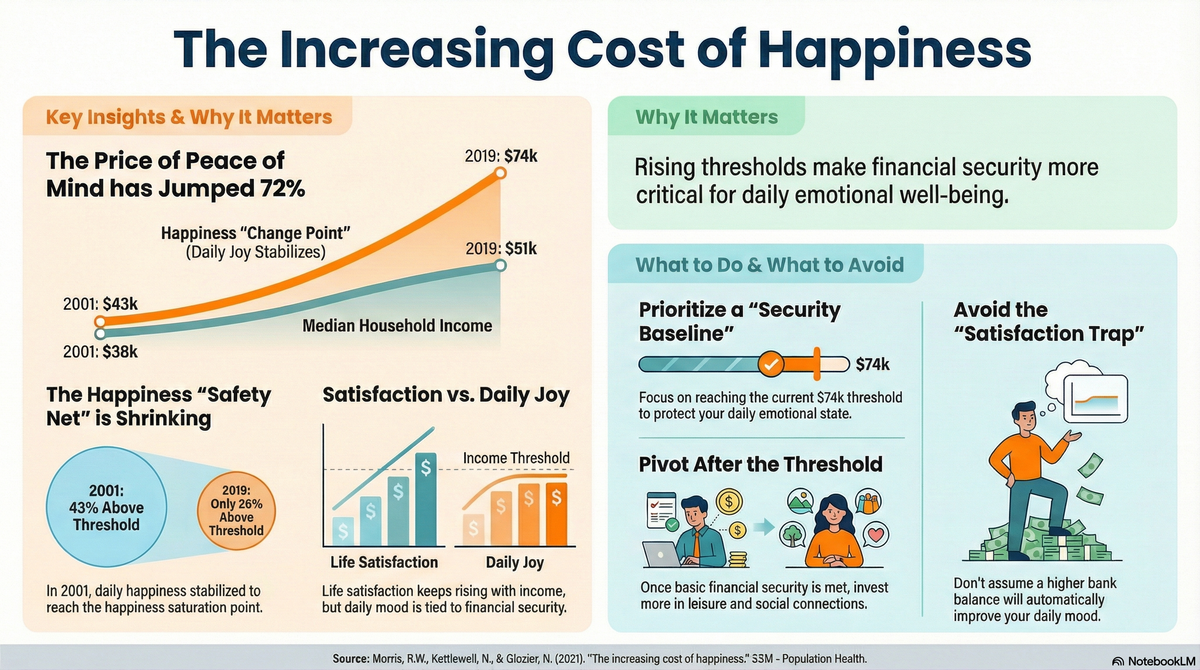
The research shows that money impacts these two types of happiness very differently. Your "big picture" life satisfaction will continually rise as your bank account grows. However, your daily, everyday joy behaves differently.
Practical Guidance:
• What to do: Get clear on which type of happiness you are chasing. Are you trying to boost your daily mood, or are you trying to build a resume of life achievements?
• What not to do: Don't confuse "looking successful" (cognitive) with "feeling happy" (affective).
• Habit to change: Audit your spending. Stop spending money on things that look good to others but do nothing to improve your actual, everyday mood.
The "Change Point" of Daily Joy
When it comes to your everyday, affective happiness, money is incredibly powerful—but only up to a certain point. For lower and middle-income individuals, every extra dollar significantly boosts daily joy by providing fundamental economic security and removing the stress of survival. However, the researchers identified a critical "change point". Once your income crosses this threshold, the happiness returns drastically diminish.
After you reach this change point, your daily joy is no longer heavily dependent on your income. Instead, further increases in your everyday happiness rely on completely different factors, like your social connections, your physical health, and your leisure time.
Practical Guidance:
• What to do: Recognize when you have crossed the threshold of basic economic security, and shift your focus toward non-financial investments like friendships and hobbies.
• What not to do: Don't sacrifice your relationships, sleep, or free time for a higher-paying job if you are already past the financial "change point."
• Decision to change: Treat your free time as your ultimate currency once your fundamental bills and savings are comfortably handled.
The Goalpost is Moving
Here is the most groundbreaking—and perhaps frustrating—insight from the study: the "cost of happiness" is rising. The income level required to hit that comfortable "change point" has increased significantly over the last two decades, outpacing both standard inflation and the growth of median wages.
What does this mean for everyday life? It means that a much larger portion of the population is now forced to tie their daily happiness to their financial struggles. Because the threshold for financial peace of mind has shot up, fewer people are reaching it. The gap in daily joy between the wealthy and the middle-class is widening simply because it costs much more today to buy the same level of stress-free living.
Practical Guidance:
• What to do: Give yourself some grace. If you feel like it is harder to reach a state of financial relaxation today than it was for previous generations, the math proves you are absolutely right.
• What not to do: Don't internalize structural economic shifts as personal failures.
• Habit to change: Since the financial goalpost for happiness is moving further away, actively double down on the free sources of daily joy—like community, nature, and gratitude—to bridge the gap that money is leaving behind.
Summary for Life
The research points to a concrete life rule: Because the financial cost of a stress-free life is mathematically rising, you must intentionally protect and cultivate non-financial sources of daily joy, rather than assuming your next raise will magically fix your mood.
Reflective Question: If the price tag for financial happiness keeps going up, what entirely free sources of joy can you invest your energy into today?
References
R.W. Morris, N. Kettlewell, N. Glozier. "The increasing cost of happiness." SSM - Population Health, vol. 16, 2021, 100949.