The Morning "Power Surge": How Your Body Reboots for the Day (A Deep Dive into "The Cortisol Awakening Response: Regulation and Functional Significance")
1. Introduction: The Mystery of the Morning "Grogginess"
We have all experienced it: the jarring sound of the alarm, the heavy limbs, and that foggy mental state known as Sleep Inertia (SI). In those first few moments of the day, it feels as though our internal systems are struggling to come online. However, beneath the surface, your body is executing a sophisticated biological reboot.
Your body does not simply "turn on" like a light switch. Instead, it relies on a precision-engineered internal alarm clock known as the Cortisol Awakening Response (CAR). The CAR is the biological antidote to sleep inertia—a rapid, potent energy injector that bridges the gap between the depths of sleep and the demands of your waking life.
2. What is the CAR? Understanding Your Daily Hormone Burst
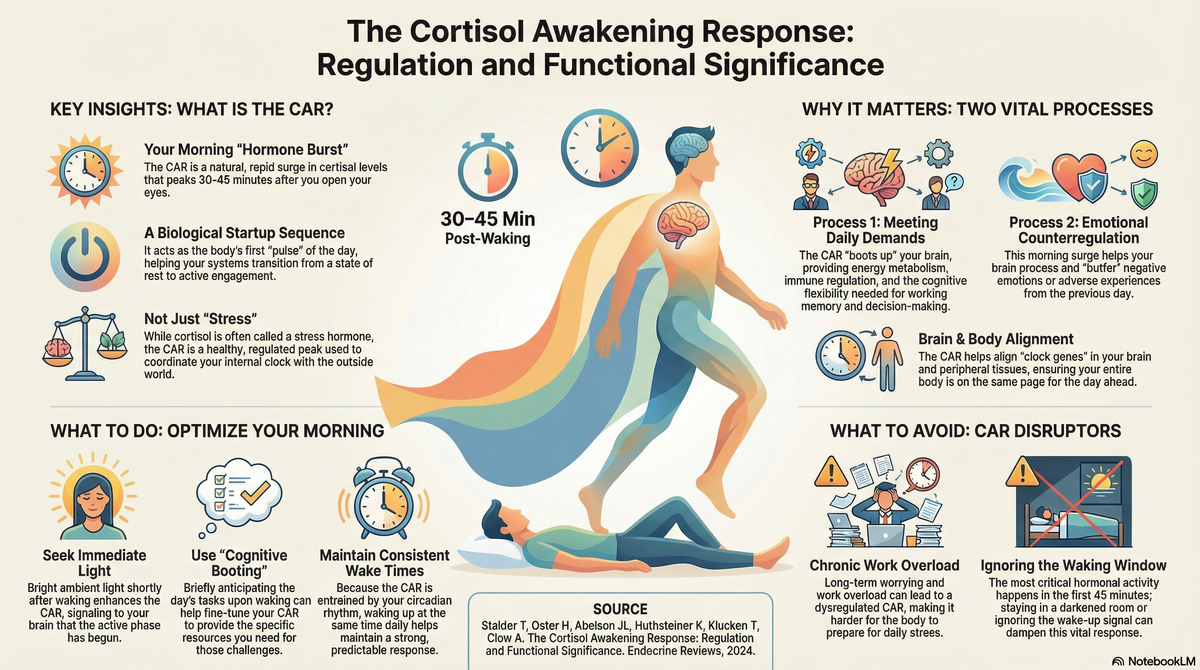
The Cortisol Awakening Response is a dramatic spike in cortisol levels that occurs within the first 30 to 45 minutes after you open your eyes. This isn't a subtle shift; in healthy individuals, cortisol levels jump by anywhere from 50% to 156% during this brief window. This surge represents the circadian peak—the single highest point of hormone concentration in your entire 24-hour cycle.
It is important to recognize the CAR as a "Unique Pulse." It isn't just a continuation of the hormone rise that happens while you sleep; it is a specific, awakening-triggered event. Think of it as the body’s first "ultradian pulse" of the active phase. Crucially, research shows this surge is driven by adrenal sensitivity rather than the typical "central drive" from the brain's pituitary gland. This means the CAR isn't a "stress response" in the negative, panicked sense; it is a healthy, adaptive surge designed to prepare your systems for the day ahead.
3. Process 1: Fueling Your Day (The Resource Mobilizer)
The primary role of the CAR is to meet "activity-related demands" by prepping your metabolic, immunological, and neurocognitive systems. But the CAR does more than just provide a quick spark. It operates through rapid nongenomic and slower genomic pathways.
In translational terms: the CAR doesn't just give you a temporary jolt; it actually triggers a "genomic reset," updating your body’s internal software by changing how your "clock genes" are expressed for the next 24 hours. This resource mobilization manifests in three vital areas:
- Energy Provision: Rapidly mobilizing glucose to fuel physical movement.
- Cognitive Functioning & Brain Plasticity: Beyond just "clearing the fog," the CAR supports neuroplasticity, essentially priming your brain to learn, adapt, and reshape itself throughout the day.
- Immune Regulation: Priming the body's defenses to ensure your immune system is ready for environmental challenges.
4. Process 2: The Emotional Reset Button (Counterregulating Yesterday)
Beyond physical fuel, the CAR serves as an emotional counterregulation tool. This is your biological "reset button" for the soul.
The research suggests that a healthy morning hormone burst helps the organism deal with "adverse prior-day emotional experiences." If you had a stressful or draining yesterday, a robust CAR helps "reset" your affective state (your mood and emotional baseline). It ensures that yesterday’s emotional "hangover" doesn't dictate your resilience today.
5. What Controls the Surge? The Dual-Control System
The CAR is managed by an intricate Dual-Control System that harmonizes your internal biology with the external world. Your body doesn't just react to the clock; it synthesizes two streams of information:
- Internal Processes (Circadian & Neurocognitive): Your internal "master clock" sets the foundation, while your affective state and cognitive anticipation of the day’s obligations act as a pre-set, scaling the size of the burst before you even move.
- External Factors (Environmental): Light exposure acts as the primary trigger. Morning light levels signal the adrenal glands to execute the surge that the internal system has prepared.
6. Actionable Habits: How to Optimize Your Morning Power Surge
To work with your biology rather than against it, follow this Morning Optimization Checklist designed to support your genomic reset:
The "Do" List
- Seek Immediate Light: Step outside or get into a brightly lit environment immediately upon waking. Light is the direct signal your adrenal glands need to trigger the pulse.
- Maintain a Consistent Wake Time: Consistency helps your master clock predict the start of the active phase, ensuring the CAR happens at the optimal circadian amplitude.
- Prime Your "Affective State": Because your CAR is influenced by cognitive anticipation, taking a moment to mentally frame your day with a sense of purpose helps your body scale the necessary resources.
The "Don't" List
- Never "Snooze" the Alarm: The CAR is an awakening-entrained pulse. By snoozing, you disrupt the synchronization between the act of waking and the hormonal surge, leading to a fragmented "reboot" and prolonged grogginess.
- Avoid the "Dark Start": Staying in a dark room for the first 30 minutes stifles the adrenal response. Your first 45 minutes are the most critical window for your entire day's hormonal health.
7. Summary: Your Daily Life Rule
If you want to master your energy and emotional resilience, you must respect the bridge between sleep and wakefulness.
The Life Rule: Respect the first 45 minutes of your day; your biology is performing a genomic update and an emotional reset to build the bridge between sleep and success.
How will you change your morning environment tomorrow to support your body's natural "power surge"?
8. References
- Stalder, T., Oster, H., Abelson, J. L., Huthsteiner, K., Klucken, T., & Clow, A. (2024). The Cortisol Awakening Response: Regulation and Functional Significance. Endocrine Reviews. https://doi.org/10.1210/endrev/bnae024