
The Hidden Cost of Being Broke: Why "Poverty Impedes Cognitive Function" Matters for Your Mind
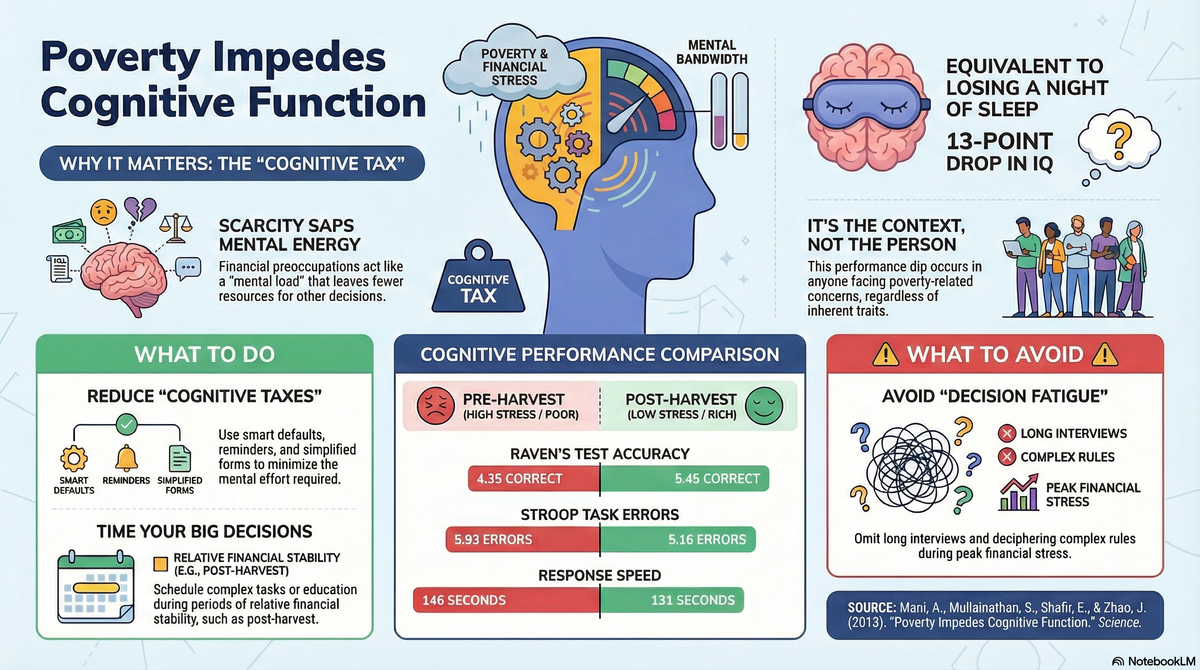
Ever get hit with an unexpected bill—like a massive car repair—and suddenly find yourself forgetting your keys, snapping at your family, or completely zoning out at work? You aren't just distracted; your brain is literally running out of processing power. We often judge people who are struggling financially for making counterproductive choices, assuming it is a character flaw or a lack of effort. But a landmark study reveals a much more biological truth: the sheer mental effort of juggling bills actively diminishes your brainpower.
Here is what the science says about how money worries hijack your mind, and how you can protect your cognitive resources.
The "Mental Bandwidth" Tax
The human cognitive system has a strictly limited capacity. When you are preoccupied with pressing budget concerns, your brain acts like an air traffic controller fixated on a single potential collision—you simply lose the capacity to give other problems in your life your full attention. This phenomenon is known as "attentional capture". It means your mind is so full of financial problem-solving and intrusive thoughts that there is literally less mental space left for everyday logic, memory, or self-control.
Practical Guidance:
• What to do: Automate your finances as much as possible to reduce the daily mental load of making money decisions.
• What not to do: Don't try to tackle complex, unrelated problems (like negotiating a work conflict or helping a child with difficult homework) immediately after dealing with a stressful financial hurdle.
• Habit to change: Build a small "buffer" in your budget if possible, not just for financial safety, but to protect your daily mental bandwidth from the exhausting friction of calculating every single penny.
A Sleepless Night for Your Brain
The cognitive toll of financial worry is staggering. The research found that triggering intense financial concerns causes a drop in cognitive function comparable to losing an entire night of sleep. In intelligence terms, the burden of poverty can temporarily drop a person's working IQ by roughly 13 points. This highlights a crucial shift in perspective: being poor does not mean a person is inherently less capable; rather, the very context of poverty imposes a heavy load that actively impedes their natural cognitive capacity.
Practical Guidance:
• What to do: Give yourself (and others) grace when facing financial hardship; recognize that your brain is operating under a severe, temporary handicap.
• What not to do: Don't make permanent life choices or sign complex contracts when you are in a state of acute financial panic. Your brain is metaphorically exhausted.
• Decision to change: Treat intense financial stress as a physical impairment, just as you would treat extreme sleep deprivation. Rest your mind before making major commitments.
The Danger of "Cognitive Taxes"
Because financial stress drains cognitive resources, any additional complicated tasks become overwhelmingly difficult. The researchers highlight the danger of "cognitive taxes"—everyday hurdles like filling out long, confusing forms, deciphering complex rules, or navigating bureaucracy. Furthermore, our brainpower naturally fluctuates depending on our financial cycle; people show significantly better cognitive performance right after they receive a major influx of income compared to the highly constrained period right before it.
Practical Guidance:
• What to do: Schedule your most demanding mental tasks, such as filling out complex paperwork, applying for programs, or taking a test, for the days immediately after you get paid, when your cognitive capacity is naturally restored.
• What not to do: Don't procrastinate on complex administrative tasks until the end of the month when your funds—and your mental bandwidth—are running low.
• Habit to change: Simplify your life admin. Use "smart defaults," calendar planning prompts, and automated reminders wherever you can to avoid unnecessarily taxing your brain when you are already under pressure.
Summary for Life
The research points to a concrete life rule: Because worrying about money actively drains your brainpower, you must aggressively protect your mental bandwidth by simplifying your daily decisions and timing your biggest life choices for the moments you feel financially secure.
Reflective Question: If acute financial stress costs your brain the equivalent of a sleepless night or 13 IQ points, what complex decisions are you forcing yourself to make while your mind is secretly running on empty?
References
Anandi Mani, Sendhil Mullainathan, Eldar Shafir, Jiaying Zhao. "Poverty Impedes Cognitive Function." Science 2013 Aug 30;341(6149):976-80. doi: 10.1126/science.1238041