Stop Arguing and Start Listening: Life-Changing Lessons from "Difficult Conversations: How to Discuss What Matters Most"
Have you ever walked away from a conversation with a coworker, partner, or family member feeling completely misunderstood and frustrated? You probably replayed the argument in your head, thinking about all the brilliant points you made and wondering why the other person was being so incredibly stubborn. We face difficult conversations every day—from asking for a raise to confronting a friend—yet most of us feel woefully unequipped to handle them without someone getting hurt.
The groundbreaking book "Difficult Conversations: How to Discuss What Matters Most" reveals the hidden mechanics of our toughest dialogues. It turns out that resolving conflicts isn't about finding better words; it is about shifting our entire mindset. Here is a breakdown of the core insights that can help you transform your most stressful interactions into moments of genuine connection.
The Myth of the "One Truth"
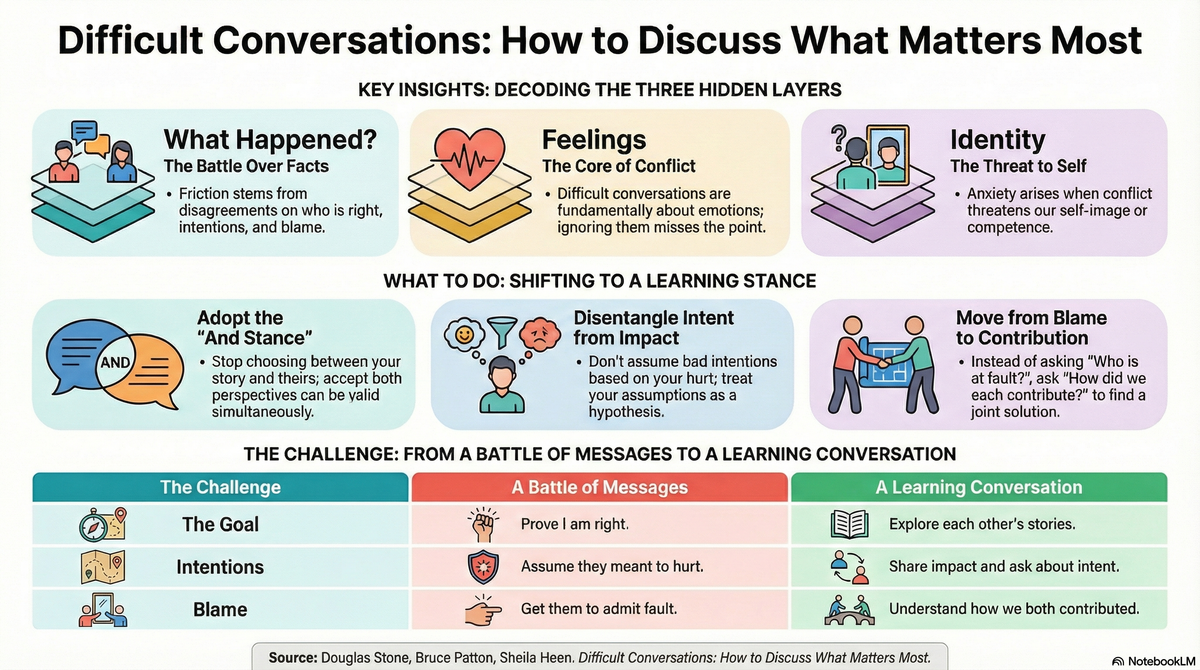
When an argument breaks out, we usually operate on one crippling assumption: I am right, and you are wrong. However, difficult conversations are almost never about getting the objective facts right; they are about conflicting perceptions, interpretations, and values. Because we all take in different information and interpret it through the lens of our unique past experiences, we literally see the world differently. When we argue, we are simply trading conclusions back and forth without ever understanding the underlying story that makes the other person's view make perfect sense to them.
Practical Guidance:
• What to do: Shift your goal from persuading the other person to exploring their story. Ask questions to understand how they are making sense of the situation.
• What not to do: Don't assume that because your view makes sense, the other person's view is irrational or selfish.
• Habit to change: Stop delivering a "message" and start having a "learning conversation" where both of you act as curious investigators trying to figure things out together.
The Intention Trap: Separating Intent from Impact
One of the most destructive mistakes we make in relationships is assuming we know what another person intended. When someone does something that hurts us, we automatically assume they meant to hurt us. Ironically, we treat ourselves much more charitably; if we snap at a colleague, we blame our stress, but if they snap at us, we assume they have a bad character. Furthermore, when we are the ones accused of hurting someone, we mistakenly believe that explaining our "good intentions" should magically make the other person's pain go away. Good intentions do not sanitize a bad impact.
Practical Guidance:
• What to do: Disentangle the actual impact their behavior had on you from your assumption about their intentions. Treat your assumption as a guess, not a fact.
• What not to do: If someone tells you they are hurt by your actions, do not immediately jump to defending your good intentions.
• Decision to change: Start difficult conversations by acknowledging the other person's feelings first. Listen past their accusation to hear their hurt, and address that emotion before you try to clarify your intent.
Ditch the Blame Game for Contribution
When things go wrong, our natural instinct is to play blame roulette: we want to pinpoint exactly whose fault it is so we can punish them. But talking about fault produces intense disagreement, denial, and fear, because nobody wants to be the "bad guy". The reality of almost any conflict is that both people contributed to the mess. Shifting your focus from blame (who is at fault?) to contribution (how did our actions interact to produce this result?) allows you to identify the real causes of the problem and actually fix them.
Practical Guidance:
• What to do: Look at the situation as a system. Ask yourself, "What did I do, or fail to do, that helped create this problem?".
• What not to do: Don't waste energy trying to corner the other person into admitting fault.
• Habit to change: Replace the question "Who is to blame?" with "How did we both contribute to this outcome, and how can we correct it going forward?".
The Hidden Identity Crisis
Every difficult conversation is actually three conversations happening at once: the debate over what happened, the emotional struggle of feelings, and the "Identity Conversation". The Identity Conversation is the silent debate happening in your own head about what the situation means about you. Are you a good person? Are you competent? Are you lovable?. When a conversation threatens our self-image—like realizing we made a foolish mistake or having to deliver bad news—we lose our balance, panic, and become incredibly defensive.
Practical Guidance:
• What to do: Recognize that your anxiety is often tied to your self-image. Accept that you are complex—you can have good intentions and still hurt someone, or make a mistake and still be competent.
• What not to do: Don't fall into the trap of an "all-or-nothing" self-image where you are either a perfect hero or a complete villain.
• Habit to change: Before entering a tense discussion, pause and ask yourself what is at stake for your identity. Building a more complex self-image will help you maintain your balance when the conversation gets rocky.
Summary for Life
The research leads to a powerful, concrete life rule: Stop trying to win the battle of who is right, and instead become deeply curious about the hidden stories, accidental impacts, and vulnerable emotions that both you and your partner are bringing to the table.
Reflective Question: The next time you are absolutely certain someone is being irrational or malicious, can you pause and ask yourself: "What information do they have that I am missing, and how might my own actions have contributed to this exact moment?"
References
Douglas Stone, Bruce Patton, and Sheila Heen. "Difficult Conversations: How to Discuss What Matters Most."