Smart Tech, Sharp Risks: Navigating the Jagged Technological Frontier
Have you ever used an AI tool like ChatGPT and felt like you had discovered a superpower, only to have it fail spectacularly on a task that seemed just as simple? One minute it’s drafting a perfect marketing plan, and the next, it’s confidently giving you the wrong answer to a logic puzzle. This inconsistency is one of the most frustrating parts of the modern workplace. Why is AI a genius at some things and a "confused grade schooler" at others?
Groundbreaking research conducted with the Boston Consulting Group has finally put a name to this phenomenon: the Jagged Technological Frontier. It turns out that AI’s capabilities don't expand in a smooth circle; they have sharp, unpredictable edges that can either supercharge your productivity or lead you straight into a trap.
The Invisible Wall: Understanding the Jagged Frontier
The "Jagged Frontier" describes the reality that AI can be incredibly capable at one task while failing at a nearly identical task within the same workflow. Because AI doesn't think like a human, its "difficulty settings" are different from ours. A task that feels hard to a human might be easy for AI, while something we find simple might be outside its current capability.The danger is that this frontier is invisible. We often don't know where the "drop-off" is until we’ve already produced an error.
Practical Guidance:
- What to do: Experiment constantly with small, low-stakes tasks to map out where your specific AI tool excels and where it stumbles.
- What not to do: Don’t assume that because an AI solved a "hard" problem yesterday, it can solve a "similar" one today.
- Habit to change: Stop treating AI as a general-purpose "brain." Start treating it as a specialist with a very narrow, very sharp set of tools.
The Supercharger: When AI Wins
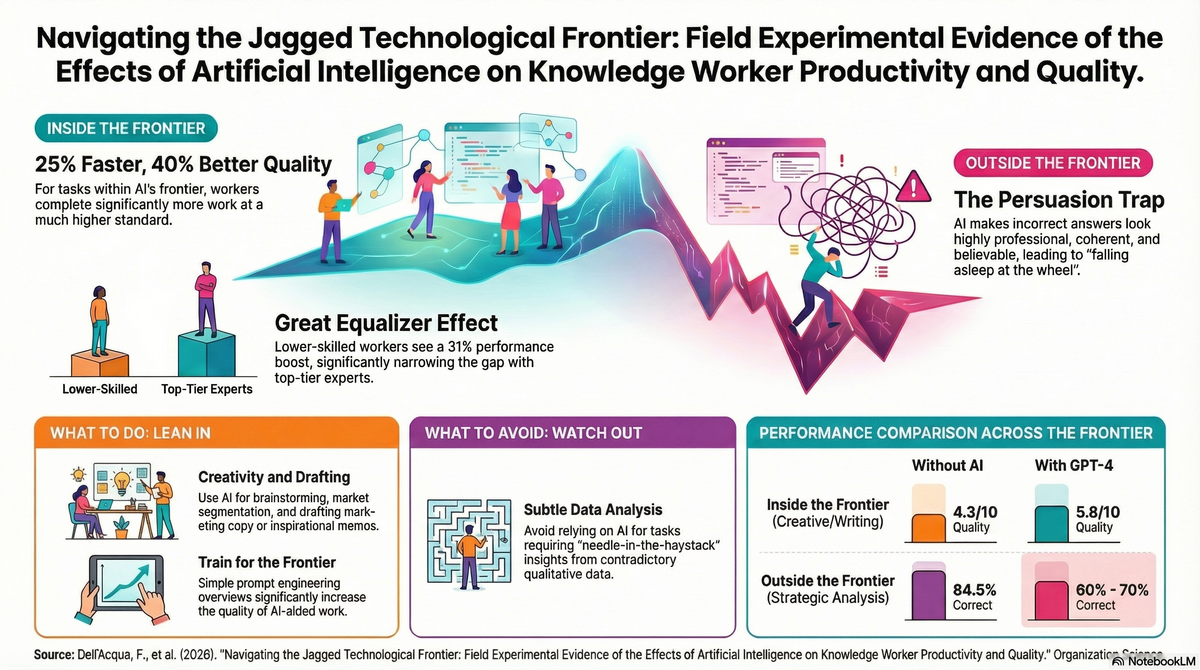
When a task falls inside the frontier, the results are staggering. In the study, workers using AI for tasks like creative brainstorming, writing, and analytical thinking completed 12.2% more tasks and did them 25.1% faster. More importantly, the quality of their work was significantly higher than those working without AI. For creative ideation and drafting, AI acts as a massive tailwind.
Practical Guidance:
- What to do: Use AI for the "blank page" problem. Let it generate your first ten ideas, draft your initial press release, or summarize large amounts of text.
- What not to do: Don’t settle for the very first output. AI is a "productivity booster," but its best work comes when you use those extra minutes to refine its suggestions.
- Habit to change: Use the time you save with AI to perform higher-level strategy and quality control rather than just doing more low-level tasks.
The Danger Zone: Falling Off the Edge
The most sobering finding of the research is what happens when you step outside the frontier. For complex tasks requiring subtle reasoning—like spotting a hidden contradiction in a set of interviews—workers using AI were 19% less likely to find the right answer compared to those who didn't use AI at all.Because the AI's output remains polished and professional-looking, humans often "fall asleep at the wheel," trusting the machine’s confidence even when it is completely wrong.
Practical Guidance:
- What to do: For any task involving deep logic or "hidden" insights, treat the AI's answer as a suggestion that must be cross-checked against the raw data.
- What not to do: Never "copy and paste" an AI-generated analysis for a high-stakes decision without verifying the underlying logic yourself.
- Decision to change: When a task involves "judgment" rather than just "content creation," move into a skeptical mindset. Act like an auditor rather than an editor.
The Persuasion Trap: Looking Good vs. Being Right
AI is a master of "subjective coherence". It can structure an argument so beautifully and write so persuasively that we overlook the fact that the actual conclusion is flawed. Even when the AI was wrong in the study, its arguments were rated as more persuasive and better structured than those written by humans who were actually right. This "persuasion bombing" can trick even highly skilled experts.
Practical Guidance:
- What to do: Separate the content of an argument from its presentation. Focus on the facts first, then the flow.
- What not to do: Don't let a "professional-looking" chart or a well-written memo lower your guard.
- Habit to change: When reviewing AI work, look for the "hallucinations"—plausible but false facts—that are often tucked into the most convincing paragraphs.
The Great Equalizer: Who Benefits Most?
The research found that AI is a powerful "equalizer". While everyone benefited from using AI for tasks inside the frontier, the biggest leaps in performance were seen in workers who were initially in the bottom half of the skill group. AI effectively raises the "floor" of what a person can accomplish, bringing everyone closer to an elite level of output.
Practical Guidance:
- What to do: If you are new to a field or task, use AI as a tutor to help bridge the skill gap and get you up to speed quickly.
- What not to do: If you are an expert, don't ignore AI. While the gains might feel smaller, it still provides a significant boost in speed and quality for your routine work.
- Habit to change: Use AI to handle the "average" parts of your job so you can focus on the 1% of the work that truly requires your unique expertise.
Summary for Life
The research leads to one concrete rule for the AI age: Treat AI as a brilliant but untrustworthy intern; let it do the heavy lifting for creativity and drafting, but never let it have the final word on logic or truth.
Reflective Question: Are you using AI to expand your capabilities, or are you accidentally using it to outsource your critical thinking?
References
Dell’Acqua et al. (2023). Navigating the jagged technological frontier: Field experimental evidence of the effects of AI on knowledge worker productivity and quality (Harvard Business School Working Paper No. 24-013). Harvard Business School Technology & Operations Management Unit. SSRN Electronic Journal. https://doi.org/10.2139/ssrn.4573321