More Important Than Your Gym Routine: Insights from "Social Relationships and Mortality Risk: A Meta-analytic Review"
We spend a massive amount of energy tracking our steps, counting our calories, and debating the merits of different vitamins. We’ve been taught that physical health is a solo mission—something we achieve through personal discipline in the kitchen and at the gym. But what if the most important thing you can do for your longevity has nothing to do with your treadmill and everything to do with your phone book?
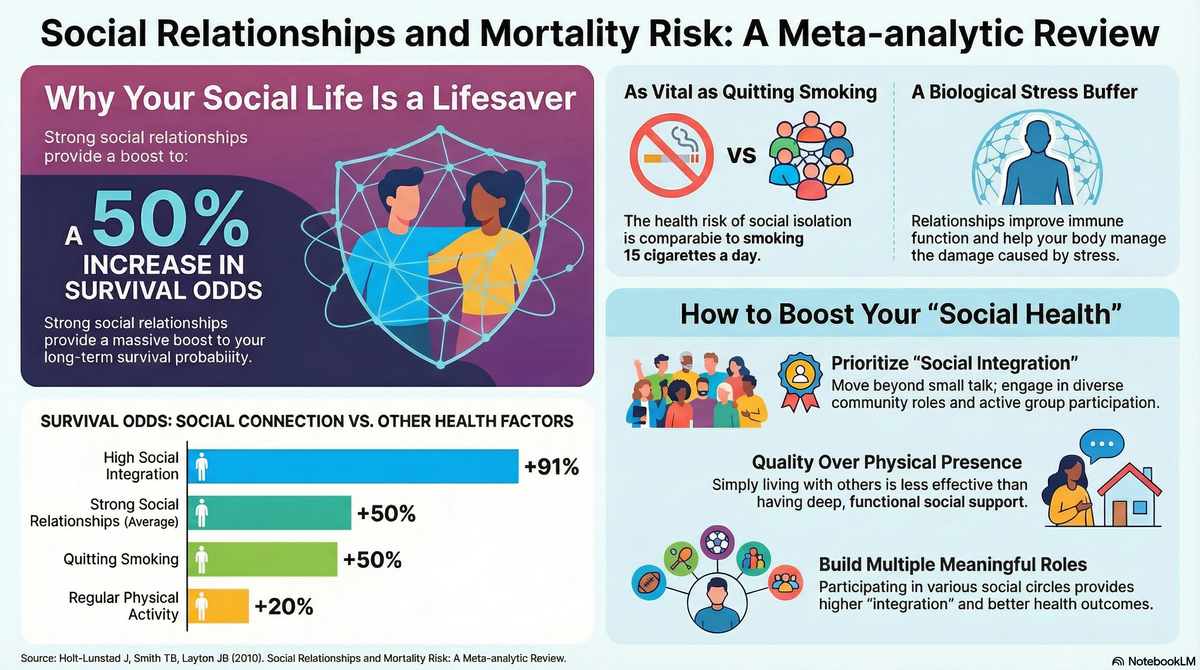
A monumental review of health data involving over 300,000 people has confirmed that our social lives are a literal matter of life and death. The research proves that high-quality relationships don't just make us feel good; they are a fundamental requirement for human survival.The 50% Survival AdvantageThe most striking insight from the research is that people with strong social relationships have a 50% greater likelihood of survival compared to those with weak or insufficient social ties. This finding held true regardless of age, sex, or initial health status. Essentially, having a robust social circle is like having a biological shield that protects your body from a wide range of health threats.
Practical Guidance:
- What to do: Treat social time as a non-negotiable health appointment.
- What not to do: Do not view spending time with friends as a "guilty pleasure" or something to do only after your work and chores are finished.
- Habit to change: Shift your perspective from viewing relationships as an emotional luxury to seeing them as a physical necessity for a long life.
Loneliness: A Risk Greater Than Obesity
We are currently facing a social epidemic where isolation is becoming the "new normal." The researchers found that the health risks associated with a lack of social connection are comparable to well-established risk factors like cigarette smoking. Even more surprisingly, social isolation is a more significant predictor of early death than physical inactivity or even obesity.
Practical Guidance:
- What to do: If you are feeling isolated, take proactive steps to "re-socialize," just as you would start a diet if you were trying to manage your weight.
- What not to do: Don't ignore the feeling of loneliness. Your brain uses that feeling as a biological alarm to tell you that your health is in danger.
- Decision to change: Make the decision to prioritize social integration over solitary entertainment, like choosing a community class over a night of solo streaming.
It’s Not Just Who You Live With
Many people assume they are "covered" socially because they live with a partner or family. However, the study found that simple indicators—like whether you live alone—are the least predictive of your actual health. What matters most is "complex social integration." This means being part of a broad range of social ties, having active roles in your community, and feeling a sense of identification with your social groups. It’s not about the number of people in your house, but the depth and variety of your social roles.
Practical Guidance:
- What to do: Diversify your social life. Aim to have roles in different "pockets" of society, such as a volunteer group, a sports team, or a professional organization.
- What not to do: Don't rely on just one person (like a spouse) to satisfy all of your social needs; that single point of failure is risky for both of you.
- Habit to change: Stop treating "networking" as just a career tool. Use it as a health tool to build a wider, more protective social web.
How Friends Keep You Physically Healthy
How do relationships actually keep you alive? The science points to two pathways. First, friends act as a "stress buffer," providing emotional or tangible resources that help you handle life's hardships without your body suffering the full blow of chronic stress. Second, being part of a group naturally encourages healthy behaviors; friends model good self-care and give you a sense of purpose and self-esteem that motivates you to stay alive.
Practical Guidance:
- What to do: Be open with your inner circle when you are struggling. Allowing them to support you is a biological intervention that protects your heart and immune system.
- What not to do: Don't isolate yourself when you are stressed or sick. That is the moment your body needs the biological "buffering" of others the most.
- Decision to change: Surround yourself with people who prioritize health, as you are biologically wired to conform to the healthy norms of your social group.
Summary for Life
The research points to a profound and concrete life rule: Human connection is not a luxury; it is a biological requirement for survival. To live a long and healthy life, you must protect your social connections as fiercely as you protect your physical fitness.
Reflective Question: If you treated your weekly social interactions like a gym membership for your longevity, how many "reps" of connection have you completed this week?
References
Holt-Lunstad, J., Smith, T. B., & Layton, J. B. Social Relationships and Mortality Risk: A Meta-analytic Review. PLoS Medicine, 2010 7(7), e1000316.