
Men and Body Image: The Science Behind a Hidden Struggle Most Men Never Talk About
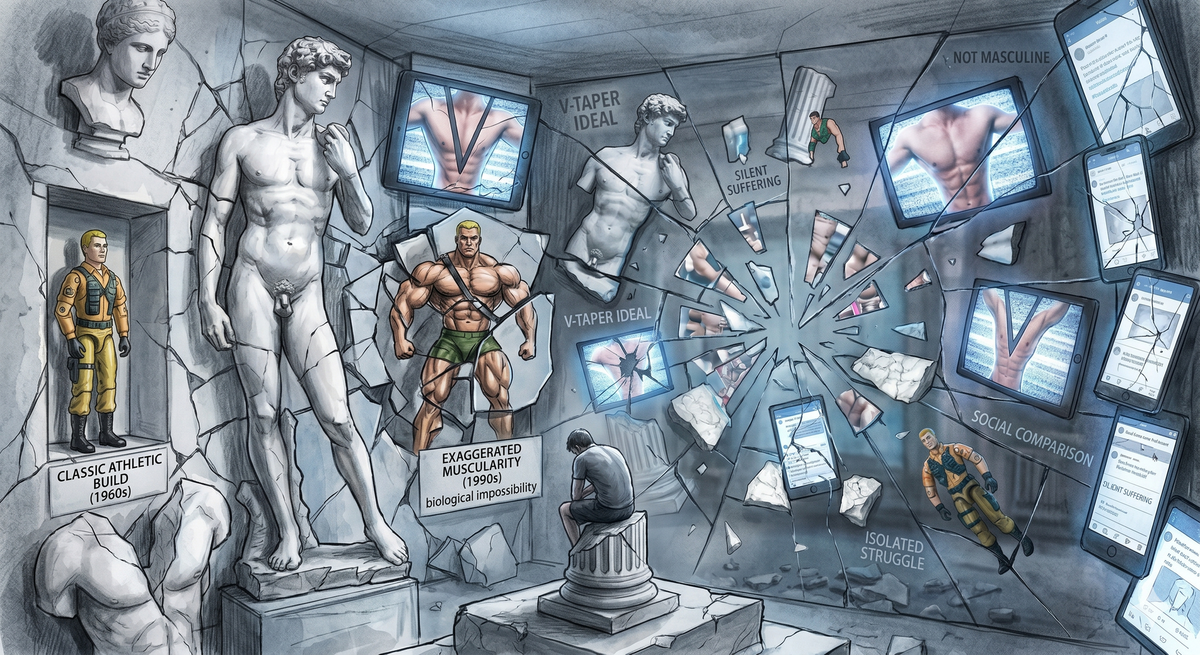
Up to 85 percent of men report dissatisfaction with their muscularity. Nearly 28 percent regularly struggle with their body image. Between 25 and 40 percent of all eating disorder cases are male. And yet the conversation about body image in mainstream culture remains almost exclusively female. This is not because men are not affected. It is because they have been largely told — directly and indirectly — that their appearance concerns are not valid, not masculine, and not worth naming.
The Lean, Muscular Ideal: What Men Are Measured Against
While women have long faced the pressure of the “thin ideal,” men operate under a different but equally demanding standard: the lean, muscular physique. The ideal male body, as constructed by advertising, entertainment, sports culture, and increasingly social media, centers on a V-shaped torso with low body fat and high visible muscle definition. It is simultaneously lean and large — a combination that, for most men, requires genetics, extreme training, and often pharmaceutical assistance to achieve.
How the Ideal Has Shifted Over Decades
The intensification of male body ideals tracks closely with the growth of visual media. Researchers who have studied the evolution of male action figures and movie characters have documented a steady progression toward more exaggerated muscularity. The G.I. Joe action figure of the 1960s had a physique consistent with a healthy athletic build. By the late 1990s, the equivalent figure had bicep measurements nearly impossible to achieve naturally. What had been an achievable aspiration became a biological impossibility dressed up as the cultural norm.
Social Media and the Acceleration of Comparison
If film and advertising created the ideal, social media has democratized and accelerated it. Fitness influencers on Instagram and TikTok provide a constant stream of idealized male physiques, often without disclosure of the interventions used to achieve them. Research has documented that even brief exposure to idealized social media imagery is associated with increased body dissatisfaction in male viewers. The mechanism is the negative contrast effect — a pattern where upward social comparison triggers an exaggerated sense of personal inadequacy.
Silence and the Limits of Masculinity
Perhaps the most significant barrier to addressing male body image is the cultural rules that prevent men from talking about it. Masculine identity in most Western contexts is built on emotional restraint, confidence, and the appearance of effortless self-possession. The messages men receive — explicitly and implicitly — that effectively shut down conversation about body image include:
- The belief that real men do not worry about their appearance
- Equating appearance concern with vanity or femininity
- The suppression of vulnerability as a cultural default
- A lack of male-specific language and support frameworks for these experiences
The result is that many men experiencing significant body-related distress have never named it, never discussed it with friends or partners, and never sought professional help. They are not not-suffering. They are suffering in isolation.
How Body Dissatisfaction Shows Up in Men's Behavior
Because men rarely speak directly about body image concerns, the distress tends to surface through behavior rather than language. Recognizing these patterns is key to understanding the real prevalence of the issue.
Excessive Exercise and Disordered Eating
For many men, body dissatisfaction manifests as compulsive exercise — training through injury, refusing rest days, experiencing significant anxiety when unable to work out. Research estimates that 25–40% of all eating disorder cases are male, yet men with eating disorders are four times more likely to remain undiagnosed than women. This gap exists partly because eating disorder screening tools were designed and validated on female populations, and partly because men are far less likely to identify their behaviors as a problem.
Muscle Dysmorphia: The Invisible Disorder
One of the most distinctly male body image disorders is muscle dysmorphia — sometimes called “reverse anorexia” — in which a person perceives themselves as small and insufficiently muscular despite being objectively large and well-developed. It is classified as a subtype of body dysmorphic disorder (BDD), and research suggests that up to 25% of all BDD cases are male. The person with muscle dysmorphia may spend four to six hours per day exercising, refuse to miss gym sessions even when injured, and use anabolic steroids despite known health risks.
Avoidance and Social Withdrawal
For many men, body shame produces a pattern of quiet avoidance: declining invitations to swimming pools, avoiding physical intimacy, wearing loose clothing regardless of weather, and refusing to be photographed. These are not dramatic behaviors — they are low-level, persistent adjustments that quietly shrink the life available to someone.
Higher-Weight Men and Appearance Stigma
While much of the research on male body image focuses on the drive for muscularity, a significant portion of men experience a different form of body distress: the stigma associated with higher body weight. Larger-bodied men face a compound burden — they are measured against a lean, muscular ideal while also navigating weight stigma in healthcare, workplaces, and social environments. Research documents that weight stigma in men is associated with higher rates of depression, lower self-esteem, and increased avoidance of healthcare out of fear of judgment.
Men's Body Image and Emotional Well-Being
The research on mental health consequences of male body dissatisfaction is consistent and concerning. Studies have documented meaningful correlations between male body image concerns and a wide range of psychological outcomes. Mental health outcomes linked to male body dissatisfaction include:
- Depression — with correlation coefficients of r = 0.23 to 0.34 across measurement instruments
- Anxiety and social anxiety, particularly in contexts involving physical exposure
- Lower self-esteem and reduced confidence in personal and professional settings
- Higher risk of clinical eating disorders
- Increased likelihood of steroid and supplement misuse with attendant health risks
- Reduced relationship satisfaction and sexual confidence
One finding worth highlighting: research has suggested that men may suffer more psychologically per unit of body dissatisfaction than women — meaning that those who experience these concerns tend to do so with greater intensity and less social support.
Why Men's Body Struggles Stay Hidden
The gap between the prevalence of male body dissatisfaction and its visibility in clinical and cultural settings has multiple causes. Historically, body image research and clinical practice were built on female populations. Men seeking help for compulsive exercise or food restriction often found that professionals lacked the frameworks to recognize what they were seeing. Between 2000 and 2022, peer-reviewed articles on male body image grew from 44 to 468 in the PsycINFO database — a tenfold increase. But the cultural conversation has not kept pace.
Shifting the Frame: What Actually Helps
The research offers practical guidance. Two approaches in particular have demonstrated clear effectiveness in reducing male body dissatisfaction.
Media Literacy Training
Media literacy training teaches men to critically analyze the idealized images they consume. Participants learn that fitness influencers' bodies are professionally optimized through lighting, staging, and often pharmaceutical assistance. In a study involving 514 male participants, those exposed to educational materials about image construction showed significantly more positive body image outcomes when viewing idealized content — compared to those who received no education. The awareness itself was protective.
Cognitive Restructuring
Cognitive restructuring involves identifying negative automatic thoughts about the body and replacing them with more accurate, compassionate assessments. When a man catches himself thinking “I look pathetic compared to that guy,” cognitive restructuring offers a path to questioning that thought: Is this comparison reasonable? What context is missing? What standard am I applying, and where did it come from? This approach does not dismiss health goals — it asks for honesty about the difference between striving for health versus measuring one’s worth against an unattainable ideal.
Building a Functional Relationship with Your Body
A third clinically supported approach involves shifting from an appearance-based to a function-based orientation toward the body. Rather than asking “does my body look the way it should?”, the question becomes “what does my body allow me to do, and how can I support it?” Bodies are instruments of experience — they allow us to move, connect, feel, and create — not decorative objects to be evaluated against a standard.
Moving Toward a More Honest Understanding
The science of male body image is catching up with what many men have quietly known for years: the pressure to look a certain way is real, it affects men broadly, and its consequences for mental health and quality of life are significant. Opening this conversation does not require men to adopt a framework that feels foreign or weak. It requires only honesty. For those who care about men in their lives — partners, friends, parents, clinicians — this research offers a useful reminder: when a man avoids the beach, obsessively tracks his diet, or struggles with how he looks, those behaviors may not be vanity. They may be the only language available to him for something that has no other name.
Conclusion
Body dissatisfaction is not a female issue. It is a human issue that presents differently across genders, is shaped by different cultural pressures, and requires different approaches to understand and address. For men, those pressures have historically operated in silence — which is exactly why making them visible matters. If you are a man who has recognized something of your own experience in this article, that recognition is worth taking seriously. And if you know someone who might — this conversation is worth starting.