Make Every Bite Count: Your Lifelong Health Roadmap in the "Dietary Guidelines for Americans, 2020–2025"
Have you ever felt like nutrition advice changes every week? One day eggs are out, the next they are in, and you’re left standing in the grocery aisle wondering what actually belongs in your cart. The truth is that healthy eating isn’t about chasing the latest "superfood" trend; it is about building a consistent pattern that supports your body from your first breath to your golden years. The latest national guidelines provide a science-based "cornerstone" to help you cut through the noise and focus on what really matters for your long-term health.
It’s About the Pattern, Not the Pill
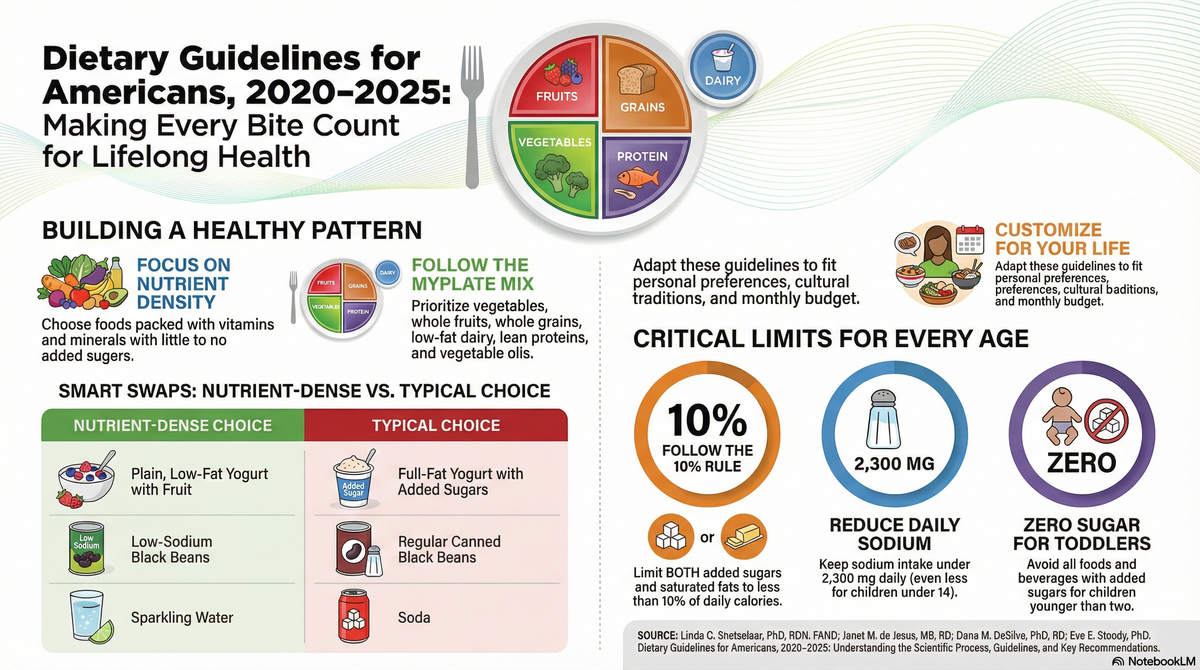
One of the most important shifts in modern nutrition is the move away from focusing on isolated vitamins or single foods. Researchers now recognize that we eat "synergistically"—meaning the foods and beverages we consume together over time affect our health more than any single ingredient. A healthy dietary pattern is like a team where every player has a role, working together to reduce the risk of chronic diseases like type 2 diabetes, heart disease, and certain cancers.
Practical Guidance:
• What to do: Focus on the "total package" of your meals by including a variety of vegetables, whole fruits, whole grains, and lean proteins.
• What not to do: Don't obsess over finding a single "miracle" nutrient or supplement to fix a poor overall diet.
• Habit to change: Instead of thinking about "good" or "bad" foods, look at your weekly eating habits and try to shift toward more nutrient-dense choices most of the time.
Start Strong: The Critical First Two Years
For the first time in decades, these guidelines provide specific advice for our youngest eaters: infants and toddlers. The first 24 months of life are a "call to action" to set a foundation for healthy growth and taste preferences. The research emphasizes that it is never too early to start healthy habits, such as exclusive breastfeeding for about the first six months and avoiding added sugars entirely before a child's second birthday.
Practical Guidance:
• What to do: Introduce nutrient-dense "complementary" foods around 6 months, specifically focusing on those rich in iron and zinc, like meats or fortified cereals.
• What not to do: Do not wait to introduce potentially allergenic foods like peanuts and eggs; doing so in the first year may actually reduce the risk of food allergies.
• Habit to change: Stop offering sugar-sweetened beverages to children under age two, as these take up space in their small stomachs that should be filled with nutrients.
The "Big Four" Limits for a Longer Life
While we need to add more "good stuff," most Americans are currently over-consuming four specific things: saturated fat, sodium, added sugars, and alcohol. These components act as "empty calories" or health stressors that leave little room for the nutrients your body actually needs to function. Keeping these in check is essential for maintaining a healthy weight and protecting your heart.
Practical Guidance:
• What to do: Aim to keep added sugars and saturated fats to less than 10% of your total daily calories.
• What not to do: Don't assume that "moderate" drinking is required for health; for those who don't drink, it is not recommended to start for any health reason.• Decision to change: Swap one salty or sugary snack a day for a whole fruit or a handful of nuts to naturally lower your sodium and sugar intake.
Fill the "Nutrient Gaps"
Even when we eat enough calories, many of us are still "under-consuming" critical nutrients that keep our systems running smoothly. Specifically, most Americans are low on vitamin D, calcium, dietary fiber, and potassium. These are considered "nutrients of public health concern" because missing out on them is directly linked to health conditions over time.
Practical Guidance:
• What to do: Make "every bite count" by choosing nutrient-dense versions of your favorite foods, such as plain yogurt with fruit instead of pre-sweetened versions.
• What not to do: Don't rely on processed "fortified" snacks to get your fiber; get it from whole sources like beans, peas, lentils, and vegetables.
• Habit to change: Try to include seafood in your meals twice a week to gain essential omega-3 fatty acids and other key minerals.
Summary for Life
The research leads to a simple, concrete life rule: Focus on the "big picture" of your plate by prioritizing whole, nutrient-dense foods at every age, while keeping sugar, salt, and saturated fats as occasional guests rather than daily staples.
Reflective Question: If you looked at your last week of meals as a "pattern" rather than a list of ingredients, what story would it tell about your future health?
References
Linda G. Snetselaar, Janet M. de Jesus, Dana M. DeSilva, and Eve E. Stoody. "The Dietary Guidelines for Americans, 2020–2025: Understanding the Scientific Process, Guidelines, and Key Recommendations." Nutrition Today, vol. 56, no. 6, 2021, pp. 287–295.