
Love, Science, and "The Seven Principles for Making Marriage Work": How to Build a Relationship That Lasts
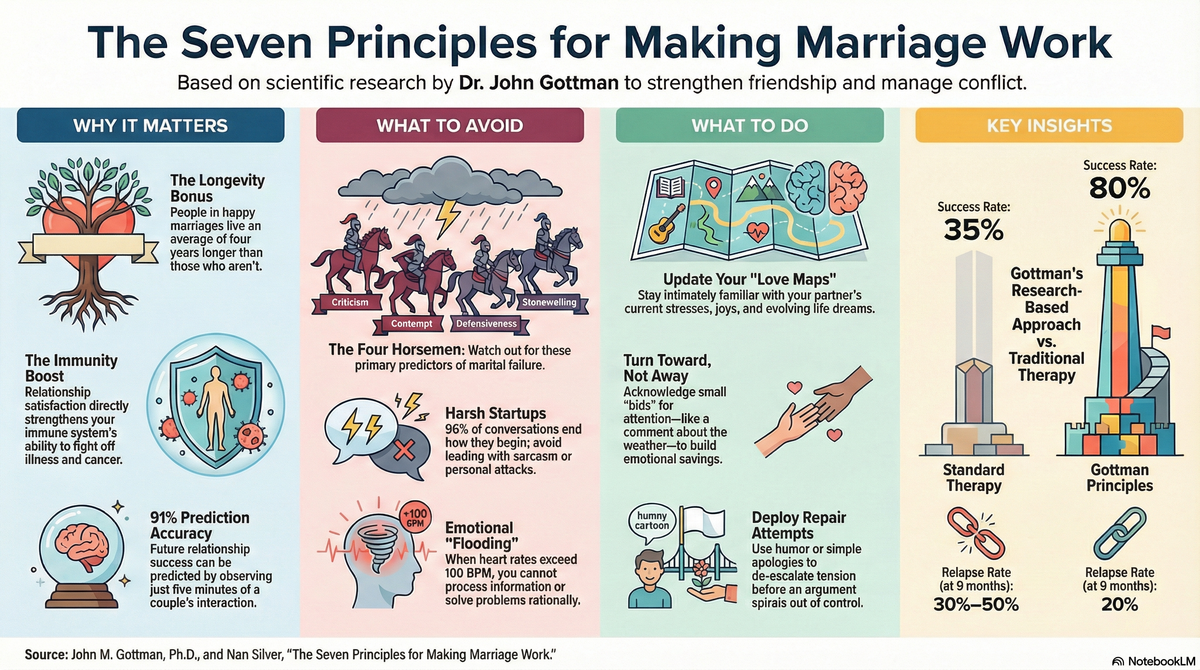
Have you ever looked at a couple who has been happily married for decades and wondered, What is their secret? We often assume that a successful marriage requires endless compromise, weekly therapy, or just plain luck. When conflicts arise—whether it is a bickering match about folding the laundry or a tense silence over finances—it is easy to feel like you are failing at love. But understanding the actual anatomy of a successful relationship can demystify romance and give you practical tools to protect your bond. It turns out that a happy marriage is not about finding the perfect person, but about practicing a specific set of emotional skills together.
Here are the key insights into what separates thriving relationships from those that fall apart, and how you can apply these principles to your everyday life.
Building Your "Love Maps"
At the foundation of any emotionally intelligent marriage is a deep, detailed knowledge of your partner's inner world, which is referred to as a "love map". Happily married couples dedicate mental space to remembering each other’s major life events, current stresses, favorite movies, and deepest fears. This isn't just about trivia; couples who start out with a deep knowledge of each other are far better equipped to handle massive life changes, such as the birth of a child or a job transition. Without this detailed map, it is incredibly easy for a marriage to lose its way when life shifts suddenly.
Practical Guidance:
• What to do: Ask your partner questions about their day, their current stresses, and their evolving dreams.
• What not to do: Don't assume you already know everything about your spouse just because you have been together for years.
• Habit to change: Make a habit of checking in periodically. Ask a question like, "How are you feeling about your boss lately?" to keep your love map updated.
Nurturing Fondness and Admiration
Fondness and admiration are two of the most crucial elements in a rewarding, long-lasting romance. When you retain a fundamental sense that your partner is worthy of being respected and liked, it acts as a protective shield against negativity. In fact, maintaining a positive view of your spouse is the ultimate antidote to contempt, which is one of the most destructive forces in any relationship. If you can easily access your fond memories and speak highly of each other's character, your relationship has a strong safety net during hard times.
Practical Guidance:
• What to do: Focus your thoughts on your partner's positive characteristics, even when you are apart or having a stressful day.
• What not to do: Don't let your partner's minor personality flaws blind you to the overall value of who they are.
• Habit to change: Build a habit of expressing appreciation out loud every single day, whether it is thanking them for cooking dinner or complimenting their sense of humor.
Turning Toward Each Other
Hollywood tells us that romance is built on candlelit dinners and dramatic declarations of love. In reality, romance is built in the grocery store aisle or while folding laundry. Throughout the day, partners make tiny "bids" for each other's attention—like pointing out a funny article or sighing heavily after a long day. When you acknowledge and engage with these moments, you are "turning toward" your partner. Couples who do this regularly build up a hefty "emotional bank account" that cushions them when conflicts inevitably arise.
Practical Guidance:
• What to do: Respond positively to your partner's casual chitchat or requests for attention, no matter how mundane they seem.
• What not to do: Do not ignore your partner, grunt apathetically, or act annoyed when they interrupt your reading or television watching to share a thought.
• Habit to change: Institute a 20-minute "stress-reducing conversation" at the end of each workday where you simply listen and support each other through outside stresses, without trying to "fix" the problem.
Letting Your Partner Influence You
A marriage thrives when both partners are willing to share power and decision-making. When couples disagree, emotionally intelligent partners actively search for common ground rather than insisting on getting their way. Research shows that when a partner—specifically a husband—resists sharing power and responds to complaints with defensiveness or contempt, the relationship becomes dangerously unstable. Accepting influence doesn't mean giving up your personal power; it means conveying honor and respect for your spouse's feelings.
Practical Guidance:
• What to do: Look for the reasonable part of your partner's request and actively search for something you can yield to.
• What not to do: Don't automatically cross your arms, become defensive, or escalate the argument when your partner brings up a complaint.
• Habit to change: Learn to "yield to win." Instead of fighting over a minor inconvenience (like leaving the toilet seat up), simply accommodate your partner to prioritize the harmony of the relationship.
Solving Your Solvable Problems
It is a myth that you need to resolve every single conflict to have a happy marriage. In fact, 69 percent of marital conflicts are "perpetual," meaning they will be a part of your lives forever due to fundamental personality differences. However, for the problems that are solvable, the key is how you start the conversation. A "harsh startup"—beginning a discussion with criticism, sarcasm, or blame—dooms the conversation to failure within the first few minutes. Using a "soft startup" and learning to hit the brakes (making repair attempts) when things get too heated prevents disagreements from destroying your connection.
Practical Guidance:
• What to do: Complain about specific behaviors without blaming. Use "I" statements, like "I am really upset that the house is a mess," rather than attacking your partner's character.
• What not to do: Never start an argument with "You always..." or "What is wrong with you?".
• Habit to change: If a discussion gets too heated, announce a "repair attempt" (like saying, "I'm feeling overwhelmed, can we take a break?") and actually pause the argument for 20 minutes to calm down.
Summary for Life
The deep truth of relationship science boils down to a single, concrete life rule: A lasting marriage is not created by avoiding conflict, but by intentionally building a daily foundation of deep friendship, mutual respect, and emotional connection in the smallest, most ordinary moments of your day.
Reflective Question: If you treated your spouse with the same eager attention and grace you give to a respected guest in your home, how would the temperature of your marriage change tonight?
References
John M. Gottman, Ph.D., and Nan Silver. "The Seven Principles for Making Marriage Work."