How Growing Together Makes You Fall in Love Again: The Science of Self-Expansion in Relationships

Think about a couple you know who has been together for decades and still seems genuinely in love — curious about each other, visibly delighted in each other's company, still physically affectionate. What is their secret? According to three decades of relationship psychology, the answer is almost certainly not compatibility, communication alone, or even commitment. It is growth. Specifically, it is something psychologists call self-expansion: the experience of becoming more through your relationship. When a couple grows together — learns new things, encounters new experiences, challenges and surprises each other — they continue to fall in love. When growth stops, love often quietly fades. This article explores the science behind self-expansion, explains why relationships stagnate, and offers a concrete, research-backed plan for growing together again.
What Is Self-Expansion and Why Are Humans Wired for It?
Self-expansion is one of the most fundamental human motivations. The theory, developed by psychologist Arthur Aron in the 1980s, proposes that people have a basic drive to expand their sense of self — to grow in perspective, capability, identity, and experience. We are drawn toward anything that makes us feel bigger, more capable, and more alive: new skills, new knowledge, new relationships, new places [1].
 Viktoria Samokhval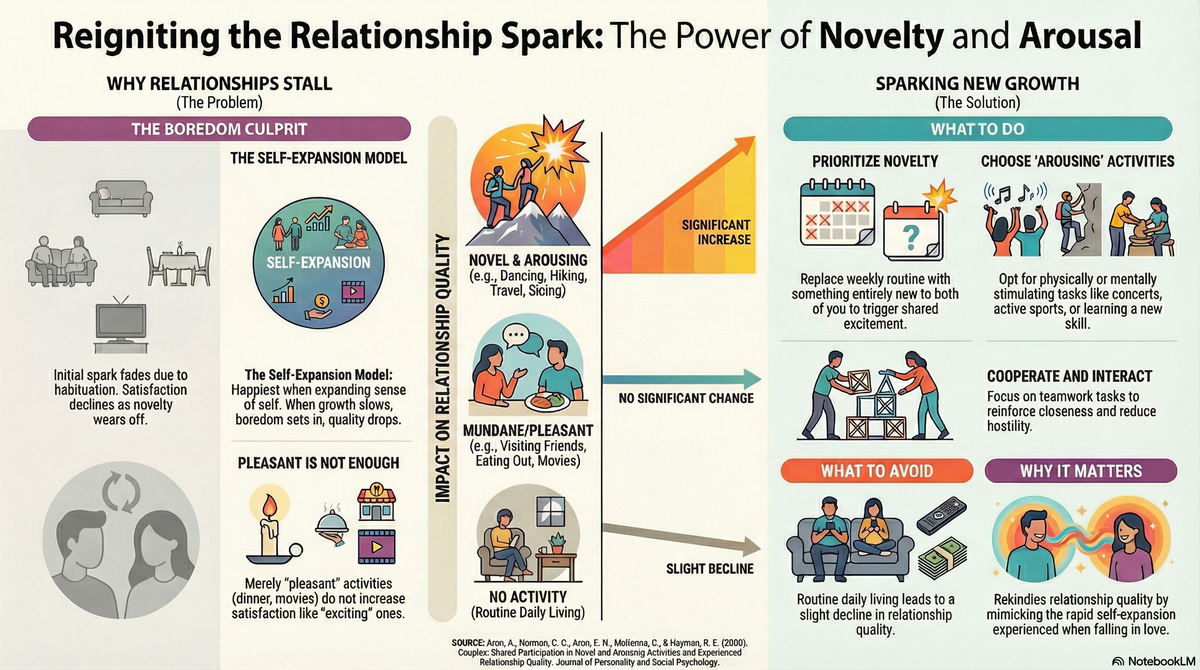
[1]
Aron's self-expansion model is notable for being the first psychological theory of love to focus specifically on what a romantic relationship does to the self. Rather than asking what people look for in a partner, it asks a more interesting question: what do we become because of a partner? The answer, when the relationship is working, is more — more complex, more capable, more open. There are two primary mechanisms through which a romantic relationship creates self-expansion. The first is what Aron calls inclusion of the other in the self: as you grow deeply close to someone, you begin to incorporate their traits, skills, perspectives, and worldview into your own identity. Their knowledge becomes available to you. The second mechanism is shared novel experiences: when you do new things together, your sense of self expands through the activity itself.
Why Falling in Love Feels So Expansive
The intoxicating, electric quality of falling in love is not just romantic idealization — it is a measurable psychological event. Prospective studies by Arthur Aron and colleagues found that after falling in love, people show greater diversity and uniqueness in their self-concept, higher self-efficacy, and increased self-esteem. They add more new, unique content to their descriptions of who they are. In practical terms: falling in love literally changes who you feel yourself to be.
This is why the early stages of a relationship feel so compelling. You are encountering a completely new person — their stories, their knowledge, their worldview, their quirks. Every conversation is an expansion. Every revelation opens a new door. The honeymoon phase is not really about the absence of conflict; it is about the abundance of growth. The challenge, of course, is that this initial burst of expansion cannot last forever. A person's identity and worldview are a finite resource. Once you have learned the outline of who they are, that particular source of expansion starts to slow. And this is where many couples run into trouble.
The Science: How Self-Expansion Predicts Passion, Desire, and Commitment
The research on self-expansion and relationship outcomes is remarkably consistent. Couples who report higher levels of self-expansion within their relationship also report more passionate love, greater relationship satisfaction, stronger commitment, more physical affection, and higher sexual desire. This holds across different relationship stages and demographics [2].
 Viktoria Samokhval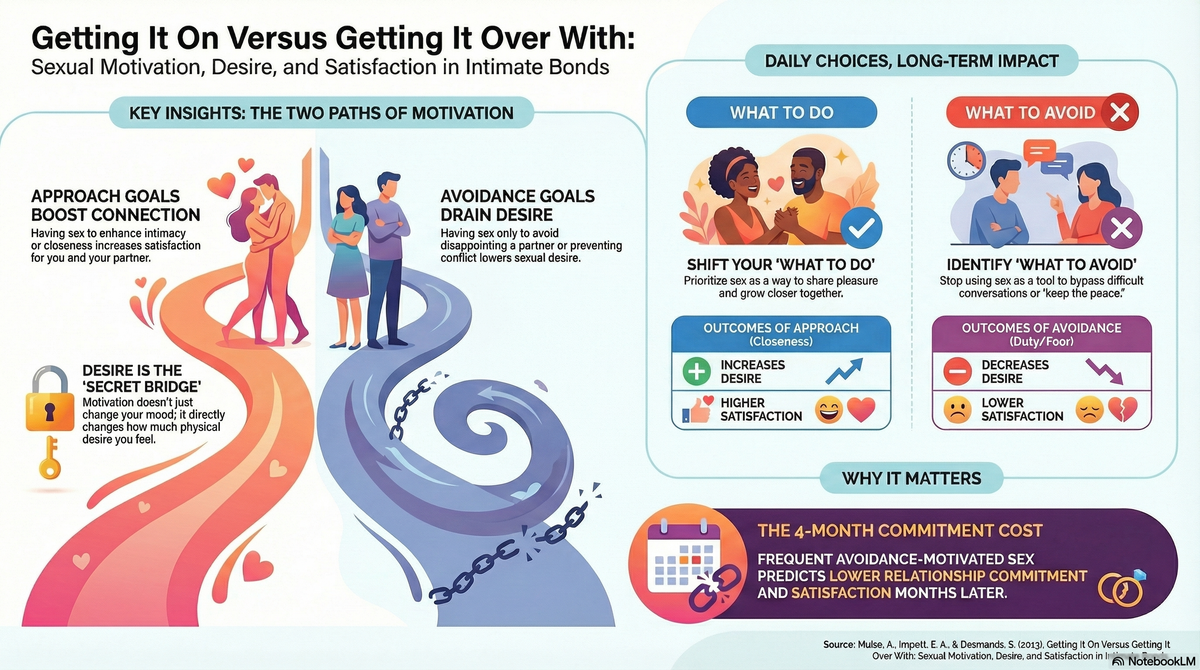
[2]
Daily diary studies have provided particularly compelling evidence. On days when participants experienced more self-expansion than usual — through their partner or shared activities — they reported higher levels of intimacy and more positive emotions. The mechanism appears to be that self-expansion generates positive affect, which then translates into greater closeness and desire.
One of the most striking findings comes from research on novelty and sexual activity: couples who tried a new experience together were found to be 36 times more likely to have sex than on days without novelty. This is not simply correlation — the experience of growth together activates closeness, pleasure, and desire in ways that routine simply cannot replicate.
Even for couples facing sexual challenges, self-expansion matters. Research by Raposo, Rosen, and Muise (2020) found that among women with low sexual desire, those who reported higher self-expansion in their relationship experienced greater relationship satisfaction, higher desire levels, and more physical affection from their partners. Self-expansion functions as a direct antidote to desire discrepancy in couples [3].
 Viktoria Samokhval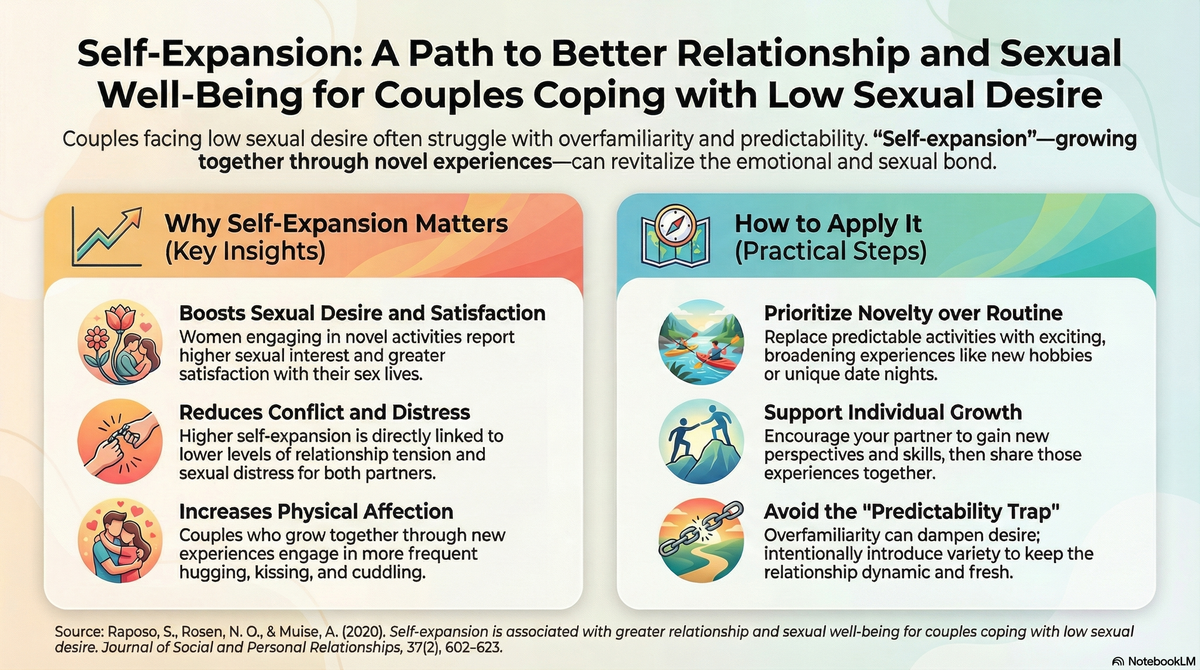
[3]
Warning Signs: What Happens When a Relationship Stops Growing
Because a partner's self-concept is a finite source of expansion, long-term relationships inevitably face a slowdown in novelty and growth. This is not a failure — it is a developmental reality. The problem arises when couples do not intentionally create new sources of expansion to replace the ones that have been exhausted.
Relationship boredom, often dismissed as trivial, is actually a serious signal worth attending to. A longitudinal study found that married couples who reported feeling more bored in their relationship at one point had significantly lower marital satisfaction nine years later. Boredom does not resolve itself; it compounds. Here is what stagnation looks like in practice:
- Conversations follow the same predictable grooves: logistics, routines, complaints, schedules
- You feel less curious about your partner — it feels like there is nothing new to discover
- Physical affection decreases without conflict as the cause
- Sexual desire declines gradually and quietly
- One or both partners feels vaguely restless or easily distracted
- Irritability increases without an obvious external reason
- The relationship starts to feel more like a co-management arrangement than a romantic partnership
Why People Mistake Stagnation for Incompatibility
One of the most costly misreadings of relationship stagnation is interpreting it as incompatibility. Many couples conclude they have grown apart, that they no longer have anything in common, or that they have simply outgrown each other — when in reality what has happened is much more specific: they have stopped generating new self-expansion together.
The distinction matters enormously. If the problem is true incompatibility — deeply misaligned values, fundamentally different life visions — that is a different conversation. But if the problem is growth stagnation, it is not a verdict on the relationship. It is a diagnosis that points directly to a treatment: intentionally creating conditions for growth again.
Practical Ways to Create Self-Expansion With Your Partner Starting This Week
Self-expansion does not require dramatic gestures, expensive travel, or personality overhauls. Research consistently shows that the strongest effects come from mild challenges and shared firsts, not extreme novelty. The key is intentionality: deliberately choosing experiences and conversations that create growth. Here are six specific things you can do this week:
- Try a shared first experience together — something neither of you has done before. It does not need to be grand: shuck oysters, visit a neighborhood you have never been to, try a recipe from a country neither of you knows well.
- Replace one routine conversation with a growth question. Instead of asking how was your day, try: What is something that surprised you recently? or What is something you have been curious about but have not explored?
- Sign up for one class or workshop together — dance, cooking, pottery, drawing, climbing, or improv.
- Explore somewhere neither of you knows well — a nearby town, a trail you have never taken, or a part of your own city that is new to both of you.
- Share something from your individual growth. Tell your partner about something you are reading, learning, or thinking about. Invite their perspective.
- Plan a mild physical challenge — a hiking trail slightly harder than usual, an escape room, a beginner dance class, or a local 5K run.
Researchers recommend committing to approximately 90 minutes of novel activity per week for at least four weeks to see measurable improvements in desire and relationship satisfaction.
The Balance: Personal Growth and Shared Growth
One important nuance from the research: personal self-expansion — growth you pursue individually through your own hobbies, career, and learning — also increases passion in a relationship. On days when people experience meaningful individual growth, they tend to report more passion toward their partner.
But there is a critical caveat. Research shows that people who chronically self-expand only on their own, without sharing that growth with their partner, actually report lower passion over time [4]. Too much solo growth without integration into the relationship predicts growing apart, not closer together. The formula is therefore: grow as an individual AND bring that growth back. Some practical ways to do this include:
- Sharing what you are working on or thinking about over dinner
- Inviting your partner to join your individual interests occasionally
- Recommending books, podcasts, or ideas you are engaging with
- Reflecting together on how each of you is changing and growing
Personal growth that stays private becomes a wedge. Personal growth that is shared becomes a bridge.
 Viktoria Samokhval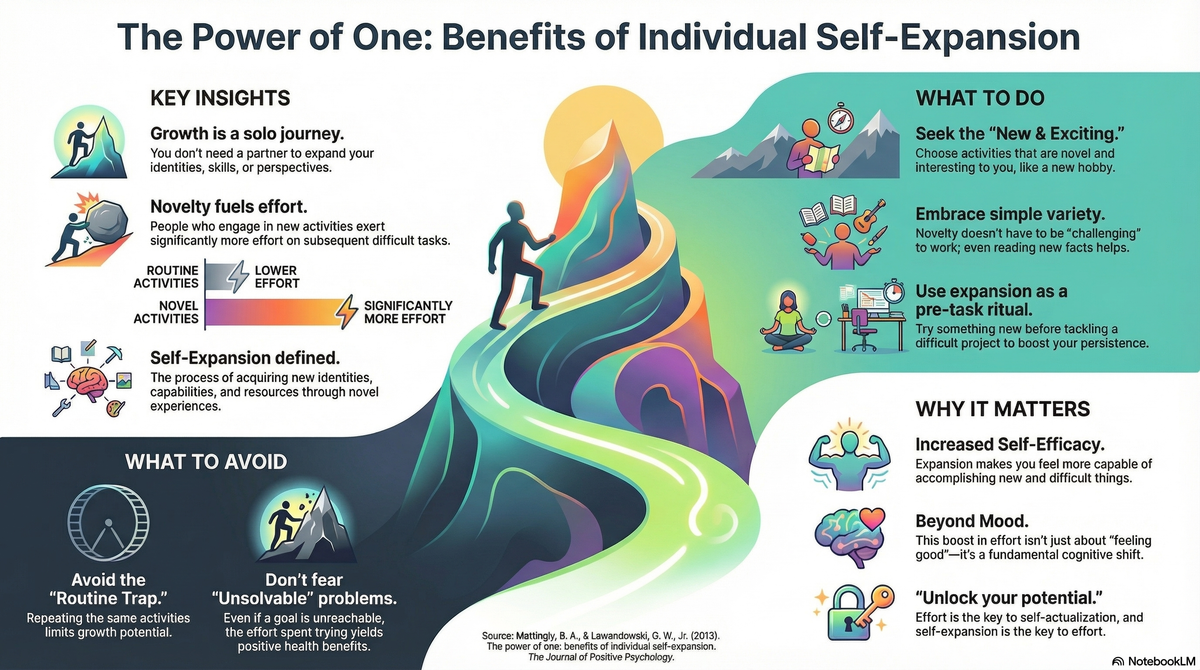
[4]
How to Reignite Growth When Your Relationship Feels Stagnant
If your relationship has begun to feel like it is going through the motions, the following step-by-step approach offers a way back to genuine growth together:
- Name it without blame. Acknowledge to yourself, and possibly to your partner, that the relationship has entered a quieter phase. Frame it as a developmental stage, not a permanent condition or a verdict on the relationship.
- Separate the problem from the person. Stagnation is not about who your partner is. It is about what you have been doing — or not doing — together.
- Start with curiosity. Ask your partner one genuine question about something you do not already know the answer to. Listen with real attention.
- Invest in your own growth first. Pick one thing you have been genuinely curious about and begin pursuing it — a skill, a subject, a practice, a creative outlet.
- Share your growth regularly. Make it a weekly habit to bring something from your individual life into the conversation between you.
- Plan one novel shared experience per week. Even something small qualifies — the novelty and the intention are what matter.
- Practice gratitude. Research shows that regularly expressing specific appreciation for your partner rebuilds positive emotional feedback loops and helps them feel genuinely seen and valued.
- Be patient. Growth restarts gradually. Do not expect instant fireworks. Expect small sparks, and trust that they accumulate into something real over time.
The Long Game: Relationships That Keep Falling in Love
The couples who manage to sustain genuine passion over decades share a common thread in the research: they keep growing — individually and together. They treat their relationship as a living project, not a finished product. They remain curious about their partner even after years together, because they understand, consciously or not, that their partner is still becoming someone new — and so are they.
Researchers who study long-term passionate love find that it is not a myth or an exception. It is an achievable outcome and, critically, it is the predictable result of sustained mutual self-expansion. Couples who maintain this quality report higher satisfaction, stronger resilience in the face of difficulty, better sex lives, and deeper emotional intimacy across decades.
The alternative — treating the relationship as a static arrangement to be managed rather than a dynamic partnership to be grown — is the most common source of slow, quiet relationship decay that couples often do not see coming until it feels too late.
Love does not fade because people change. It fades when people stop changing together. The initial rush of falling in love was not magic — it was growth. And growth is something you can choose. This week, choose one shared first experience. Ask one new question at dinner instead of a familiar one. Share something you are learning and invite your partner's response. Watch what happens when you treat your relationship as a place where both of you are still becoming. That is where love lives — and where it keeps returning, if you keep creating the conditions for it to grow.
References
-
Aron, A., Norman, C.C., Aron, E.N., McKenna, C. and Heyman, R.E. Couples’ shared participation in novel and arousing activities and experienced relationship quality.
Journal of Personality and Social Psychology, 2000 78(2), 273–284 -
Muise, A., Impett, E.A. and Desmarais, S. Getting it on versus getting it over with: Sexual motivation, desire, and satisfaction in intimate bonds.
Personality and Social Psychology Bulletin, 2013 39(10), 1320–1332 -
Raposo, S., Rosen, N. O., & Muise, A. Self-expansion is associated with greater relationship and sexual well-being for couples coping with low sexual desire.
Journal of Social and Personal Relationships, 2020 37(2), 602–623 -
Mattingly, B. A., & Lewandowski, G. W., Jr. The power of one: Benefits of individual self-expansion.
Journal of Social and Personal Relationships, 2013 30(1), 106–123