From Fetal Growth to Sharp Aging: Why "Omega-3 Fatty Acids EPA and DHA: Health Benefits Throughout Life" is Your Blueprint for Vitality
Have you ever wondered why every health enthusiast and doctor seems to obsess over fish oil? We all want to age gracefully, keep our hearts ticking perfectly, and give our children the best possible start in life, yet the world of nutrition can feel like a maze of confusing labels. It turns out that two specific fats found in the ocean might be the closest thing we have to a lifelong health insurance policy.
The Marine Edge: Why Your Body Needs More Than Just Seeds
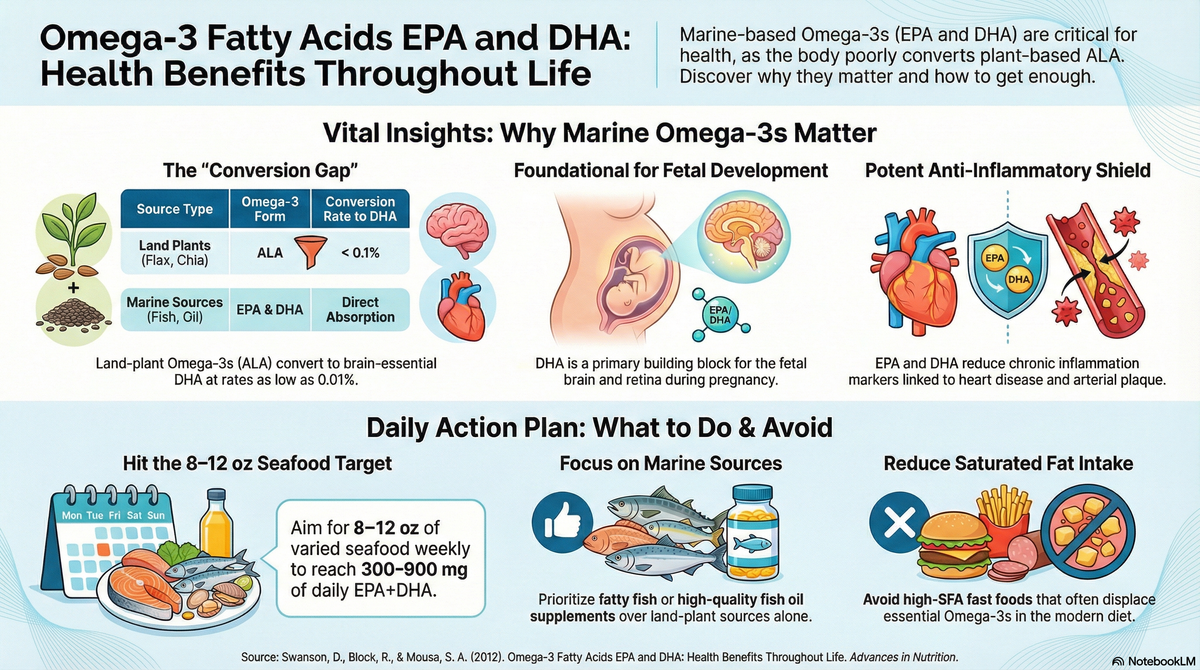
We often hear that seeds like flax or chia are great sources of "good fats." While they are healthy, they contain a short-chain omega-3 called ALA, which our bodies struggle to use efficiently. The real "superstars" are EPA and DHA, the long-chain fats found in marine life. Research shows our bodies are actually quite poor at converting plant-based ALA into the EPA and DHA our brains and hearts crave—sometimes converting less than 1% of what we eat.
Practical Guidance:
• What to do: Prioritize direct sources of EPA and DHA by eating oily fish or taking high-quality fish oil supplements.
• What not to do: Do not rely solely on plant sources like flaxseed for your omega-3 needs, as they likely won't provide enough "brain fuel".
• Habit to change: Swap a "fast food" meal for home-prepared fish at least twice a week to combat the typical low-omega-3 diet.
A Bright Future: Building Brains Before Birth
The foundation of a healthy life begins in the womb. DHA is a primary structural block for the brain and the retina (the back of the eye). When mothers get enough of these fats, babies tend to show better problem-solving skills and improved hand-eye coordination as they grow. Beyond brainpower, these fats help ensure the baby is born at the right time and may even protect them from developing food allergies or eczema later on.
Practical Guidance:
• What to do: If you are pregnant or breastfeeding, aim for 8 to 12 ounces of a variety of seafood every week.
• What not to do: Don't ignore the importance of these fats in the third trimester, which is when the most DHA accumulates in the baby's brain.• Decision to change: If you don't enjoy fish, talk to your doctor about an EPA/DHA supplement to ensure your baby gets these vital nutrients.
The Heart’s Quiet Bodyguard
Cardiovascular disease remains a leading health challenge, but EPA and DHA act as a multi-layered defense system. They work by cooling down "silent" inflammation in the body and improving the stability of plaque in your arteries, making it less likely to cause a heart attack. They even help your blood flow more smoothly and can make standard treatments, like low-dose aspirin, work more effectively for heart protection.
Practical Guidance:
• What to do: Focus on long-term, consistent intake to help stabilize arterial plaques and lower inflammatory markers like C-reactive protein.
• What not to do: Don't assume heart benefits are only for those who are already sick; even those with healthy hearts benefit from the anti-inflammatory effects.• Habit to change: If you are taking blood thinners or aspirin for your heart, consult your doctor about adding omega-3s to potentially improve your body's response to those treatments.
Defending the Mind Against Time
As we get older, our brain's supply of DHA can naturally decline, which is often seen in those struggling with memory loss or Alzheimer’s disease. While omega-3s aren't a "cure," they are essential for maintaining the structure of our brain cells. In people with very mild memory issues, supplementation has been shown to significantly slow down the rate of mental decline. It can even help those with advanced memory loss maintain a healthy weight and appetite.
Practical Guidance:
• What to do: Adopt a "brain-protective" diet rich in fish, nuts, salad dressings, and leafy greens while cutting back on high-fat dairy and red meats.
• What not to do: Don't wait until memory loss is severe to start thinking about brain nutrition; the benefits are much stronger when started early or in very mild stages.
• Decision to change: If a loved one with memory issues is losing weight, consider fish oil as a way to help support their appetite and weight maintenance.
Summary for Life
The research leads us to one concrete life rule: Treat EPA and DHA as "essential equipment" for your body at every age—from the womb to old age—by making seafood a non-negotiable part of your weekly routine.
Reflective Question: If your body can't build a healthy brain or a strong heart without these specific fats, are you giving it the right "building materials" today?
References
Danielle Swanson, Robert Block, and Shaker A. Mousa. "Omega-3 Fatty Acids EPA and DHA: Health Benefits Throughout Life." Advances in Nutrition, vol. 3, no. 1, 2012, pp. 1–7.