Finding Your North Star: Identifying Core Values with a Hierarchical Ipsative Preference Assessment
Have you ever felt like you were drifting through life, making choices that looked good on paper but left you feeling empty? Or perhaps you’ve felt overwhelmed by a sea of opportunities, unsure which path actually belongs to you. Eleanor Roosevelt once remarked that failing to arrive at a clear understanding of your own values is a tragic waste of the point of life. Most of us have a vague idea of what we care about, but we rarely take the time to pinpoint the specific "core values" that define who we are and act as our internal compass.
Recent psychological research has introduced a faster, more engaging way to discover these guiding principles. By moving beyond simple "ratings" and into a process of structured choices, we can unlock a more authentic version of ourselves. Here is what the science of value assessment tells us about living a more intentional life.
Your Core Values are the Secret to Effortless Motivation
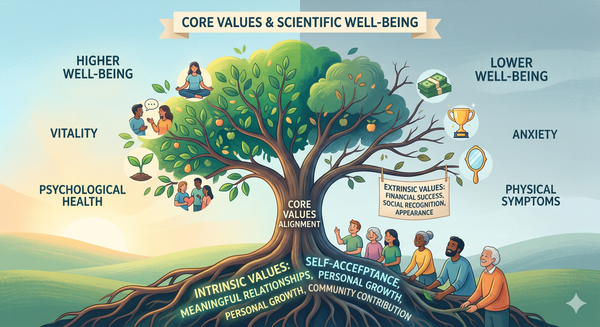
We often think of willpower as a finite battery we have to recharge, but research suggests that true motivation comes from "self-concordance"—the alignment between our goals and our underlying values. When you pursue a goal that feels deeply consistent with your core values, you don't just work harder; you are significantly more likely to succeed and experience lasting happiness when you do.Values aren't just abstract ideas; they are "trans-situational goals" that serve as the foundation for every decision you make, every emotional reaction you have, and even how you perceive the people around you. Understanding them helps you move from being a passive observer of your personality to being a conscious author of your behavior.
Practical Guidance:
- What to do: Audit your current big goals. Ask yourself, "Does this goal reflect a value that is actually mine, or is it a cultural norm I’ve simply adopted?".
- What not to do: Don't chase "extrinsic" rewards—like a certain job title or salary—unless you can clearly link them to a personal value like "security," "mastery," or "contribution".
- Habit to change: Shift your focus from "what" you want to achieve to "why" you want to achieve it. Identifying the underlying value can turn a grueling task into an inspiring mission.
The "Self-Affirmation" Hack for Better Mental Health
Taking a few minutes to reflect on your core values—a process psychologists call "self-affirmation"—is one of the most effective mental health interventions available. Science shows that this simple act of reflection acts as a psychological shield. It promotes self-compassion, reduces defensive reactions in threatening situations, and even helps stop the cycle of "rumination" (overthinking) after a failure.The benefits are surprisingly broad: people who habitually reflect on their values report higher levels of optimism and meaning in their lives. In professional and academic settings, this practice has even been shown to boost creativity and improve long-term performance.
Practical Guidance:
- What to do: Set aside five minutes once a week to write about why your top values are important to you. This "spontaneous self-affirmation" is a proven booster for happiness.
- What not to do: Don't wait for a crisis to think about what matters. Use value reflection as a preventative tool to build emotional resilience before stress hits.
- Decision to change: When you face a setback, instead of criticizing your performance, spend a moment thinking about a core value that remains true regardless of that specific failure.
Why Life is About Choices, Not Just Ratings
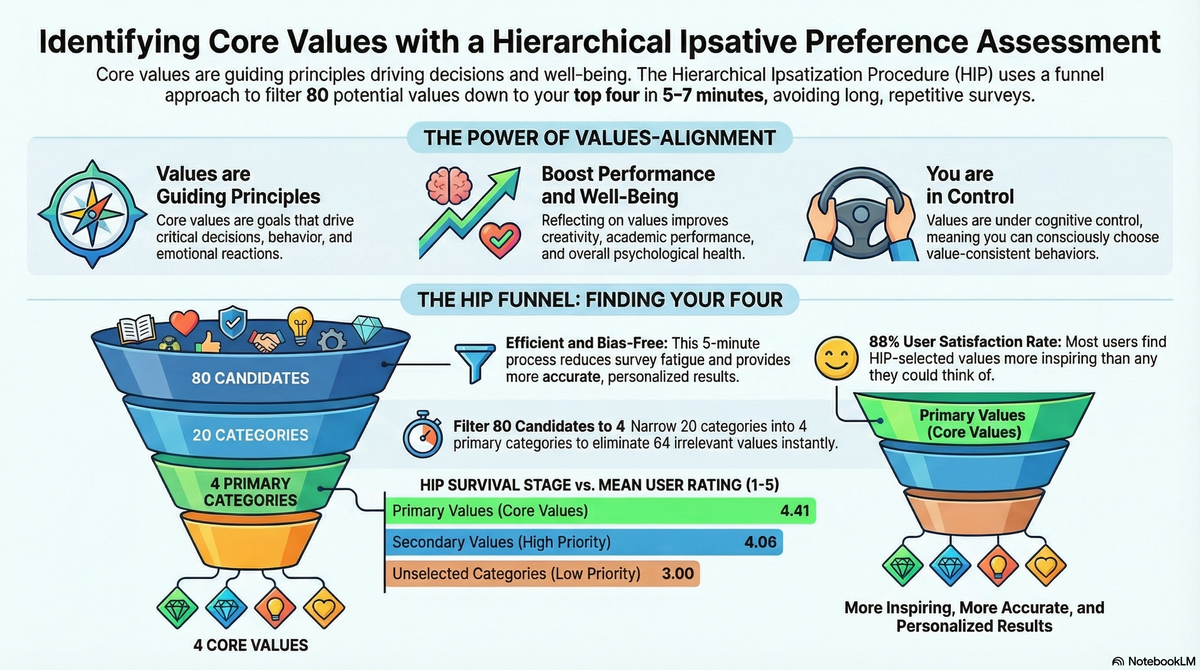
Most of us fall into a "rating trap." If asked to rate eighty different values, we might say almost all of them are "important". While it’s nice to believe in everything from "teamwork" to "wisdom," having too many priorities means you actually have none.The new "Hierarchical Ipsatization Procedure" (HIP) teaches us that identifying your core values requires making difficult choices. By forcing yourself to pick a "Top 4" from a larger list, you move from abstract agreement to concrete commitment. This process of "choosing between what inspires you and what really inspires you" is what leads to genuine self-awareness.
Practical Guidance:
- What to do: Narrow your focus. Try to identify your "Primary 4" values. Having a small, distinct set makes them much easier to use as a decision-making tool in daily life.
- What not to do: Don't be afraid to "reject" a good value to make room for a great one. Choosing a primary value doesn't mean you've abandoned the others; it just means you've found your most potent motivators.
- Habit to change: Stop treating values as a static list. Recognize that "life is about choices," and the values that inspire you most are the ones that should get the "yes" when your time and energy are limited.
Summary for Life
The science of value assessment offers us a concrete life rule: To find true direction and resilience, you must stop broadly endorsing every "good" idea and start fiercely identifying the specific four values that truly move your soul.
Reflective Question: If you were forced to choose only four words to define what makes your life worth living, which ones would survive the cut today?
References
Stanislaw, H., & McCreary, J. Identifying core values with a hierarchical, ipsative, preference assessment. Journal of Personality Assessment, 2023 105(3), 329–341.