Fast Reading vs. Slow Reading: What Science Says About How We Actually Learn
We live in a world that rewards speed. Finish more books. Process more information. Get ahead. The self-improvement industry has made speed reading feel like a superpower — a skill that separates the merely productive from the truly elite. But what if the science says otherwise? What if reading faster isn't helping you learn — it's just helping you feel busy?
The research on fast reading vs. slow reading paints a striking picture: our brains have limits on how much meaning they can reliably extract at higher speeds, and pushing those limits often reduces comprehension. It just makes us skimmers. Understanding what actually happens in your brain at different reading speeds — and when each mode works — is one of the most practical things you can learn about learning itself.
The Speed Reading Myth — What Decades of Research Actually Show
The 500–600 WPM Ceiling
The most cited piece of reading science comes from cognitive psychologist Keith Rayner and colleagues, whose 2016 meta-analysis published in Psychological Science in the Public Interest examined decades of eye-tracking and comprehension studies. Their conclusion was clear: the average skilled reader processes text at 200–400 words per minute. Beyond roughly 500–600 wpm, comprehension tends to decline, especially for complex material.
This reflects both physiological constraints and cognitive trade-offs rather than a simple skill deficit. Reading depends on a series of eye movements called saccades — rapid jumps between fixation points. Each fixation lasts roughly 200–250 milliseconds, during which your visual system captures a small window of text. Your brain then processes that window for meaning before the eyes jump again. There is no technique that meaningfully shortens this cycle without costing comprehension. The hardware has a speed limit.
When researchers asked normal readers to skim at 600–700 wpm, their eye movement patterns matched those of speed readers — and so did their comprehension scores. Both groups were guessing at meaning, not reading it.
Speed Reading Is Just Optimized Skimming
So what are speed reading programs actually teaching? They train three core skills — none of which are true reading:
- Pattern recognition — training readers to identify sentence structure and predict meaning from context, so they can skip more words without noticing
- Chunking — grouping words visually so that fewer fixations cover more text
- Suppressing subvocalization — reducing the inner voice that says words as you read them
These are legitimate cognitive skills that can improve reading efficiency. However, they primarily optimize rapid scanning, and increasing speed generally involves trade-offs in depth of comprehension. Speed reading programs are optimizing a different task — scanning — and calling it reading. That's not a small distinction.
The difference between visual processing and meaning construction is the core issue. Your eyes can move quickly across a page. At higher speeds, semantic integration becomes more effortful and may not keep pace with rapid visual input. Comprehension is built in working memory, and working memory has a strict bottleneck.
What Happens in the Brain When You Read Slowly
Deep Reading Activates More of Your Brain
Slow, attentive reading is neurologically rich. Brain imaging studies have shown that deep reading engages a broad network of cortical regions: the visual cortex processes letter shapes, Broca's and Wernicke's areas handle language and syntax, the prefrontal cortex manages working memory and inference, and regions associated with motor imagery, emotion, and sensory simulation light up when reading vivid narrative text.
Philosopher and cognitive scientist Bence Nanay, writing in Psychology Today in April 2026, describes slow reading as a fundamentally different attentional mode than fast reading. Slow attention allows the mind to linger — to make associations, form mental images, and connect new ideas to existing knowledge. This kind of attention is not passive. It requires the reader to stay present with difficulty rather than resolve it quickly by moving on.
This is exactly the kind of engagement that builds durable knowledge. When you read slowly enough to visualize what you're reading, argue back against it, or notice where it contradicts something you already believe, you are encoding it. You are making it yours.
Memory, Retention, and the Spacing Effect
Slower reading gives working memory time to do its job. Researchers have found that reading in a harder-to-decipher font — which forces readers to slow down — actually improves recall of the material compared to reading the same content in an easy-to-read font. The additional processing effort becomes a memory advantage.
This connects to a broader principle in learning science called desirable difficulty. Tasks that require more cognitive effort during encoding tend to produce stronger, longer-lasting memories. Skimming is cognitively easy. Deep reading is hard. And hard is often better. The following conditions consistently improve reading retention:
- Pausing to summarize what you just read before moving on
- Connecting new material explicitly to something you already know
- Reading at a pace that allows inner speech rather than suppressing it
- Returning to difficult passages rather than accepting partial understanding
- Reading in focused, distraction-free conditions rather than while multitasking
Fast vs. Slow Reading — Two Distinct Cognitive Modes
Bence Nanay's Framework: Fast Attention vs. Slow Attention
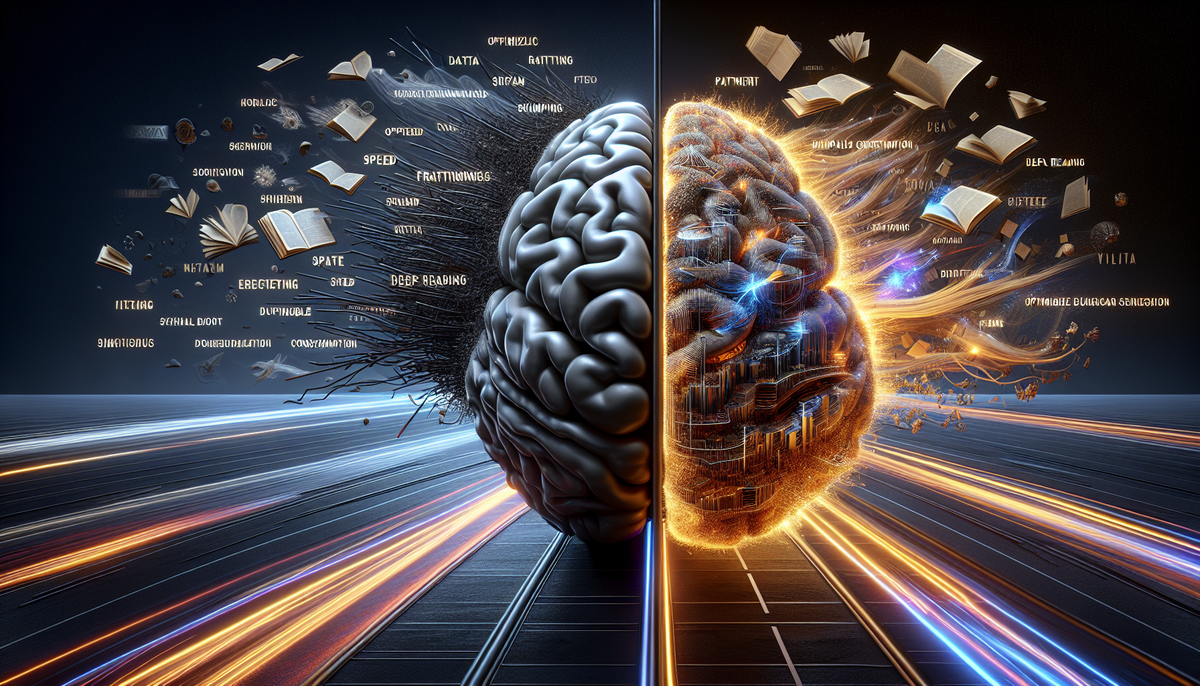
Nanay's contribution is not just a restatement of the speed-comprehension trade-off. He argues that fast reading and slow reading are qualitatively different mental states — not just different speeds of the same process. Fast reading involves broad, scanning attention: the mind looks for structure, signal words, and familiar patterns. Slow reading involves narrow, sustained attention: the mind dwells on individual words, unpacks sentences, and follows the thread of an argument carefully.
Neither mode is inherently superior. The problem arises when one becomes your default regardless of what you're reading. Habitual fast reading doesn't just mean you read quickly — it means you've lost ready access to the slow mode. And slow mode is where learning actually happens.
When Fast Reading Is Appropriate
There are real situations where skimming is the right tool:
- Previewing a book or article to decide whether it's worth reading in full
- Searching for a specific fact, date, or reference you know is somewhere in the text
- Reviewing material you've already studied carefully, to refresh key points
- Scanning an email or document for action items and deadlines
- Getting a structural overview of an unfamiliar field before diving deeper
In each of these cases, you're not trying to build understanding — you're extracting a specific signal. Fast reading excels at that.
When Slow Reading Is Essential
Slow reading is non-negotiable in these situations:
- Learning a new concept or skill that requires building a mental model from scratch
- Reading anything that contradicts your existing beliefs and deserves careful evaluation
- Following a complex argument where each sentence depends on what came before
- Reading literature or narrative work where attention to language is part of the value
- Studying for an exam, certification, or high-stakes presentation where recall actually matters
In these cases, skimming doesn't just mean you learn less — it means you might walk away with confident misunderstanding. You'll think you know something you don't.
How Habitual Skimming Rewires Your Brain
Here is where the stakes become serious. Neuroscience research using MRI and eye-tracking technologies has shown that habitual skimmers — people who default to fast reading across all contexts — show reduced activation in brain regions associated with deep language processing and cognitive control. The reading circuits that support sustained focus on long-form text appear to weaken with disuse.
Cognitive neuroscientist Maryanne Wolf has argued that our collective shift toward digital skimming is changing the way readers' brains develop. When skimming becomes the norm, the neural architecture for deep reading has fewer opportunities to be reinforced. The attention economy plays a role here. Social media platforms, notification-driven news feeds, and short-form content are all optimized for fast scanning. They reward quick pattern recognition and punish the sustained attention that slow reading requires.
The practical implication is significant: fast reading as a default — not a deliberate choice — gradually limits your learning capacity. It's not that you become incapable of deep reading. It's that it becomes uncomfortable, effortful, and easy to abandon.
Practical Strategies to Match Reading Mode to Your Goal
The Pre-Reading Decision
The most important reading skill is not speed — it's intentionality. Before opening any book or article, ask yourself three questions:
- What do I actually need from this text? (Overview, specific fact, full understanding, or enjoyment?)
- How will I use what I learn? (Conversation, decision, performance, or general awareness?)
- How confident am I that I already understand the basics of this topic?
Your answers determine your mode. If you need full understanding of unfamiliar material, default to slow. If you're refreshing familiar ground or hunting for a specific reference, fast is fine.
Techniques for Deeper Reading and Better Retention
If slow reading is your goal, these five techniques make it significantly more effective:
- Annotate as you go. Write in the margins or in a notes app — not summaries, but reactions. Underline what surprises you. Question what you doubt. Connect ideas to other things you know.
- Use the SQ3R method. Survey the structure first, generate Questions based on headings, Read actively, Recite key points in your own words after each section, then Review the whole at the end.
- Read difficult passages aloud. Subvocalization is often suppressed in the name of speed, but reading aloud forces a slower pace and engages additional auditory processing pathways that aid memory.
- Stop at the end of each section and summarize in one sentence before continuing. If you can't, go back.
- Let yourself re-read. The cultural pressure to always move forward is an enemy of comprehension. Rereading a paragraph until you understand it is not failure — it's reading.
How to Use Speed Strategically Without Losing Comprehension
The goal is not to read slowly all the time — it's to match your reading mode to your purpose. A useful hybrid approach: skim first, then slow down. For non-fiction, preview the chapter structure, read the introduction and conclusion, then go back and read the sections that matter most at full depth. For academic papers, read the abstract and conclusion first, then the methodology and results if they're relevant. For long-form journalism, read the opening paragraphs fast, then decide whether to commit to the full piece slowly.
This isn't compromise. It's strategy. Fast reading helps you allocate your slow reading time wisely.
The Case for Slowing Down in a Fast World
There is something worth naming beyond the neuroscience: we have collectively made speed a virtue in domains where it doesn't belong. We track how many books we read per year. We summarize instead of engage. We skim our way to the feeling of being informed without doing the work of actually being so.
The research on reading speed and comprehension isn't just telling us to read slower. It's telling us that depth takes time — and that time is not wasted. The ideas you sit with, argue against, return to, and build on are the ones that change how you think. The ones you scan are mostly forgotten by Thursday. Slowing down is also, quietly, a form of pleasure. Deep reading habits are associated with lower stress, greater empathy, and stronger verbal reasoning. These aren't small benefits. They compound over a lifetime.
Conclusion
The science of fast reading vs. slow reading doesn't tell us to never skim. It tells us to be honest about what skimming is — and to protect the slower mode that's responsible for actual learning. Comprehension has hard biological speed limits. Deep reading engages far more of the brain than skimming. And matching your reading mode to your purpose is a skill worth developing deliberately. This week, try an experiment: pick one article or chapter you'd normally race through and read it slowly. Annotate it. Summarize it. Sit with the ideas that resist quick understanding. Reading well has always been more valuable than reading fast. The science just confirms what slow readers have known all along.