
Embrace the Chaos: The Surprising Truths of "The Manager’s Job: Folklore and Fact"
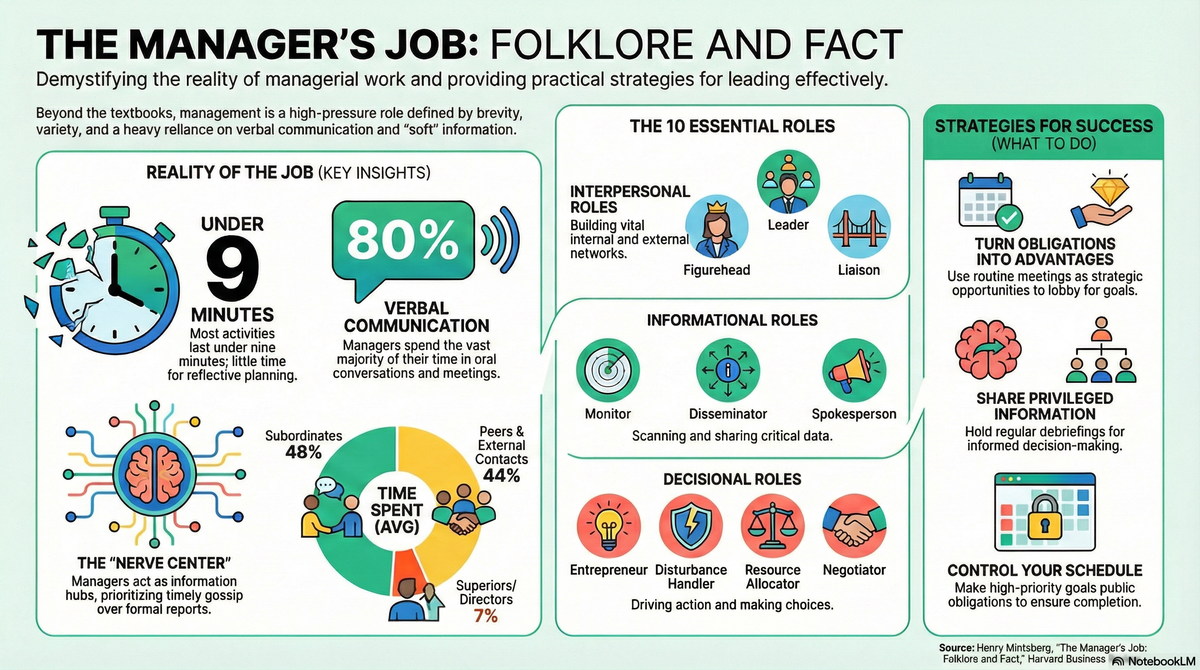
Have you ever felt guilty that your workday consists of putting out fires, answering endless emails, and surviving back-to-back meetings instead of engaging in deep, strategic planning? For decades, business schools have taught that a good manager carefully plans, coordinates, and controls. But a groundbreaking look at actual workplace behavior reveals that this traditional view is largely a myth. Henry Mintzberg’s research breaks down the reality of what leaders actually do, proving that the chaos of leadership is a natural part of the job. Here is what the science says about the real work of managing, and how you can harness it.
The Myth of the "Reflective Planner"
The traditional view paints the manager as a calm, systematic planner, but the evidence shows something entirely different. In reality, managers work at an unrelenting pace, constantly jumping between brief, varied, and disconnected activities. They are driven by an orientation to action rather than reflection. Plans often exist merely as flexible intentions in their heads, constantly adapting to daily stimuli rather than being mapped out in an abstract retreat. Knowing this relieves the guilt of the daily grind: your fragmented schedule isn't a failure of organization, it is the actual nature of the job.
Practical Guidance:
- What to do: Accept that your day will be full of interruptions and quick tasks, and learn to respond flexibly to real-time stimuli.
- What not to do: Don't beat yourself up for not spending hours in solitary reflection or abstract planning.
- Habit to change: Since brevity and fragmentation characterize your work, consciously schedule moments to step back and build a comprehensive picture of your environment, so you aren't just reacting to every small issue equally.
The Power of "Soft" Information
We often assume that top-tier leaders rely on massive, formal databases and giant reports to make decisions. However, the research shows that managers overwhelmingly favor verbal communication, such as telephone calls and face-to-face meetings. They actively seek out "soft" information—including gossip, hearsay, and speculation—because it is much more timely than historical, aggregated data. Today's gossip might be tomorrow's actual fact. Because so much critical information is verbal, the true strategic database of an organization lives inside the minds of its people, not in its computers.
Practical Guidance:
- What to do: Seek out direct, verbal interactions to gather the most current details, odds and ends, and opinions about what is happening in your organization.
- What not to do: Do not rely exclusively on formal reports or printed documents to understand the reality of your environment, as this information is often outdated by the time it reaches you.
- Habit to change: Overcome the "dilemma of delegation" by establishing a regular habit of "dumping your memory" (like holding debriefing sessions) to share the verbal information locked in your head with your subordinates.
The 10 Inseparable Roles of a Leader
A manager's job cannot be boiled down to a single task; it is an integrated whole consisting of ten different roles. Formal authority gives managers interpersonal roles (like acting as a figurehead, leader, and liaison), which automatically connects them to vital information. This network allows them to play informational roles (monitor, disseminator, and spokesperson), ultimately giving them the knowledge and power required for decisional roles (entrepreneur, disturbance handler, resource allocator, and negotiator). You cannot pull one role out without the whole system falling apart. For example, without strong interpersonal liaison contacts, you lose the external information needed to make good decisions.
Practical Guidance:
- What to do: Recognize that ceremonial duties—like greeting visitors or attending an employee's wedding—are essential interpersonal tasks that build your information network.
- What not to do: Don't attempt to split a single managerial position entirely with another person (like having an "internal" and "external" boss) unless you can perfectly share all verbal information back and forth.
- Decision to change: View your mandatory obligations not as distractions, but as valuable opportunities to exercise your different roles; use a speech to lobby for a cause, or a required meeting to gather trade information.
Summary for Life
The research leads to a concrete life rule: To be an effective leader, you must embrace the fast-paced, verbal, and highly interpersonal nature of your role, deliberately turning everyday obligations into opportunities to gather information and inspire your team.
Reflective Question: Are you hoarding critical information in your own mind, or are you actively finding systematic ways to share your knowledge so your team can succeed?.
References
“The Manager’s Job: Folklore and Fact” Henry Mintzberg (Harvard Business Review, March–April 1990)