Decoding Your Body’s Clock: Practical Lessons from "Circadian Biomarkers in Humans: Methodological Insights into the Detection of Melatonin and Cortisol"
Do you ever feel like you are perpetually jet-lagged, even though you haven't left your time zone? Or perhaps you struggle to drag yourself out of bed in the morning, only to feel wide awake the moment your head hits the pillow? You aren’t alone, and it isn’t just "bad habits"—it is biology. Your body runs on a tight 24-hour schedule known as the circadian rhythm, orchestrated by a complex dance of hormones. A comprehensive new review explores exactly how these chemical messengers work and, crucially, how easily they can be disrupted by our modern lifestyle.
The Yin and Yang of Your Daily Energy
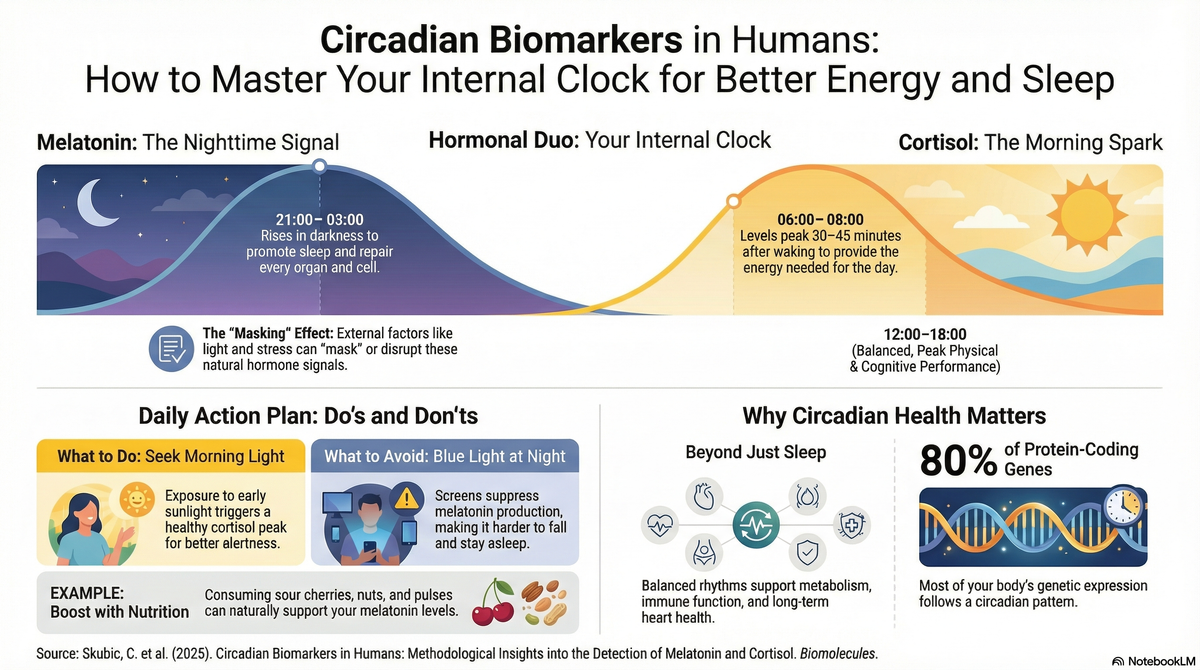
The research identifies two main characters in the story of your day: Melatonin and Cortisol. Think of them as the opening and closing acts of your daily show. Melatonin is the "hormone of darkness," signaling to your body that it is time to wind down and repair. Cortisol, often misunderstood as just a stress hormone, is actually your body’s morning coffee—it naturally spikes within 30 minutes of waking up to give you the energy to face the day. When these two are in sync, you sleep well and wake up alert. When they are misaligned, it opens the door to sleep disorders, metabolic issues, and even mood changes.
Practical Guidance:
• What to do: Maintain a consistent wake-up time to help "train" your cortisol to spike at the right moment every morning.
• What not to do: Don't view cortisol purely as the enemy; you need that morning surge. The problem arises when stress keeps it high all day and night.
• Habit to change: Create a distinct "wind down" routine in the evening to allow melatonin to rise without interference.
Light: The Master Switch
The study emphasizes that light is the primary synchronizer of your internal clock. Light entering your eyes tells your brain to suppress melatonin and wake up. In our modern world, artificial lighting and screens can trick your brain into thinking it is noon at midnight. This suppression of melatonin doesn't just ruin your sleep; it disrupts the hormone's other vital roles, such as acting as an antioxidant and supporting your immune system.
Practical Guidance:
• What to do: Expose yourself to bright natural light immediately after waking up to anchor your circadian rhythm.
• What not to do: Avoid bright blue-spectrum light (phones, tablets, cool-white LED bulbs) for at least 2–3 hours before bed.
• Habit to change: Install dimmer switches or use warm-colored lamps in the evening to mimic the setting sun, signaling your body to produce melatonin.
Hidden Saboteurs: Food, Caffeine, and Posture
Interestingly, the research highlights that it is not just light that affects these hormones—what you eat and do matters, too. Certain foods, like sour cherries, walnuts, and kiwis, are rich in melatonin and can actually influence your levels. On the flip side, caffeine and alcohol can delay your rhythm or reduce the quality of your sleep. Even your posture plays a role; standing up can shift fluid levels in the body and alter hormone concentration readings!
Practical Guidance:
• What to do: Consider adding melatonin-rich foods like cherries or walnuts to your evening snack if you struggle with sleep onset.
• What not to do: Don't consume heavy meals or caffeine late in the day, as they act as "confounding factors" that confuse your body's chemical signals.
• Habit to change: Be mindful of "hidden" caffeine in sodas or chocolate if you are sensitive to sleep disruptions.
The Science of Measurement: Why Accuracy Matters
While this might seem technical, the paper explains that measuring these hormones (usually through saliva or blood) is how doctors diagnose serious sleep-wake disorders. However, these tests are incredibly sensitive. Tiny amounts of blood from brushing your teeth too hard, or even the stress of a needle stick, can ruin the results. This underscores a broader lesson: our stress systems are highly reactive. If a simple tooth-brushing can spike markers in a lab test, imagine what chronic daily stress does to your baseline levels.
Practical Guidance:
• What to do: If you are ever prescribed a saliva test for hormones, follow the instructions religiously—no eating or brushing teeth right before the sample.
• What not to do: Don't stress about the test itself! Stress induces an immediate cortisol spike that can mask the natural rhythm you are trying to measure.
• Decision to change: Recognize that your body is sensitive to inputs. Treat your environment—light, noise, and stress—as inputs that directly shape your biology.
Summary for Life
The research leads to a concrete life rule: Respect the rhythm by anchoring your day with morning light to trigger cortisol and embracing evening darkness to welcome melatonin. Your body is a precision instrument; give it the clear signals it needs to keep time.
Reflective Question: Are you accidentally sending your body "daytime" signals at midnight through your screens and snacks, forcing your internal clock to run out of sync?
References
Cene Skubic, Urša Zevnik, Katarina Nahtigal, Leja Dolenc Grošelj, and Damjana Rozman. "Circadian Biomarkers in Humans: Methodological Insights into the Detection of Melatonin and Cortisol." Biomolecules, vol. 15, no. 1006, 2025