
Chasing the Perfect Salary: What "Happiness, income satiation and turning points around the world" Teaches Us About Money and Joy
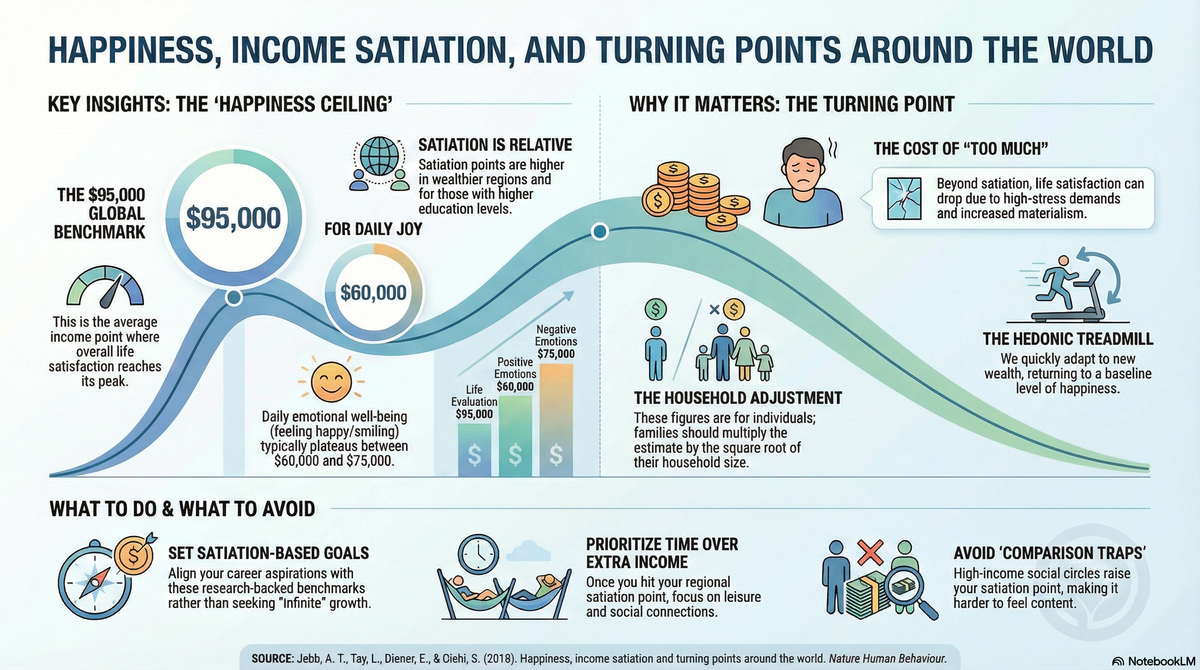
We have all daydreamed about hitting the jackpot or landing a massive promotion, convinced that a bigger bank account is the ultimate key to a stress-free, joyful life. But when you finally get that raise, the thrill often fades much faster than expected. Are we just chasing a moving target? A fascinating global study provides a concrete answer to this age-old question. By looking at data from over 1.7 million people, researchers have mapped exactly where money stops buying happiness—and where it might actually start making us miserable.
Here is what the science says about the true relationship between your wallet and your well-being.
The "Enough" Number
Researchers found that there is a specific income level where happiness maxes out, known as "income satiation". Globally, for a single individual, everyday emotional well-being (like feeling joy or avoiding sadness) plateaus between $60,000 and $75,000. When looking at overall life satisfaction—how you evaluate your life as a whole—that number bumps up to around $95,000. Once you hit these numbers, extra cash simply does not make your days any brighter. Money is excellent at fulfilling our basic human needs, but once those needs are met, it loses its power to boost our mood.
Practical Guidance:
• What to do: Figure out your household's unique "enough" number. The study's numbers are for single individuals, meaning a family of four will naturally have a higher satiation point to cover their baseline needs.
• What not to do: Don't sacrifice your health or relationships assuming that doubling your salary will double your happiness—the data proves it won't.
• Habit to change: Shift your focus from endless accumulation to maximizing the joy you get from the resources you already have.
The Danger of Earning "Too Much"
Here is the most shocking twist: in many parts of the world, earning significantly more than the satiation point is actually linked to a drop in life satisfaction. How can more money make you less happy? The researchers suggest that massive incomes often come with massive hidden costs: longer hours, crushing responsibilities, high-stress workloads, and a severe lack of free time. Furthermore, extreme wealth can trap you in a cycle of materialistic desires and stressful social comparisons, where you are constantly trying to keep up with even richer peers.
Practical Guidance:
• What to do: Treat your time as your most valuable asset once your fundamental financial needs are comfortably met.
• What not to do: Don't automatically accept a promotion or a new job just because the salary is higher, especially if it comes with a severe loss of personal time.
• Decision to change: Before taking on a higher-paying, higher-stress role, ask yourself if the extra income is worth the "happiness tax" of an increased workload and lost leisure time.
The Comparison Trap
Your exact "happiness number" isn't universal; it depends heavily on who you are surrounded by. The study found that satiation points are much higher in wealthy regions like North America (105,000) and Western Europe (100,000) compared to places like Latin America (35,000). Similarly,people with higher education levels need more income to hit their happiness plateau(115,000) than those with less education ($70,000). Why? Because our happiness is deeply tied to social comparison and our own aspirations. We often judge our success by looking at the lifestyles of our neighbors and peers.
Practical Guidance:
• What to do: Define success on your own terms rather than letting your zip code or peer group dictate your financial goals.
• What not to do: Avoid playing the "keeping up with the Joneses" game; moving to a richer neighborhood might just reset your expectations and erase your happiness gains.
• Habit to change: Actively practice gratitude for your current standard of living. Unfollowing "luxury lifestyle" accounts on social media can help lower the artificial aspirations that make you feel like you never have enough.
Summary for Life
The research points to a concrete life rule: Use money to secure your basic needs and comfort, but once you reach your "enough" point, pivot your energy toward time, relationships, and purpose, rather than mindlessly chasing the next dollar.
Reflective Question: If you knew for a mathematical fact that your next raise wouldn't actually make you any happier, what would you choose to do with your time today?
References
Andrew T. Jebb, Louis Tay, Ed Diener, and Shigehiro Oishi. "Happiness, income satiation and turning points around the world." Nature Human Behaviour V2, p 33-38 (2018)