Beyond the "Love Hormone" Hype: Why Context and Person Matter in the Social Effects of Oxytocin in Humans
Have you ever wished for a "magic pill" that could instantly cure shyness or make you feel deeply connected to everyone in the room? Over the last two decades, public interest in a neurochemical called oxytocin has exploded, with internet searches for "oxytocin nasal spray" growing by over 5,000%. Dubbed the "love hormone" by the media, it has been marketed as a universal shortcut to trust, empathy, and better relationships.
However, the reality of the human brain is far more sophisticated than a catchy nickname suggests. Recent scientific reviews indicate that oxytocin is not a "one-size-fits-all" solution for social connection. Instead, its impact is entirely dependent on the situation you are in and the type of person you are. Here is what the science actually says about how oxytocin shapes our social world and what it means for your daily life.
It’s Not a "Magic Love Pill" for Everyone
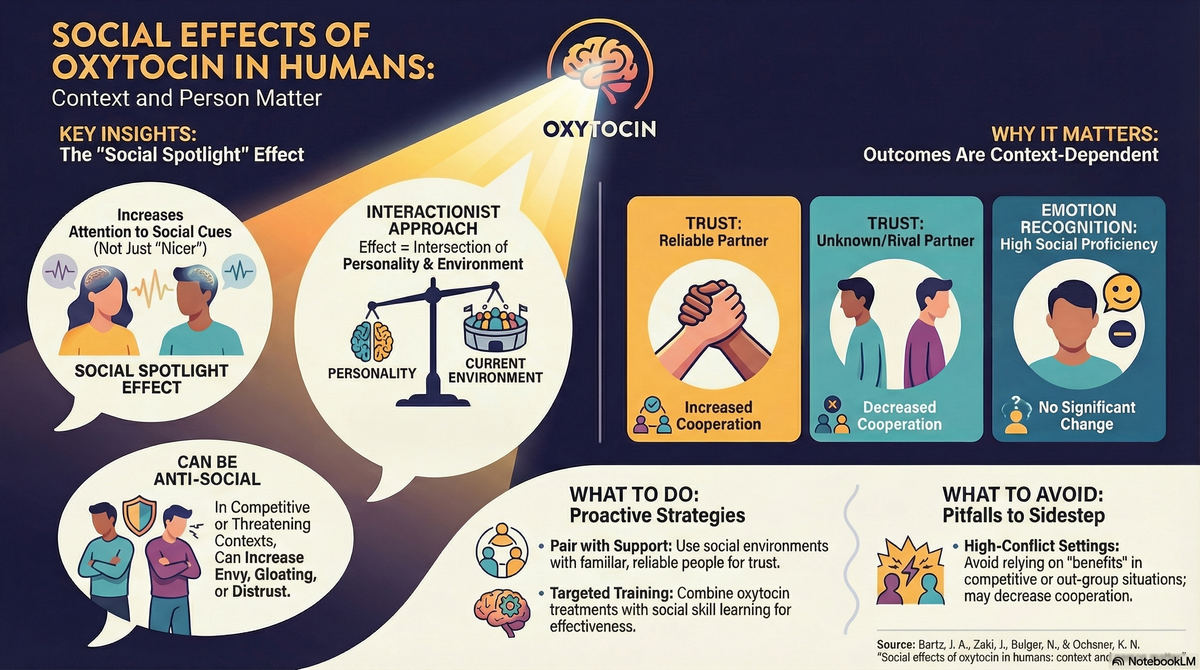
While early headlines suggested oxytocin would make everyone more trusting and prosocial, the actual results are remarkably inconsistent. Scientists have found that oxytocin follows an "interactionist" path—meaning the chemical only works by interacting with your specific personality and your current environment. For example, if you are already very socially proficient, oxytocin might not change your behavior at all. It seems to act more like a "social booster" for those who find social situations challenging rather than a universal enhancement for everyone.
Practical Guidance:
- What to do: Recognize that your social skills are a combination of biology and environment. Focus on practicing social interactions in safe, comfortable settings to build natural confidence.
- What not to do: Don't believe the hype that a single chemical can bypass the hard work of building authentic social skills or personality.
- Habit to change: Stop looking for "quick fixes" for social anxiety and start viewing social proficiency as a skill that can be refined with the right context and support.
It Only Enhances Trust When the "Context" is Right
One of the most famous claims about oxytocin is that it increases trust. While it can certainly encourage generosity and cooperation, these effects are highly fragile. Research shows that oxytocin only promotes trust when you are dealing with someone who is already familiar or seems reliable. If you are interacting with a stranger, a competitor, or someone from a "rival" group, oxytocin can actually decrease your willingness to cooperate and increase your defensiveness.
Practical Guidance:
- What to do: Prioritize building deep trust with your "inner circle"—family, close friends, and reliable colleagues—where bonding chemistry works in your favor.
- What not to do: Don't expect to feel an instant, deep bond with strangers just because you are in a "prosocial" mindset; your brain is naturally wired to be cautious of those outside your group.
- Decision to change: Use your natural intuition. If a situation feels competitive or uncertain, acknowledge that your brain’s chemistry might be heightening your "us versus them" mentality.
Turning Up the "Social Volume"
The leading theory on how oxytocin actually works is called "Social Salience". Instead of just making you "nicer," oxytocin acts like a volume knob for social cues. It makes you more aware of the expressions, voices, and intentions of people around you. This is great if you are at a wedding surrounded by friends, but it can be overwhelming or even negative if you are in a hostile environment. By making social information "louder," oxytocin helps you pay attention to the eye region of faces and better decode emotions—but only if you aren't already hypersensitive to those cues.
Practical Guidance:
- What to do: If you struggle to read social cues, practice active listening and maintain eye contact; these are the specific behaviors oxytocin tries to encourage.
- What not to do: Avoid social environments that are chronically negative or hostile; "turning up the volume" on those social cues will only increase your distress.
- Habit to change: Be mindful of your "social battery." If you are feeling hypersensitive or defensive, step away to a quiet space to lower the "social volume" and recalibrate your nervous system.
The Dark Side of Connection
Because oxytocin makes us more attuned to our social standing, it doesn't always produce "warm and fuzzy" feelings. Under certain conditions, it has been shown to increase feelings of envy and "schadenfreude" (gloating at others' misfortunes). It can also heighten feelings of mistrust in people who already struggle with significant social insecurity. It isn't a "love hormone"; it's a "connection hormone," and connection includes the messy, competitive, and protective parts of being human.
Practical Guidance:
- What to do: Focus on your own growth rather than comparing yourself to others. Comparison in a highly "socially aware" state is a recipe for envy.
- What not to do: Don't beat yourself up for feeling competitive or envious; acknowledge it as a natural (if unpleasant) byproduct of your brain's deep desire to belong and succeed.
- Habit to change: Practice "in-group" kindness. Use your natural biological drive to support your community while consciously working to avoid the "out-group" derogation that oxytocin can sometimes trigger.
Summary for Life
The research points to a profound and concrete life rule: There are no shortcuts to human connection; biological "love" chemistry is a powerful tool that only works when you provide the right environment and the right mindset to help it flourish.
Reflective Question: If oxytocin is a volume knob for the social world around you, are you currently surrounding yourself with a "song" worth listening to?
References
Bartz, J. A., Zaki, J., Bolger, N., & Ochsner, K. N. Social effects of oxytocin in humans: context and person matter. Trends in Cognitive Sciences, 2011 15(7), 301–309.