Beyond Dinner and a Movie: How "Couples’ Shared Participation in Novel and Arousing Activities and Experienced Relationship Quality" Can Save Your Spark
We’ve all been there: the "honeymoon phase" is over, and the exciting, late-night conversations have been replaced by "What do you want for dinner?" and "Did you remember to pay the electric bill?". It’s a common story, and for a long time, we’ve been told that this decline in excitement is just an inevitable part of long-term commitment. We try to fix it by scheduling "quality time," but often that just means more of the same routine—dinner, a movie, or visiting friends.
But what if the problem isn't that you’ve run out of love, but simply that you’ve run out of newness? A landmark study on relationship psychology reveals that the secret to a thriving partnership isn't just spending more time together—it’s about how you spend that time. Here is what the science says about breaking the boredom cycle and reigniting your connection.
The Boredom Trap: Why Routine is the Silent Relationship Killer
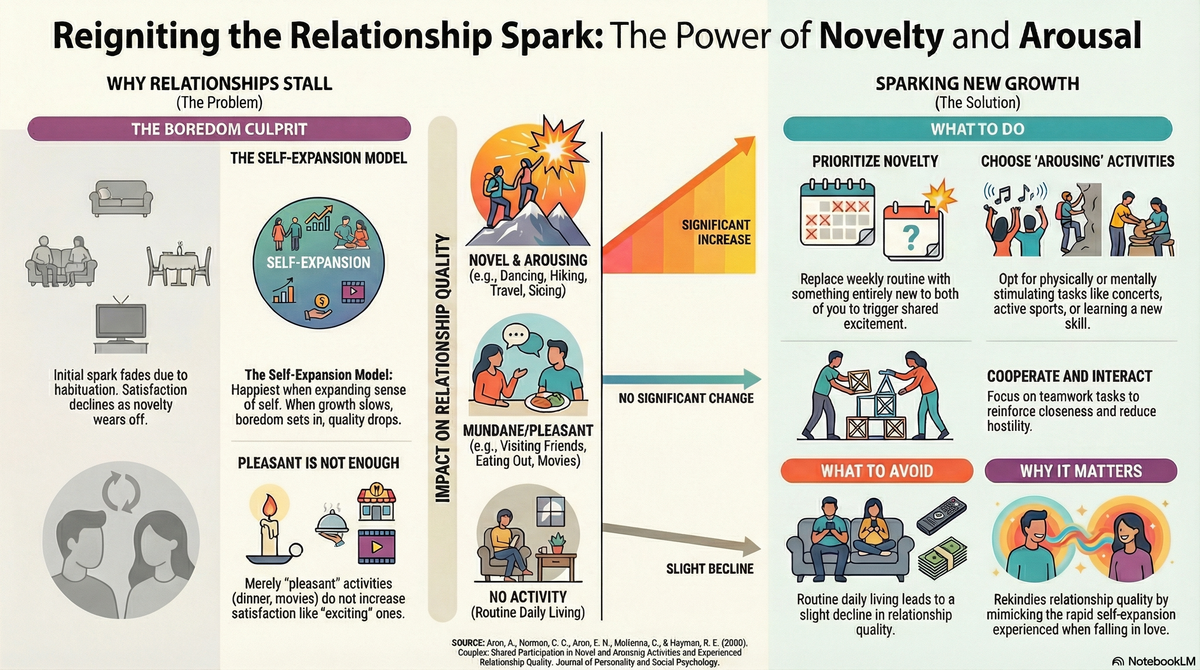
In the early days of a relationship, everything is "self-expanding". You are learning about your partner’s world, their dreams, and their quirks, which creates a natural biological rush of excitement. However, once you know each other well, that rapid expansion slows down. If you don’t find new ways to grow, the relationship can easily slip into boredom. The research shows that this isn't just a minor annoyance; boredom is a primary mediator that links a lack of exciting activities to lower relationship satisfaction.
Practical Guidance:
- What to do: Acknowledge when things feel "ho-hum." Instead of worrying that you are "falling out of love," reframe the feeling as a signal that the relationship is starving for novelty.
- What not to do: Don’t ignore boredom or assume it will go away on its own. Left unaddressed, it can lead to a steady decline in how you perceive your partner and your future together.
- Habit to change: Stop viewing "comfort" as the ultimate goal. While stability is important, a relationship that is only comfortable is at high risk for stagnation.
Not All "Quality Time" is Created Equal
Many couples think that as long as they are in the same room, they are doing the work to maintain their relationship. However, the study found a massive difference between "pleasant" activities and "exciting" ones. Activities that are merely pleasant—like eating out or attending a movie—don't actually provide the same boost to relationship quality that novel and arousing activities do. To keep the spark alive, you need activities that are active, challenging, or entirely new to both of you.
Practical Guidance:
- What to do: Seek out "novel and arousing" experiences. This could be anything from taking a dance class or hiking a new trail to traveling somewhere you’ve never been.
- What not to do: Don't default to the couch and a streaming service every night. While these are "pleasant," they are passive and don't provide the "arousal-attraction" effect that keeps a partnership feeling vibrant.
- Habit to change: When planning a date night, ask: "When was the last time we did this?" If the answer is "every week," swap it for something that makes you both a little nervous or excited.
The "Self-Expansion" Hack: Growing Together
The reason novel activities work so well is that they mimic the early-relationship rush of "expanding the self". When you tackle a new challenge together, you associate that sense of growth and excitement with your partner. The research suggests that by engaging in these shared adventures, you aren't just having fun—you are reinforcing your sense of closeness and interdependence.
Practical Guidance:
- What to do: Pick a hobby or a goal that requires cooperation. Learning a new language together or training for a race forces you to coordinate and support one another in new ways.
- What not to do: Don't choose activities that are too stressful or conflict-heavy if your relationship is already in a rocky place, as the added arousal could be mislabeled as anger.
- Decision to change: Start viewing your partner as a "teammate" in exploration rather than just a roommate.
Better Adventures Lead to Better Behavior
One of the most surprising findings is that the benefits of exciting activities aren't just "in your head". The researchers found that after participating in something novel together, couples actually behaved better toward one another. They were more supportive, showed more "active listening" skills, and were significantly less hostile during difficult conversations. A few minutes of shared excitement can literally change the way you communicate.
Practical Guidance:
- What to do: Use novelty as a "reset button." If you know you have a stressful week ahead or need to discuss a difficult topic, try to schedule a novel activity beforehand to prime your brain for better communication.
- What not to do: Don't wait for a crisis to try something new. Proactive novelty acts as a buffer that protects the relationship from the daily wear and tear of life.
- Habit to change: Stop relying solely on "talking it out." If verbal communication feels stuck, physical and novel activities can provide an easier route to improving your connection.
Summary for Life
The deep truth of relationship psychology boils down to a single, concrete life rule: To keep your relationship from fading into the background of your life, you must stop settling for routine comfort and start intentionally pursuing shared adventures that challenge you both to grow.
Reflective Question: If you had to describe your relationship as a "book," has the plot become a repetitive loop, or are you and your partner actively writing a new and exciting chapter today?
References
Aron, A., Norman, C.C., Aron, E.N., McKenna, C. and Heyman, R.E. Couples’ shared participation in novel and arousing activities and experienced relationship quality, Journal of Personality and Social Psychology, 2000 78(2), pp. 273–284.