
Are You Leading or Just Managing? Insights from "Leadership versus Management: How They Are Different, and Why"
Have you ever worked for a boss who was brilliant at organizing schedules and budgets, but terrible at inspiring the team? Or perhaps you know a visionary founder whose big ideas are constantly derailed because they can't keep track of simple daily tasks? We often use the words "leader" and "manager" as if they mean the exact same thing, but they are entirely different skills.
Understanding the distinct line between leadership and management isn't just for corporate executives—it is the secret to taking charge of your own life, career, and household. A comprehensive review dives deep into the philosophy behind these roles, revealing why we desperately need both to succeed. Let's break down the hidden differences and how you can apply them to your everyday life.
The Destination vs. The Train Schedule
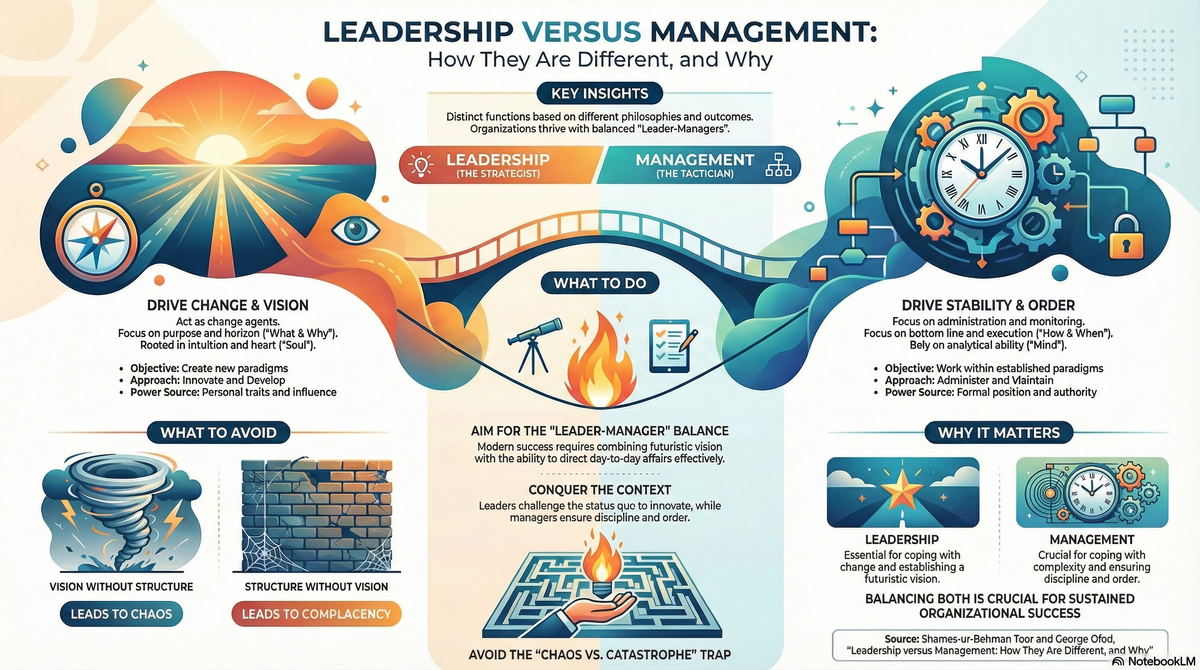
One of the most powerful distinctions between a leader and a manager lies in their focus. Managers are tactical; they work within the established system to create order, consistency, and predictability. Leaders, on the other hand, are strategic visionaries who challenge the status quo and push for dramatic change. To use an analogy from the research: managers make sure the trains run on time, but it is leaders who decide the destination and what the train is carrying. Similarly, management is about efficiently climbing the ladder of success, while leadership determines if the ladder is leaning against the right wall.
Practical Guidance:
- What to do: Step back and clearly define your ultimate goal or "destination" (leadership) before mapping out your daily to-do lists (management).
- What not to do: Don't get so caught up in the daily grind of crossing off tasks that you forget why you are doing the work in the first place.
- Habit to change: Set aside time each month to evaluate your big-picture goals, ensuring your daily routines are actually moving you toward the right destination.
Heart vs. Mind
When things get complicated, managers and leaders react very differently. The managerial mindset is rooted in rationality, control, and problem-solving. Managers rely on their authority to allocate resources and direct people to achieve specific targets. Leaders, however, operate more from the "soul" or heart. They rely on their personal influence, values, and emotional connection to empower people, build trust, and inspire action. People follow managers because they have to; they follow leaders because they want to.
Practical Guidance:
- What to do: Connect with your coworkers, friends, or family members on a personal, empathetic level to build trust and motivation.
- What not to do: Don't try to "manage" people the same way you manage a budget or a piece of equipment. Humans require influence, not just instruction.
- Decision to change: When someone comes to you with an issue, shift from immediately fixing it for them (manager mode) to coaching and empowering them to find the solution themselves (leader mode).
Embracing Chaos vs. Seeking Order
Growth requires stepping into the unknown, while survival requires keeping things running smoothly. The research highlights that managers are stability-seekers who limit choices to quickly solve problems. They are uncomfortable with chaos and prefer to accept the current rules. Leaders, however, are naturally rebellious. They question assumptions, tolerate chaos, and actively seek out new options and fresh approaches to old problems.
Practical Guidance:
- What to do: Actively look for fresh, innovative approaches to long-standing problems in your life, even if it means trying something unconventional.
- What not to do: Don't accept a broken system or a bad habit just because "that's the way it has always been done".
- Habit to change: Allow yourself to tolerate a little chaos and uncertainty when brainstorming or trying a new hobby, rather than rushing to immediately enforce order.
The Ultimate Sweet Spot: The "Leader-Manager"
So, which is better? The truth is, neither is superior—they are complementary halves of a whole. Vision without structure leads to chaos, but structure without vision leads to complacency and ultimate failure. The most effective people in any organization are "leader-managers". They have the visionary, inspiring traits necessary to anticipate change, while also possessing the practical skills required to direct day-to-day affairs efficiently.
Practical Guidance:
- What to do: Honestly assess which side you lean toward naturally, and actively work to develop your weaker side.
- What not to do: Don't assume that having a "manager" title means you can't be a leader, or that being a visionary excuses you from being organized.
- Habit to change: Blend the two roles in your daily life. Give yourself the freedom to dream and strategize (leadership), but hold yourself accountable to deadlines and budgets (management).
Summary for Life
The deep truth of this research boils down to a single, concrete life rule: To build a successful life, you must be a leader who bravely determines your future destination, and a manager who diligently builds the daily tracks to get you there.
Reflective Question: If you look at how you spent your time this past week, were you effectively climbing the ladder, or did you pause to make sure the ladder was leaning against the right wall?
References
Leadership versus Management: How They Are Different, and Why Shamas-ur-Rehman Toor and George Ofori, April 2008 Leadership and Management in Engineering 8(2) DOI:10.1061/(ASCE)1532-6748(2008)8:2(61)