Are You Having Sex for the Right Reasons? Unlocking Joy with "Getting It On Versus Getting It Over With: Sexual Motivation, Desire, and Satisfaction in Intimate Bonds"
We have all been there: sometimes you lean into a romantic moment because you genuinely want to feel closer to your partner, but other times, you might find yourself saying "yes" just to avoid a potential argument or because you don’t want to deal with their disappointment. It feels like a small compromise in the moment, but does the "why" behind your intimacy actually change the quality of your relationship?
A landmark study in relationship psychology proves that your motivations for sex—what researchers call your "sexual goals"—act as the hidden architect of your long-term happiness. Whether you are "getting it on" to pursue joy or "getting it over with" to avoid a fight determines not only your satisfaction but your partner’s as well. Here is what the science says about the power of your "why."
The Two Paths: Approach vs. Avoidance
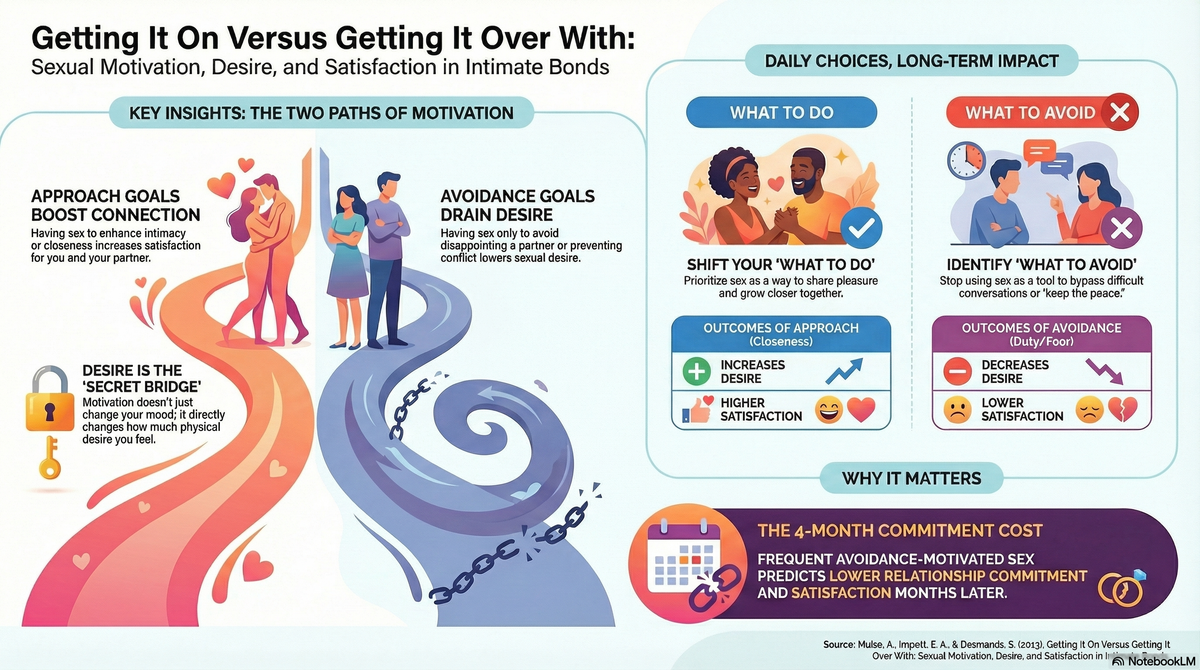
Researchers found that our reasons for intimacy generally fall into two categories: approach goals and avoidance goals. Approach goals are about moving toward a positive outcome, like wanting to feel more intimate, experience pleasure, or promote closeness. Avoidance goals, on the other hand, are about trying to prevent something negative, such as a partner’s disapproval, a feelings of guilt, or relationship conflict.In everyday life, this is the difference between eating a meal because you love the flavor versus eating just so your stomach stops growling. The study found that when we focus on the positive "approach" side, we experience significantly greater well-being and relationship satisfaction.
Practical Guidance:
- What to do: Before becoming intimate, try to consciously focus on a positive outcome you desire, such as "I want to feel connected to you tonight".
- What not to do: Don't use sex as a shield to hide from difficult conversations or to pacify a partner’s bad mood.
- Habit to change: Practice identifying your "why." If you find your primary motivation is avoiding a lecture, it’s time to have a conversation about the health of your communication outside the bedroom.
The Secret Ingredient: Sexual Desire
Why does the "why" matter so much? The research identified sexual desire as the missing link. When you pursue sex for approach goals—like growth and connection—it acts as fuel, sustaining your desire for your partner even through daily disagreements. Conversely, having sex to avoid negative outcomes actually snuffs out desire.If you treat intimacy as a chore to be checked off a list, your brain stops signaling the desire that makes sex fulfilling in the first place.
Practical Guidance:
- What to do: Prioritize "self-expansion" in your relationship. Find new ways to grow with your partner, as this fuels the approach-oriented mindset that keeps desire high.
- What not to do: Don't ignore a drop in desire; it is often a biological alarm bell telling you that your motivations have shifted from "want to" to "have to".
- Decision to change: View desire as a resource to be nurtured through positive goals rather than a static feeling that either exists or doesn't.
The Partner Ripple Effect
Perhaps the most surprising finding is that your partner can "feel" your motivation. You might think that having "duty sex" is a gift to your partner because they are still "getting" sex, but the data shows the opposite: when one person has sex for avoidance goals, their partner actually feels less satisfied and experiences lower desire themselves.However, when you have sex to enhance intimacy, your partner reaps the rewards, reporting higher desire and a deeper sense that you are responsive to their needs.
Practical Guidance:
- What to do: Be honest about your needs for closeness. Authenticity in your "approach" goals makes your partner feel more valued and desirable.
- What not to do: Don't assume "getting it over with" is doing your partner a favor; they are likely picking up on the lack of genuine desire, which can create a cycle of dissatisfaction for you both.
- Habit to change: Focus on being present. Shared intimacy driven by a goal of connection creates a "positive spiral" where both people feel more satisfied.
The Long Game: Preventing the Burnout
The study tracked couples over four months and found that the impact of these goals isn't just a one-night thing. People who consistently pursued sex for avoidance goals reported lower commitment and less satisfaction months down the line. While avoidance goals might prevent a fight today, they act as a slow-acting poison to the relationship's future.
Practical Guidance:
- What to do: Build a relationship where "no" is a safe answer. When both partners know that sex isn't a requirement to avoid conflict, the "yes" becomes much more powerful and approach-oriented.
- What not to do: Don't let a cycle of avoidance-motivated sex become your "new normal." It is a leading predictor of long-term dissatisfaction.
- Decision to change: Choose to prioritize the quality of your reasons for sex over the frequency of the act. A few instances of high-approach intimacy are better for your long-term bond than frequent instances of "getting it over with".
Summary for Life
The deep truth of this research boils down to a single, concrete life rule: Intimacy is not just a physical act, but a motivational one; to sustain a thriving bond, you must stop using sex to run away from conflict and start using it as a way to run toward closeness.
Reflective Question: If your partner could read your mind during your next intimate moment, would they see someone pursuing a deeper connection with them, or someone just trying to avoid a difficult tomorrow?
References
Muise, A., Impett, E.A. and Desmarais, S. Getting it on versus getting it over with: Sexual motivation, desire, and satisfaction in intimate bonds, Personality and Social Psychology Bulletin, 2013 39(10), pp. 1320–1332.