Adapt or Fade Away: Master Your Growth with "Learning Agility: In Search of Conceptual Clarity and Theoretical Grounding"
We have all worked with that one person who seems to effortlessly "download" a new skill or navigate a chaotic reorganization as if they had a map while everyone else was lost. In a world where the only constant is change, traditional intelligence or a fancy degree isn't always enough to keep you relevant. The real secret to staying ahead isn't just how much you know, but how quickly you can learn, unlearn, and pivot when the rules of the game change.
Psychologists call this "Learning Agility." While many treat it as a buzzword, groundbreaking research reveals it is a specific, measurable skill set that separates high-potential leaders from those who plateau. Here is how you can harness the science of agility to master your own growth.
The Need for Speed and Flexibility
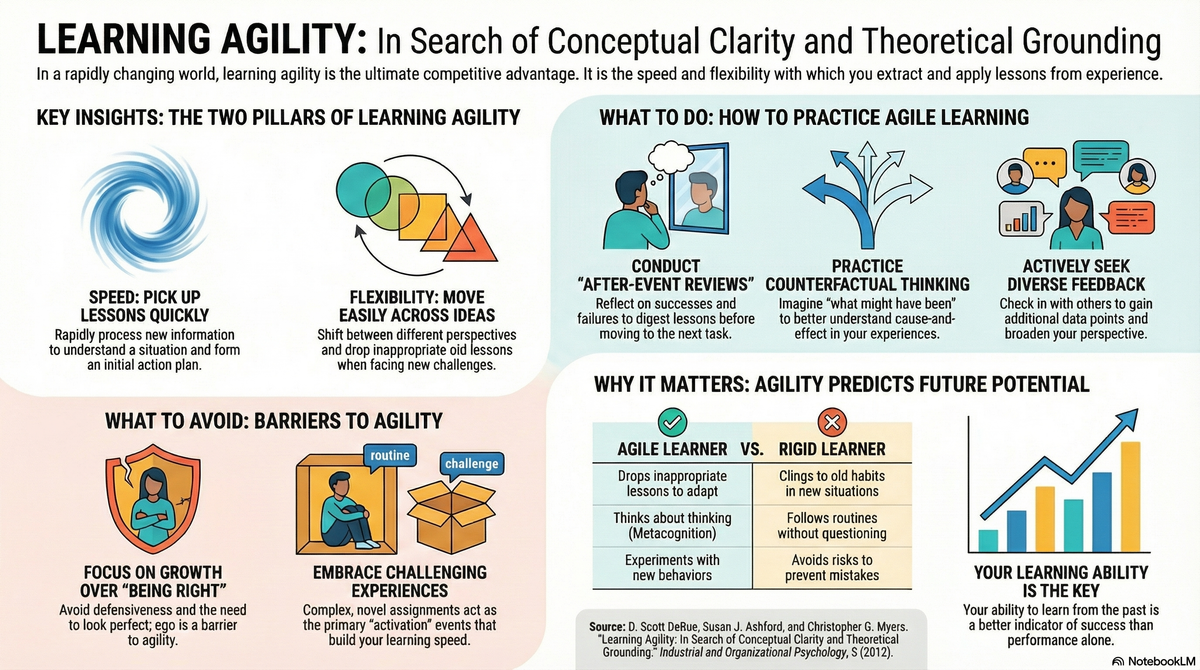
Learning agility is more than just being "smart." It is specifically the ability to come up to speed quickly in a new situation and move between different ideas or points of view with ease. Think of it as your brain’s "nimbleness". It’s the difference between someone who gets stuck in one way of thinking and an agile learner who can hold multiple, conflicting ideas at once to find the best path forward.
Practical Guidance:
- What to do: In new situations, focus on identifying patterns quickly. Ask yourself: "What does this remind me of from a different area of my life?".
- What not to do: Don't get married to your first conclusion. Practice "intellectual acuity" by intentionally looking for counterintuitive ways to solve a problem.
- Habit to change: When you feel yourself becoming defensive about your point of view, pause and try to argue for the opposite perspective to build your mental flexibility.
The Art of Unlearning
One of the most overlooked parts of growth is "unlearning". Agile learners are not just great at picking up new habits; they are masters at dropping old ones that no longer serve them. As you move through different roles or cultures, the "lessons" that made you successful in your last job might actually sabotage you in your next one. Agility means having the courage to abandon your old playbook when you enter a new stadium.
Practical Guidance:
- What to do: When starting a new project or role, explicitly list the "rules" that worked for you in the past and ask which ones are inappropriate for this new setting.
- What not to do: Don't let public commitment to a prior course of action stop you from changing direction when the data shifts.
- Habit to change: Instead of asking "What do I need to know?", start asking "What do I need to stop doing to succeed here?".
Mental Time Travel: Simulations and Patterns
High-agility individuals don't just wait for things to happen; they use their imagination as a laboratory. They engage in "prospective simulations"—basically, mental dress rehearsals of future challenges. They also use "counterfactual thinking," looking back at past events and asking "what might have been" if they had acted differently. These mental exercises allow you to extract years of experience from a single afternoon of reflection.
Practical Guidance:
- What to do: Before a high-stakes meeting, spend five minutes visualizing different ways the conversation could go and how you would flexibly respond to each.
- What not to do: Don't just ruminate on a mistake. Turn it into a learning tool by identifying the specific cause-and-effect relationships that led to the outcome.
- Decision to change: Start a "pattern recognition" journal. When you face a problem, write down three other disparate situations that share similar underlying features.
The Three Habits of Agile Learners
Agility isn't just in your head; it’s in your actions. The research identifies three key behaviors that "prime" your ability to learn from experience: seeking feedback, running mini-experiments, and structured reflection. By actively "checking in" with others and trying out new tactics rather than playing it safe, you gather more data and develop more accurate mental models of how to succeed.
Practical Guidance:
- What to do: Conduct "After-Event Reviews" (AERs). After a major task, spend a few minutes reflecting on both your successes and your failures to "digest" the experience.
- What not to do: Don't wait for your annual review to get feedback. Seek it out in real-time, especially when situations are uncertain.
- Habit to change: Treat your workday as a series of mini-experiments. Try one new approach to a recurring task each week and observe the results.
Creating a Climate for Agility
You don't learn in a vacuum. Your environment can either act as a catalyst or a cage for your agility. A "punitive" culture—where being right is more important than being curious—kills the "freedom of thought" or "playfulness" required to move flexibly across ideas. To be truly agile, you need a environment of "psychological safety" where it is okay to be wrong in the service of eventually being right.
Practical Guidance:
- What to do: Surround yourself with people who prioritize learning over "looking right".
- What not to do: Avoid letting your ego or image-consciousness stop you from asking "dumb" questions.
- Decision to change: If you lead a team, stop rewarding perfection and start rewarding the speed of the "learning loop"—how quickly your team identifies a mistake, unlearns the behavior, and tries a new strategy.
Summary for Life
The research points to a profound and concrete life rule: To remain competitive in a dynamic world, you must stop viewing your intelligence as a static library of facts and start viewing it as a high-speed engine that thrives on the constant intake of new ideas and the fearless discarding of old ones.
Reflective Question: If the world changed overnight, would you be fast enough to unlearn your favorite "success secrets" and flexible enough to find a new way forward?
References
DeRue, D. S., Ashford, S. J., & Myers, C. G. Learning agility: In search of conceptual clarity and theoretical grounding. Industrial and Organizational Psychology,2012 5(3), 258–279.